
The effect of metformin on behavioral characteristics and Bdnf gene expression of old rats with sex differences
Authors
-
Ajgul Z. Hafizova
Kazan State Medical University
 https://orcid.org/0009-0007-3795-1407
-
Elena V. Valeeva
Kazan State Medical University
https://orcid.org/0000-0001-7080-3878
-
Dmitry O. Nikitin
Kazan State Medical Universit
https://orcid.org/0000-0001-5773-867X
-
Rouslan I. Moustafine
Kazan State Medical University
https://orcid.org/0000-0002-0916-2853
-
Anastasia V. Nikitina
Kazan State Medical University
https://orcid.org/0000-0001-6219-6246
-
Irina I. Semina
Kazan State Medical University
https://orcid.org/0000-0003-3515-0845
DOI:
https://doi.org/10.18413/rrpharmacology.11.856Abstract
Introduction: Ageing is a key risk factor for neurodegenerative diseases, so aging heightens the urgency of developing safe geroprotectors. Metformin is a compound of significant interest owing to its ability to modulate the pathogenesis of aging and related cognitive decline. Thus, the aim of the workwas to study the effects of metformin on behavior and Bdnf gene expression in the brains of aged rats with consideration of sex differences.
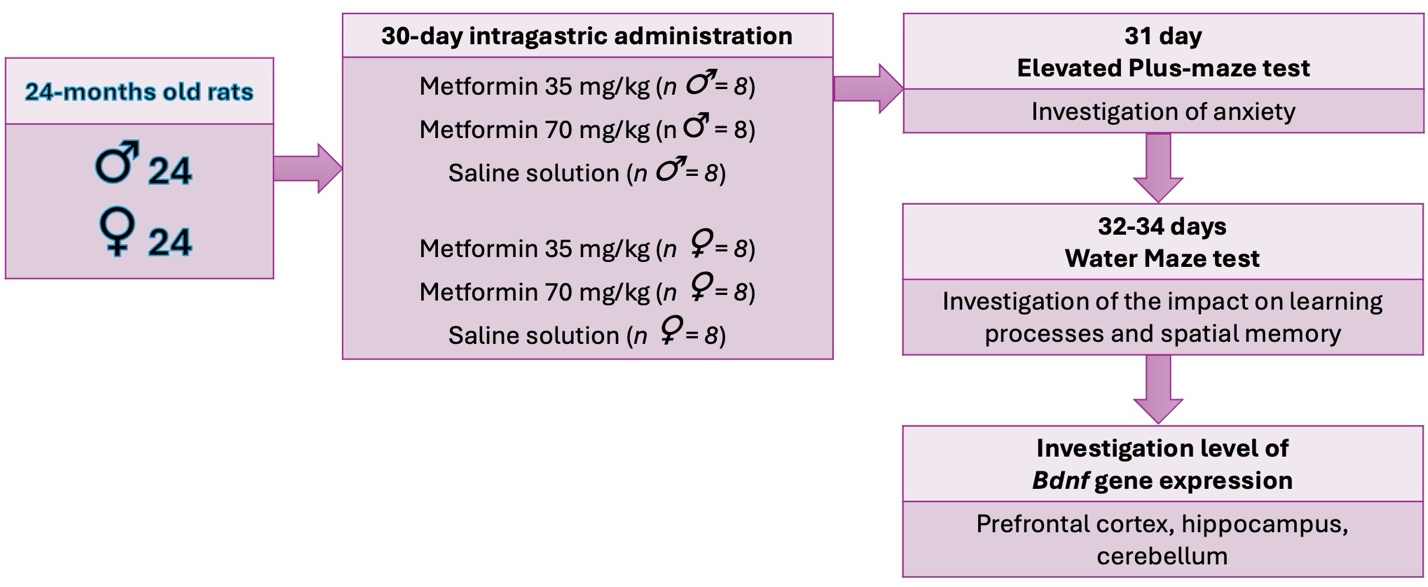
Materials and Methods: The study was performed on 48 old (24 months) Wistar rats divided into groups (n=8): males and females receiving metformin (35 or 70 mg/kg/day) or saline (control) for 30 days. Anxiety (Elevated Plus maze test) and spatial memory (Water maze test) were assessed. The relative level of Bdnf gene expression was determined by real-time PCR.
Results: Metformin at a dose of 70 mg/kg exerts an anxiolytic effect in males in the Elevated Plus maze test, increasing the duration of stay in the open ”arms” of the maze by 3.5 times (p=0.0443) and reducing the time of closed ”arms” by 1.5 times (p=0.0161) compared to those in the control group. Males also showed an improvement in spatial memory after the introduction of metformin at doses of 35 and 70 mg/kg in the Water Maze test: the duration of swimming in the platform zone increased by 1.7 times (35 mg/kg, p=0.04) and 1.5 times (70 mg/kg, p=0.03), respectively, compared to such in the control group. At a dose of 35 mg/kg, metformin causes a 3-fold increase in Bdnf gene expression in males in the prefrontal cortex (p=0.047) compared to such in the control group. In females, Bdnf gene expression in the cerebellum positively correlates with spatial memory (p=0.039), which emphasizes its role in cognitive functions.
Conclusion: A 30-day metformin treatment exerted pronounced anxiolytic (70 mg/kg) and mnemotropic effects (35 and 70 mg/kg) in aged male rats, correlating with elevated prefrontal cortex Bdnf geneexpression. In females, spatial memory improvement correlated with cerebellar Bdnf gene upregulation.
Graphical Abstract
Keywords:
anxiety, behavioral tests, Bdnf gene expression, cognitive function, metformin, old ratsReferences
AboTaleb HA, Alturkistani HA, Abd El-Aziz GS, Hindi EA, Halawani MM, Al-Thepyani MA, Alghamdi BS (2024) The antinociceptive effects and sex-specific neurotransmitter modulation of metformin in a mouse model of fibromyalgia. Cells 13(23): 1986. https://doi.org/10.3390/cells13231986 [PubMed] [PMC]
Arezoumand KS, Roberts CT, Rastegar M (2024) Metformin induces MeCP2 in the hippocampus of male mice with sex-specific and brain-region-dependent molecular impact. Biomolecules 14(4): 505. https://doi.org/10.3390/biom14040505 [PubMed] [PMC]
Ashrostaghi Z, Ganji F, Sepehri H (2015) Effect of metformin on the spatial memory in aged rats. National Journal of Physiology, Pharmacy and Pharmacology 5(5): 416–420. https://doi.org/10.5455/njppp.2015.5.1208201564 [PubMed] [PMC]
Buckner RL (2013) The cerebellum and cognitive function: 25 years of insight from anatomy and neuroimaging. Neuron 80(3): 807–815. https://doi.org/10.1016/j.neuron.2013.10.044[PubMed]
Fan J, Li D, Chen HS, Huang JG, Xu JF, Zhu WW, Chen JG, Wang F (2019) Metformin produces anxiolytic-like effects in rats by facilitating GABAA receptor trafficking to membrane. British Journal of Pharmacology 176(2): 297–316. https://doi.org/10.1111/bph.14519 [PubMed] [PMC]
Grigoryan GA (2020) Sex differences in behaviour and biochemical markers in animals in response to neuroinflammatory stress. Advances in the Physiological Sciences [Uspekhi Fiziologicheskikh Nauk] 51(1): 18–32. https://doi.org/10.31857/S0301179820010051 [in Russian]
Gudasheva TA, Tarasiuk AV, Povarnina PY (2017) Brain-derived neurotrophic factor and its low-molecular mimetics. Pharmacokinetics and Pharmacodynamics [Farmakokinetika i Farmakodinamika] (3): 3–13. [in Russian]
Hafizova AZ, Semina II (2025) Study of the possibility of using metformin by intranasal administration for the correction of behavioral and cognitive dysfunctions of rats. Pharmacokinetics and Pharmacodynamics [Farmakokinetika i Farmakodinamika] (1): 35–42. https://doi.org/10.37489/2587–7836-2025-1-35-42 [in Russian]
Hafizova AZ, Semina II, Nikitin DO, Nikitin DO, Mustafin RI (2025) Perspectives for the use of the antidiabetic drug metformin as a strategy to slow biological aging and age-related diseases. Kazan Medical Journal [Kazanskii Meditsinskii Zhurnal] 106(1): 105–106. https://doi.org/0.17816/KMJ382686
Kight KE, McCarthy MM (2017) Sex differences and estrogen regulation of BDNF gene expression, but not propeptide content, in the developing hippocampus. Journal of Neuroscience Research 95(1-2): 345–354. https://doi.org/10.1002/jnr.23920 [PubMed] [PMC]
Kondaurova EM, Antonov YV, Bazhenova EY, Bazovkina DV, Naumenko VS (2020) Acute stress effects on mice different by sensivity of 5-HT1A-receptors to chronic activation with 8-OH-DPAT. Journal of Evolutionary Biochemistry and Physiology [Rossiiskii Fiziologicheskii Zhurnal im. I.M. Sechenova] 106(9): 1069–1084. https://doi.org/10.31857/S0869813920090010 [in Russian]
Livak KJ, Schmittgen TD (2001) Analysis of relative gene expression data using real-time quantitative PCR and the 2(-Delta Delta C(T)) Method. Methods 25(4): 402-408. https://doi.org/10.1006/meth.2001.1262 [PubMed]
Li N, Zhou T, Fei E (2022) Actions of metformin in the brain: A new perspective of metformin treatments in related neurological disorders. International Journal of Molecular Sciences 23(15): 8281. https://doi.org/10.3390/ijms23158281 [PubMed] [PMC]
Markowicz-Piasecka M, Sikora J, Szydłowska A, Skupień A, Mikiciuk-Olasik E, Huttunen KM (2017) Metformin – a future therapy for neurodegenerative diseases. Pharmaceutical Research 34(12): 2614–2627. https://doi.org/10.1007/s11095–017–2199–y [PubMed] [PMC]
Mohammed I, Hollenberg MD, Ding H, Triggle CR (2021) Critical review of the evidence that metformin is a putative anti-aging drug that enhances healthspan and extends lifespan. Frontiers in Endocrinology 12: 718942. https://doi.org/10.3389/fendo.2021.718942[PubMed] [PMC]
Mironov AN, Bunatyan ND, Vasilev AN (2012) Guideline for Conducting Preclinical Studies of Medicinal Products. Moscow, Griff and K, 112 pp. [in Russian]
Semina II, Baichurina AZ, Nikitin DO, Nikitina AV, Moustafine RI, Khutoryanskiy VV (2023) Behavioral pharmacology as the main approach to study the efficiency of potential psychotropic drugs: Analysis of modern methods (review). Drug Development & Registration 12(1): 161–181. https://doi.org/10.33380/2305-2066-2023-12-1-161-181
Wang C, Chen B, Feng Q, Nie C, Li T (2020) Clinical perspectives and concerns of metformin as an anti-aging drug. Aging Medicine 3(4): 266–275. https://doi.org/10.1002/agm2.12135[PubMed] [PMC]
Zhou X, Zhou J, Ban Q, Zhang M, Ban B (2024) Effects of metformin on the glucose regulation, lipid levels and gut microbiota in high-fat diet with streptozotocin induced type 2 diabetes mellitus rats. Endocrine 86(1): 163–172. https://doi.org/10.1007/s12020-024-03843-y[PubMed]
Published
How to Cite
Issue
Section
License
Copyright (c) 2025 Hafizova AZ, Valeeva EV, Nikitin DO, Moustafine RI, Nikitina AV, Semina II

This work is licensed under a Creative Commons Attribution 4.0 International License.
 Русский
 English