Designing siRNA nanocarriers for myocardial ischemia/reperfusion injury: pathobiological targets, delivery barriers, platform strategies, and translational constraints
Авторы
-
Baihao Mei
Mudanjiang Medical University
 https://orcid.org/0009-0002-9150-6703
-
Ying Li
Mudanjiang Medical University
https://orcid.org/0009-0001-8410-7678
-
Zhaoyu Gao
Mudanjiang Medical University
https://orcid.org/0009-0009-3801-8592
DOI:
https://doi.org/10.18413/rrpharmacology.12.1206Аннотация
Introduction: Reperfusion remains the only effective way to salvage myocardium after acute infarction, yet restoring blood flow can itself aggravate injury through gene-regulated oxidative, inflammatory, mitochondrial, endothelial, and cell-death programs. Small interfering RNA (siRNA) can silence such transcripts with high sequence specificity, but its value in myocardial ischemia/reperfusion (MI/R) injury depends on delivery to the right cardiac cell population at the right phase of reperfusion, not on target discovery alone. This traditional narrative review builds a barrier-to-design framework for MI/R siRNA nanocarriers and is not an efficacy ranking; it was motivated by a delivery gap (the injured microvasculature can deny access to any payload) that existing platform-organized reviews leave unexamined.
Materials and Methods: Literature was screened across four domains (MI/R pathobiology and cardioprotection; RNA interference and cardiovascular RNA therapeutics; nanocarrier design for nucleic-acid delivery; preclinical cardiac nanomedicine) using structured Crossref-based searches (13 keyword groups, coverage 1982–2026, with a dedicated 2023–2026 recency pass); screening produced 152 unique candidates, of which 97 sources were retained in the evidence bank and 69 are cited, 71 % published in 2021–2026.
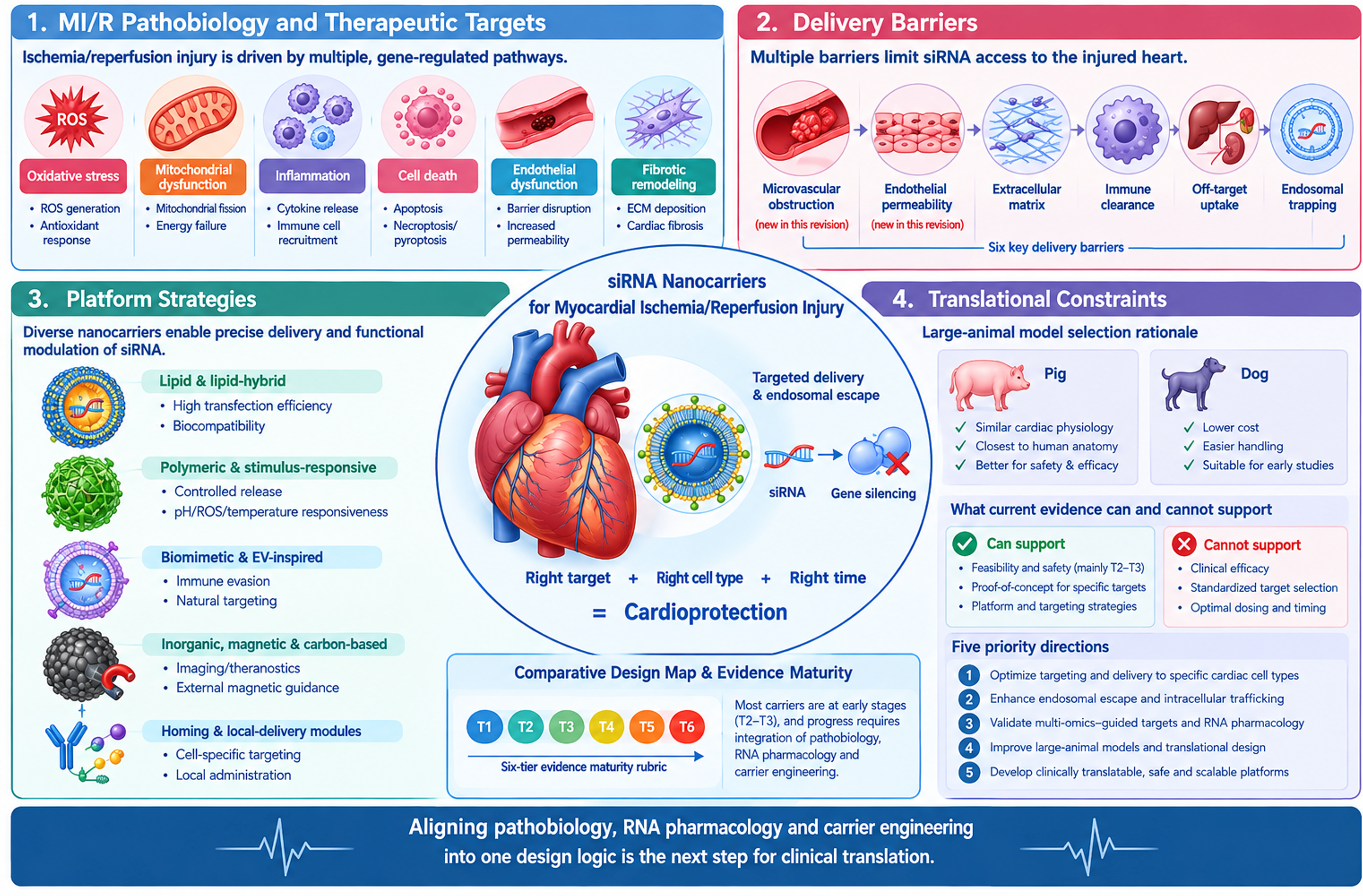
Results: the review reports (1) an MI/R target map governed by five explicit inclusion criteria and evidence-maturity tiers; (2) six delivery barriers, naming microvascular obstruction and endothelial permeability as the sixth, an independent access barrier added in this revision; (3) a platform-by-function analysis of lipid and lipid-hybrid, polymeric and stimulus-responsive, biomimetic and extracellular-vesicle-inspired, and inorganic, magnetic, and carbon-based carriers, including homing and local-delivery modules; (4) a comparative design map with an explicit six-tier evidence-maturity rubric (T1–T6); (5) a statement of what current evidence can and cannot support, closing with five priority directions; and (6) translational constraints, including a large-animal model-selection rationale (pig versus dog).
Conclusion: most surveyed carriers sit at early maturity tiers (T2–T3), which is the honest state of the field rather than a deficit; the next advance is more likely to come from aligning pathobiology, RNA pharmacology, and carrier engineering into one design logic than from adding new material names.
Графическая аннотация
Ключевые слова:
cardiac drug delivery, endosomal escape, evidence maturity, ischemia/reperfusion injury, microvascular obstruction, nanocarrier, RNA interference, siRNAБиблиографические ссылки
Beitzinger B, Draphoen B, Hald J, Krämer M, Rudolf T, Schmitt F, Schwarz P, Lindén M (2025) On the cellular selectivity of targeting peptide-nanoparticle conjugates – a nanoparticle perspective. Expert Opinion on Drug Delivery 22(9): 1345–1358. https://doi.org/10.1080/17425247.2025.2522245 [PubMed]
Bertero E, Popoiu TA, Maack C (2024) Mitochondrial calcium in cardiac ischemia/reperfusion injury and cardioprotection. Basic Research in Cardiology 119(4): 569–585. https://doi.org/10.1007/s00395-024-01060-2 [PubMed] [PMC]
Chen W, Liu L, Tang M, Li J, Yuan W, Yin D, Cao Y, Tian J (2024) Type I collagen-targeted liposome delivery of Serca2a modulates myocardium calcium homeostasis and reduces cardiac fibrosis induced by myocardial infarction. Materials Today Bio 28: 101162. https://doi.org/10.1016/j.mtbio.2024.101162 [PubMed] [PMC]
Damase TR, Sukhovershin R, Boada C, Taraballi F, Pettigrew RI, Cooke JP (2021) The limitless future of RNA therapeutics. Frontiers in Bioengineering and Biotechnology 9: 628137. https://doi.org/10.3389/fbioe.2021.628137 [PubMed] [PMC]
Daniel MC, Astruc D (2004) Gold nanoparticles: assembly, supramolecular chemistry, quantum-size-related properties, and applications toward biology, catalysis, and nanotechnology. Chemical Reviews 104(1): 293–346. https://doi.org/10.1021/cr030698 [PubMed]
Dharmakumar S, Vora KP, Huo H, Yoosefian G, Yang HJ, Krishnam M, Kumar A (2025) Detecting hemorrhagic myocardial infarction with T2 CMR at 3T: initial evidence from a large animal model. Journal of Cardiovascular Magnetic Resonance 27: 101231. https://doi.org/10.1016/j.jocmr.2024.101231
Duan Y, Li Q, Wu J, Zhou C, Liu X, Yue J, Chen X, Liu J, Zhang Q, Zhang Y, Zhang L (2024) A detrimental role of endothelial S1PR2 in cardiac ischemia-reperfusion injury via modulating mitochondrial dysfunction, NLRP3 inflammasome activation, and pyroptosis. Redox Biology 75: 103244. https://doi.org/10.1016/j.redox.2024.103244 [PubMed] [PMC]
Eitel I, Saraei R, Jurczyk D, Stiermaier T (2025) Correlation of angiographic microvascular obstruction (no reflow phenomenon) with CMR derived microvascular obstruction: implications and future opportunities for paradigm-shifting. Journal of Cardiovascular Magnetic Resonance 27: 101205. https://doi.org/10.1016/j.jocmr.2024.101205
Fernandes PLM, de Castro Silva PA, Miranda CH (2026) Fucoidan preserves endothelial glycocalyx and reduces microvascular obstruction after myocardial ischemia-reperfusion. Microvascular Research 167: 104985. https://doi.org/10.1016/j.mvr.2026.104985 [PubMed]
Ferraresso F, Badior K, Seadler M, Zhang Y, Wietrzny A, Cau MF, Haugen A, Rodriguez GG, Dyer MR, Cullis PR, Jan E, Kastrup CJ (2024) Protein is expressed in all major organs after intravenous infusion of mRNA-lipid nanoparticles in swine. Molecular Therapy – Methods & Clinical Development 32(3): 101314. https://doi.org/10.1016/j.omtm.2024.101314 [PubMed] [PMC]
Fire A, Xu S, Montgomery MK, Kostas SA, Driver SE, Mello CC (1998) Potent and specific genetic interference by double-stranded RNA in Caenorhabditis elegans. Nature 391(6669): 806–811. https://doi.org/10.1038/35888 [PubMed]
Fischer A, Collins HE (2024) Female cardioprotection in ischemia/reperfusion: isn't a SUR thing anymore? Journal of Molecular and Cellular Cardiology Plus 10: 100089. https://doi.org/10.1016/j.jmccpl.2024.100089 [PubMed] [PMC]
Gabisonia K, Prosdocimo G, Aquaro GD, Carlucci L, Zentilin L, Secco I, Ali H, Braga L, Gorgodze N, Bernini F, Burchielli S, Collesi C, Zandonà L, Sinagra G, Piacenti M, Zacchigna S, Bussani R, Recchia FA, Giacca M (2019) MicroRNA therapy stimulates uncontrolled cardiac repair after myocardial infarction in pigs. Nature 569(7756): 418–422. https://doi.org/10.1038/s41586-019-1191-6 [PubMed] [PMC]
Geelen T, Paulis LEM, Coolen BF, Nicolay K, Strijkers GJ (2013) Passive targeting of lipid-based nanoparticles to mouse cardiac ischemia-reperfusion injury. Contrast Media & Molecular Imaging 8(2): 117–126. https://doi.org/10.1002/cmmi.1501 [PubMed]
Gil-Cabrerizo P, Simon-Yarza T, Garbayo E, Blanco-Prieto MJ (2024) Navigating the landscape of RNA delivery systems in cardiovascular disease therapeutics. Advanced Drug Delivery Reviews 208: 115302. https://doi.org/10.1016/j.addr.2024.115302 [PubMed]
Hausenloy DJ, Yellon DM (2013) Myocardial ischemia-reperfusion injury: a neglected therapeutic target. The Journal of Clinical Investigation 123(1): 92–100. https://doi.org/10.1172/JCI62874 [PubMed] [PMC]
Heusch G (2017) Critical issues for the translation of cardioprotection. Circulation Research 120(9): 1477–1486. https://doi.org/10.1161/CIRCRESAHA.117.310820 [PubMed]
Heusch G (2020) Myocardial ischaemia-reperfusion injury and cardioprotection in perspective. Nature Reviews Cardiology 17(2): 773–789. https://doi.org/10.1038/s41569-020-0403-y [PubMed]
Heusch G, Skyschally A, Schulz R (2011) The in-situ pig heart with regional ischemia/reperfusion – ready for translation. Journal of Molecular and Cellular Cardiology 50(6): 951–963. https://doi.org/10.1016/j.yjmcc.2011.02.016 [PubMed]
Hou M, Wu X, Zhao Z, Deng Q, Chen Y, Yin L (2022) Endothelial cell-targeting, ROS-ultrasensitive drug/siRNA co-delivery nanocomplexes mitigate early-stage neutrophil recruitment for the anti-inflammatory treatment of myocardial ischemia reperfusion injury. Acta Biomaterialia 143: 344–355. https://doi.org/10.1016/j.actbio.2022.02.018 [PubMed]
Hou X, Zaks T, Langer R, Dong Y (2021) Lipid nanoparticles for mRNA delivery. Nature Reviews Materials 6: 1078–1094. https://doi.org/10.1038/s41578-021-00358-0
Huang C, Zhang X, Wu SX, Chang Q, Zheng ZK, Xu J (2025) Cardioprotective effects of hUCMSCs-Exosi-EGR1 MN patch in MI/RI by modulating oxidative stress and mitophagy. Materials Today Bio 31: 101500. https://doi.org/10.1016/j.mtbio.2025.101500 [PubMed] [PMC]
Huang K, Zhang X, Yan X, Qin M, Lv L, Yang S, Zheng Y, Yin G, Tian X, Wang X, Deng W, Yan Y, Wu W, Yuan H, Fan Z, Wang C, Ma J (2026a) Endothelial-targeted modification of ginseng-derived exosomes for IL-6 siRNA delivery ameliorates hepatic ischemia-reperfusion injury. Journal of Nanobiotechnology 24(1): 22. https://doi.org/10.1186/s12951-025-03954-2 [PubMed] [PMC]
Huang T, Zhang Z, Hou R, Lin B, Wang D, Xu G (2026b) Macrophage membrane-biomimetic nanoparticles for targeted delivery of melatonin in myocardial ischemia-reperfusion injury. Nanomedicine: Nanotechnology, Biology and Medicine 75: 102962. https://doi.org/10.1016/j.nano.2026.102962 [PubMed]
Jiang Y, Jiang R, Xia Z, Guo M, Fu Y, Wang X (2025) Engineered neutrophil membrane-camouflaged nanocomplexes for targeted siRNA delivery against myocardial ischemia reperfusion injury. Journal of Nanobiotechnology 23(1): 134. https://doi.org/10.1186/s12951-025-03172-w [PubMed] [PMC]
Jin B, Zhang Z, Zhang Y, Yang M, Wang C, Xu J, Zhu Y, Mi Y, Jiang J, Sun Z (2024) Ferroptosis and myocardial ischemia-reperfusion: mechanistic insights and new therapeutic perspectives. Frontiers in Pharmacology 15: 1482986. https://doi.org/10.3389/fphar.2024.1482986 [PubMed] [PMC]
Kalogeris T, Baines CP, Krenz M, Korthuis RJ (2012) Cell biology of ischemia/reperfusion injury. International Review of Cell and Molecular Biology 298: 229–317.
Kang J, Mun D, Chun Y, Park D, Kim H, Yun N, Joung B (2023) Engineered small extracellular vesicle-mediated NOX4 siRNA delivery for targeted therapy of cardiac hypertrophy. Journal of Extracellular Vesicles 12(10): e12371. https://doi.org/10.1002/jev2.12371 [PubMed] [PMC]
Kang JY, Mun D, Park M, Yoo G, Kim H, Yun N, Joung B (2025) Injured cardiac tissue-targeted delivery of TGF-β1 siRNA by FAP aptamer-functionalized extracellular vesicles promotes cardiac repair. International Journal of Nanomedicine 20: 2575–2592. https://doi.org/10.2147/IJN.S497428 [PubMed] [PMC]
Kleinbongard P, Arriola CG, Badimon L, Crisostomo V, Giricz Z, Gyöngyösi M, Heusch G, Ibanez B, Kiss A, de Kleijn DPV, Podesser BK, Carracedo RR, Rodríguez-Sinovas A, Ruiz-Meana M, Sanchez Margallo FM, Vilahur G, Zamorano JL, Zaragoza C, Ferdinandy P, Hausenloy DJ (2024) The IMPACT multicenter pig study on the effect of ischemic preconditioning. Basic Research in Cardiology 119(6): 893–909. https://doi.org/10.1007/s00395-024-01083-9 [PubMed] [PMC]
Labonia M, Estapé Senti M, van der Kraak P, Brans M, Dokter I, Streef T, Smits A, Deshantri A, de Jager S, Schiffelers R, Sluijter J, Vader P (2024) Cardiac delivery of modified mRNA using lipid nanoparticles: cellular targets and biodistribution after intramyocardial administration. Journal of Controlled Release 369: 734–745. https://doi.org/10.1016/j.jconrel.2024.04.018 [PubMed]
Laurent S, Forge D, Port M, Roch A, Robic C, Vander Elst L, Muller RN (2008) Magnetic iron oxide nanoparticles: synthesis, stabilization, vectorization, physicochemical characterizations, and biological applications. Chemical Reviews 108(6): 2064–2110. https://doi.org/10.1021/cr068445e [PubMed]
Lecour S, Andreadou I, Bøtker HE, Davidson SM, Heusch G, Ruiz-Meana M, Schulz R, Zuurbier CJ, Ferdinandy P, Hausenloy DJ, European Union-CARDIOPROTECTION COST Action (CA16225) (2021) IMPACT criteria: guidelines of the EU-CARDIOPROTECTION COST Action (CA16225). Basic Research in Cardiology 116(1): 52. https://doi.org/10.1007/s00395-021-00893-5[PubMed] [PMC]
Lecour S, Bøtker HE, Condorelli G, Davidson SM, Garcia-Dorado D, Engel FB, Ferdinandy P, Heusch G, Madonna R, Ovize M, Ruiz-Meana M, Schulz R, Sluijter JP, Van Laake LW, Yellon DM, Hausenloy DJ (2014) ESC Working Group Cellular Biology of the Heart: position paper: Improving the preclinical assessment of novel cardioprotective therapies. Cardiovascular Research 104(3): 399–411. https://doi.org/10.1093/cvr/cvu225 [PubMed] [PMC]
Li Y, Li P, Wang W, Zhang Y, Li S, Li D, Lin Q (2025) Nanoparticle-based drug delivery systems targeting inflammatory immune mechanisms in acute myocardial infarction: current advances and perspectives. Frontiers in Cardiovascular Medicine 12: 1657300. https://doi.org/10.3389/fcvm.2025.1657300 [PubMed] [PMC]
Liu Y, Li L, Wang Z, Zhang J, Zhou Z (2023) Myocardial ischemia-reperfusion injury: molecular mechanisms and prevention. Microvascular Research 149: 104565. https://doi.org/10.1016/j.mvr.2023.104565 [PubMed]
Lu H, Huang Q, Xiong Z, Wu C, Ren S, Wang X, Shi J (2026) Precision nanomedicine in cardiovascular disease: engineered siRNA delivery platforms for atherosclerosis and ischemic heart disease. Chemical Engineering Journal 529: 172968. https://doi.org/10.1016/j.cej.2026.172968
Lu H, Wang J, Chen Z, Wang J, Jiang Y, Xia Z (2024) Engineered macrophage membrane-coated S100A9-siRNA for ameliorating myocardial ischemia-reperfusion injury. Advanced Science 11(41): e2403542. https://doi.org/10.1002/advs.202403542 [PubMed] [PMC]
Lundy DJ, Chen KH, Toh EKW, Hsieh PCH (2016) Distribution of systemically administered nanoparticles reveals a size-dependent effect immediately following cardiac ischaemia-reperfusion injury. Scientific Reports 6: 25613. https://doi.org/10.1038/srep25613 [PubMed] [PMC]
Ma XR, Yan TM, Pan Y, Jiang ZH (2025) Optimization of siRNA therapeutics targeting MIAT for cardioprotection in myocardial ischemia/reperfusion injury. Molecular Therapy – Nucleic Acids 36(4): 102747. https://doi.org/10.1016/j.omtn.2025.102747 [PubMed] [PMC]
Maxwell MP, Hearse DJ, Yellon DM (1987) Species variation in the coronary collateral circulation during regional myocardial ischaemia: a critical determinant of the rate of evolution and extent of myocardial infarction. Cardiovascular Research 21(10): 737–746. https://doi.org/10.1093/cvr/21.10.737 [PubMed]
Mun D, Kang JY, Park M, Yoo G, Lee J, Yun N, Joung B (2026) Injured cardiac targeting magnetic nanovesicles for mRNA treatment of myocardial infarction. Theranostics 16(8): 4090–4112. https://doi.org/10.7150/thno.124754 [PubMed] [PMC]
Nicoletti L, Coletto M, Stola GP, Paoletti C, Marcello E, Testore D, Tivano F, Zoso A, Mattu C, Chiono V (2025) Strategies for the delivery of RNA therapeutics to diseased heart tissue. Expert Opinion on Drug Delivery 22(10): 1583–1598. https://doi.org/10.1080/17425247.2025.2539960 [PubMed]
Niu X, Zhang J, Hu S, Dang W, Wang K, Bai M (2024) lncRNA Oip5-as1 inhibits excessive mitochondrial fission in myocardial ischemia/reperfusion injury by modulating DRP1 phosphorylation. Cellular & Molecular Biology Letters 29(1): 72. https://doi.org/10.1186/s11658-024-00588-4 [PubMed] [PMC]
Pan H, Lindon A, Grabau R, Dominguez W, Wickline S (2019) Anti-thrombin nanoparticles limit ischemia-reperfusion injury and no-reflow in myocardial infarction. European Heart Journal 40(Supplement 1): ehz745.0176. https://doi.org/10.1093/eurheartj/ehz745.0176
Paulis LE, Geelen T, Kuhlmann MT, Coolen BF, Schäfers M, Nicolay K, Strijkers GJ (2012) Distribution of lipid-based nanoparticles to infarcted myocardium with potential application for MRI-monitored drug delivery. Journal of Controlled Release 162(2): 276–285.https://doi.org/10.1016/j.jconrel.2012.06.035 [PubMed]
Pędzińska-Betiuk A, Schlicker E, Weresa J, Malinowska B (2024) Re-evaluation of the cardioprotective effects of cannabinoids against ischemia-reperfusion injury according to the IMPACT criteria. Frontiers in Pharmacology 15: 1382995. https://doi.org/10.3389/fphar.2024.1382995 [PubMed] [PMC]
Shrestha R, Elsabahy M, Florez-Malaver S, Samarajeewa S, Wooley KL (2012) Endosomal escape and siRNA delivery with cationic shell crosslinked knedel-like nanoparticles with tunable buffering capacities. Biomaterials 33(30): 7145–7153. https://doi.org/10.1016/j.biomaterials.2012.07.054 [PubMed] [PMC]
Song L, Jia K, Yang F, Wang J (2024) Advanced nanomedicine approaches for myocardial infarction treatment. International Journal of Nanomedicine 19: 6399–6425. https://doi.org/10.2147/IJN.S467219 [PubMed] [PMC]
Tian H, Xiong Y, Zhan J, Lu Z, Zhang Y, Leng Y, Huang Q, Xia Z (2025) Inhibition of macrophage ARID3A alleviates myocardial ischemia-reperfusion injury after heart transplantation by reducing THBS1/CD47 signaling-mediated neutrophil extracellular traps. Advanced Science 12(44): e09952. https://doi.org/10.1002/advs.202509952 [PubMed] [PMC]
Turnbull IC, Eltoukhy AA, Fish KM, Nonnenmacher M, Ishikawa K, Chen J, Hajjar RJ, Anderson DG, Costa KD (2016) Myocardial delivery of lipidoid nanoparticle carrying modRNA induces rapid and transient expression. Molecular Therapy 24(1): 66–75. https://doi.org/10.1038/mt.2015.193 [PubMed] [PMC]
Vargas I, Grabau RP, Chen J, Weinheimer C, Kovacs A, Dominguez-Viqueira W, Mitchell A, Wickline SA, Pan H (2023) Simultaneous inhibition of thrombosis and inflammation is beneficial in treating acute myocardial infarction. International Journal of Molecular Sciences 24(8): 7333. https://doi.org/10.3390/ijms24087333 [PubMed] [PMC]
Wang H, Li L, Luo L, Cheng Y, Zhou F, Zhao S, Li Y, Yang Y, Zhou Q, Niu H, He J, Zhang C, Guo J, Tang L, Xu J (2025a) Advanced nanomaterial platforms for targeted therapy of myocardial ischemia-reperfusion injury. Research (Washington, D.C.) 8: 0822. https://doi.org/10.34133/research.0822 [PubMed] [PMC]
Wang S, Yao Y, Song L, Zhai Z, Li S, Wang Z, Shen L, Zhu Y, Liu W, Gao C (2024) ROS-responsive drug-releasing injectable microgels for ameliorating myocardial infarction. Biomaterials 307: 122534. https://doi.org/10.1016/j.biomaterials.2024.122534 [PubMed]
Wang X, Zhong Y, Qian B, Huang S, Long Q, Zhang H, Zhao Q, Ye X (2025b) Self-assembled extracellular matrix-lipid nanoparticle composite for site-specific siRNA delivery to improve cardiac repair post-myocardial infarction. Materials Today Bio 34: 102205. https://doi.org/10.1016/j.mtbio.2025.102205 [PubMed] [PMC]
Warltier DC, Zyvoloski MG, Gross GJ, Brooks HL (1982) Subendocardial versus transmural myocardial infarction: relationship to the collateral circulation in canine and porcine hearts. Canadian Journal of Physiology and Pharmacology 60(12): 1700–1706. https://doi.org/10.1139/y82-248 [PubMed]
Wilhelm S, Tavares AJ, Dai Q, Ohta S, Audet J, Dvorak HF, Chan WCW (2016) Analysis of nanoparticle delivery to tumours. Nature Reviews Materials 1: 16014. https://doi.org/10.1038/natrevmats.2016.14
Wu Y, Lin Y, Liu B, Ma J, Xiang Y, Wang Y, Meng S (2024) Shexiang Tongxin dropping pill ameliorates microvascular obstruction via downregulating ALOX12 after myocardial ischemia-reperfusion. International Journal of Cardiology 416: 132481. https://doi.org/10.1016/j.ijcard.2024.132481 [PubMed]
Xu N, Chi Z, Zhang H, Wu J, Sun R, Tian C (2025) CD11b-modified ROS/pH-responsive nanoparticles co-deliver dioscin and siRNA to improve cardiac repair after myocardial infarction by reducing neutrophil recruitment. Materials Today Bio 34: 102226. https://doi.org/10.1016/j.mtbio.2025.102226 [PubMed] [PMC]
Yin T, Wang N, Jia F, Wu Y, Gao L, Zhang J, Hou R (2024) Exosome-based WTAP siRNA delivery ameliorates myocardial ischemia-reperfusion injury. European Journal of Pharmaceutics and Biopharmaceutics 197: 114218. https://doi.org/10.1016/j.ejpb.2024.114218[PubMed]
You L, Wang Q, Ma Y, Li Y, Ye H, Xu L, Lei M (2022) Precise dapagliflozin delivery by cardiac homing peptide functionalized mesoporous silica nanocarries for heart failure repair after myocardial infarction. Frontiers in Chemistry 10: 1013910. https://doi.org/10.3389/fchem.2022.1013910 [PubMed] [PMC]
Yu H, Li S, Niu H, Li Z, Gai Y, Sun B, Zhao L (2026) Precise atorvastatin delivery by cardiac homing peptide functionalized nanoliposomes for myocardial damage repair after myocardial infarction. Nanomedicine (London) 21(6): 789–801. https://doi.org/10.1080/17435889.2026.2628309 [PubMed] [PMC]
Yue R, Liu Y, Luo J, Huang Y, Li Y, Zhang Y, Wang K, Zhang Y, Rao C, Gou J, Hu H (2026) Macrophage pyroptosis suppression by membrane-coated nanoparticles ameliorates myocardial ischemia-reperfusion injury. Chemical Engineering Journal 537: 175926. https://doi.org/10.1016/j.cej.2026.175926
Zhang B, Li J, Jiang J, Lin X, Sun X, Wang Q (2023) Overcoming delivery barriers for RNA therapeutics in the treatment of rheumatoid arthritis. European Journal of Pharmaceutics and Biopharmaceutics 192: 147–160. https://doi.org/10.1016/j.ejpb.2023.10.010 [PubMed]
Zhang X, Wang R, Li X, Song J, Wang Y, Chatterjee E, Li G, Jiang J, Yao J (2026) Cardiac targeting extracellular vesicles combined with quercetin co-delivery system enhances the therapeutic efficacy of myocardial infarction. Biomaterials Advances 185: 214880.https://doi.org/10.1016/j.bioadv.2026.214880 [PubMed]
Zhao X, Chen W, Wu J, Shen Y, Xu B, Chen Z, Sun Y (2025) Application of biomimetic cell membrane-coated nanocarriers in cardiovascular diseases. International Journal of Nanomedicine 20: 8249–8289. https://doi.org/10.2147/IJN.S531558 [PubMed] [PMC]
Zhou Y, Liang Q, Wu X, Duan S, Ge C, Ye H (2023) siRNA delivery against myocardial ischemia reperfusion injury mediated by reversibly camouflaged biomimetic nanocomplexes. Advanced Materials 35(23): e2210691. https://doi.org/10.1002/adma.202210691 [PubMed]
Zhu Y, Zheng H, Li H, Xue L, Cai H, Pei C (2026) Potential relationship between ferroptosis and pyroptosis in myocardial ischemia/reperfusion injury: molecular mechanisms and therapeutic targets. Reviews in Cardiovascular Medicine 27(7): 50196. https://doi.org/10.31083/rcm50196 [PubMed] [PMC]
Zwetsloot PP, Kouwenberg LHJA, Sena ES, Eding JE, den Ruijter HM, Sluijter JPG, Pasterkamp G, Doevendans PA, Hoefer IE, Chamuleau SAJ, van Hout GPJ, Jansen of Lorkeers SJ (2017) Optimization of large animal MI models; a systematic analysis of control groups from preclinical studies. Scientific Reports 7(1): 14294. https://doi.org/10.1038/s41598-017-14294-z [PubMed] [PMC]
Загрузки
Опубликован
Как цитировать
Выпуск
Раздел
Лицензия
Copyright (c) 2026 Mei B, Li Y, Gao Zh

Это произведение доступно по лицензии Creative Commons «Attribution» («Атрибуция») 4.0 Всемирная.
 Русский
 English