The resident-intruder model: a platform for in-depth study of novel molecules with antidepressant activity
Авторы
-
Ирина Л. Никитина
Башкирский государственный медицинский университет
 https://orcid.org/0000-0002-6283-5762
-
Гульнара Г. Гаишина
Башкирский государственный медицинский университет
https://orcid.org/0000-0002-1936-3720
-
Елена Е. Клен
Башкирский государственный медицинский университет
https://orcid.org/0000-0001-7538-6030
- Екатерина А. Маракаева Башкирский государственный медицинский университет
-
Екатерина А. Никитина
Федеральный научно-исследовательский центр инновационных и перспективных биомедицинских и фармацевтических технологий
https://orcid.org/0000-0002-0400-3749
- Николай А. Костин Санкт-Петербургский университет
- Ксения Н. Федосеева Санкт-Петербургский университет
-
Любовь А. Ткаченко
Санкт-Петербургский университет
https://orcid.org/0000-0002-9051-9636
DOI:
https://doi.org/10.18413/rrpharmacology.11.646Аннотация
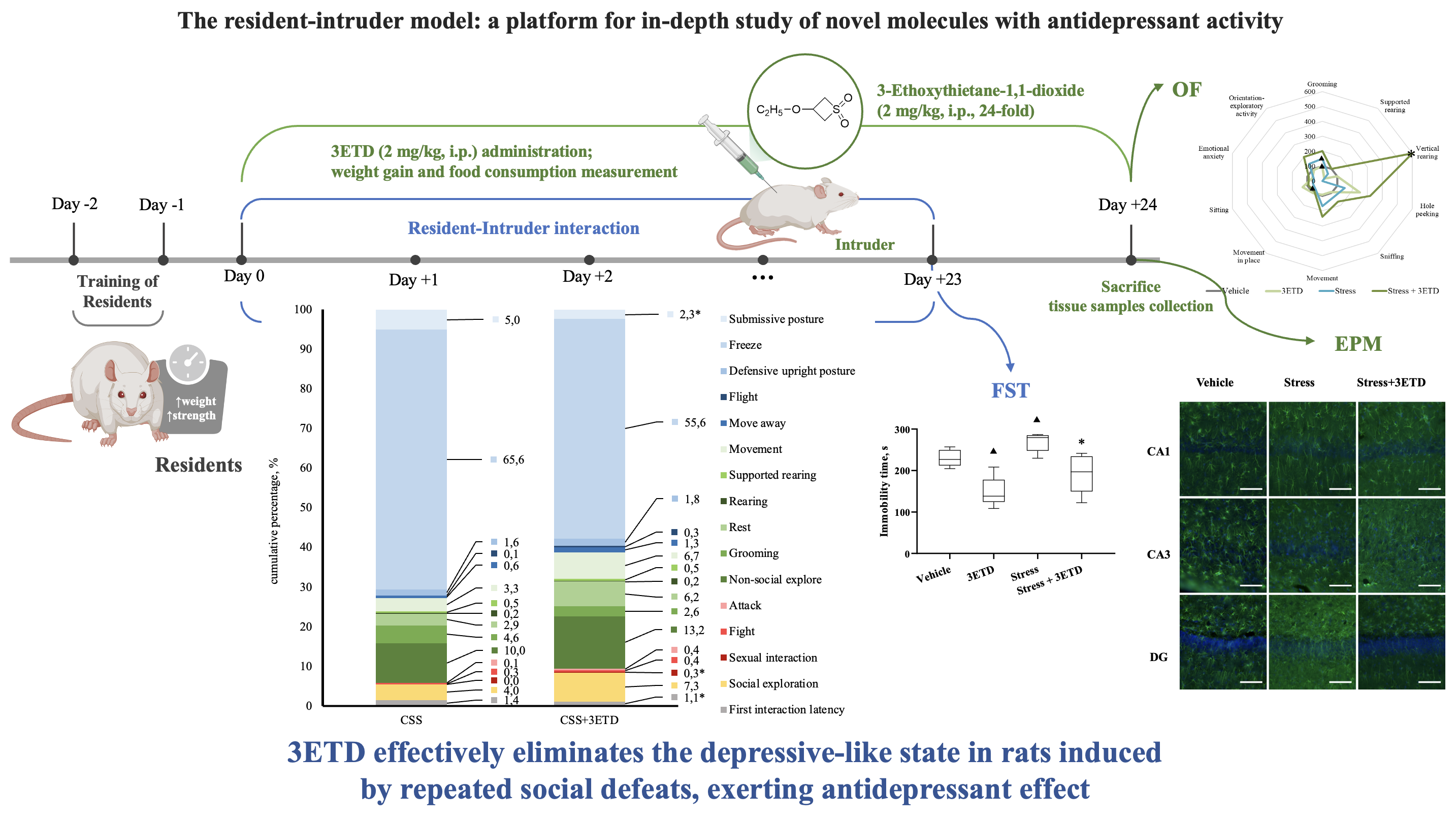
Introduction: The aim of the study was to investigate the features of the resident-intruder paradigm as a basic translational method for in-depth evaluation of antidepressant activity of new compounds using the example of 3-ethoxythietane-1,1-dioxide (3ETD), which has antidepressant activity.
Materials and Methods: A depressive-like state in white non-inbred rats (intruders) was modeled by long-term (24-day) exposure to chronic social stress (CSS) during interaction with residents. Intruders were divided into 4 experimental groups (n=6). Intruders of the CSS and CSS+3ETD groups interacted with residents daily for 10 min from Day 0 to Day +23, 30 min after intraperitoneal administration of 3ETD (2 mg/kg, 3ETD, CSS+3ETD groups) or saline (Vehicle and CSS groups). At the end of the experiment, the behavior of intruders of all groups was studied in the forced swimming test (FST, Day +23), open field test, and elevated plus maze test (Day +24). Intruders’ body weight and food consumption were measured daily. After euthanasia (Day +24), the weight coefficients of internal organs were calculated and the level of apoptosis markers/regulators in the rat hippocampus was determined immunohistochemically.
Results and Discussion: CSS induced a state similar to asthenic depression in intruders: it increased immobility time in FST, the duration of passive behaviors (including submissive), while the duration of active behaviors (defensive, exploratory, social) decreased. 3ETD eliminated these manifestations, exerting an antidepressant effect: it reduced the despair behavior in FST, enhanced motor activity, social and exploratory behavior of intruders, stimulated active defense and reduced passive defense during contact with residents, as well as reduced apoptosis in the hippocampus of intruders, exhibiting neuroprotective properties.
Conclusion: The resident-intruder model allows modeling in rats a condition similar to the human asthenic depression and demonstrating the antidepressant effect of novel molecules, as was shown on the 3ETD example when administered at a dose of 2 mg/kg/day intraperitoneally.
Графическая аннотация
Ключевые слова:
antidepressant activity, resident-intruder, animal outbred strain, thietaneБиблиографические ссылки
Bakshaliyeva AYa (2010) Peculiarities of development of the depression state in rats characterized by different individual/typological behavioral statuses. Neurophysiology 42: 130–138. https://doi.org/10.1007/s11062-010-9141-9
Belzung C (2014) Innovative drugs to treat depression: did animal models fail to be predictive or did clinical trials fail to detect effects? Neuropsychopharmacology 39: 1041–1051. https://doi.org/10.1038/npp.2013.342
Czéh B, Fuchs E, Wiborg O, Simon M (2016) Animal models of major depression and their clinical implications. Progress in Neuro-Psychopharmacology & Biological Psychiatry 64: 293–310. https://doi.org/10.1016/j.pnpbp.2015.04.004 [PubMed]
Kolomeets NS, Uranova NA (2014) Current conceptions about astrocyte reactivity in schizophrenia. Zhurnal Nevrologii i Psikhiatrii Imeni SS Korsakova 114: 92–99. [in Russian] [PubMed]
Koolhaas JM, Coppens CM, de Boer SF, Buwalda B, Meerlo P, Timmermans PJA (2013) The resident-intruder paradigm: A standardized test for aggression, violence and social stress. Journal of Visualized Experiments 77: e4367. https://doi.org/10.3791/4367 [PubMed] [PMC]
Lu J, Gong X, Yao X, Guang Y, Yang H, Ji R, He Y, Zhou W, Wang H, Wang W, Bai S, Guo H, Guo ZV, Xie P (2021) Prolonged chronic social defeat stress promotes less resilience and higher uniformity in depression-like behaviors in adult male mice. Biochemical and Biophysical Research Communications 553: 107–113. https://doi.org/10.1016/j.bbrc.2021.03.058[PubMed]
Nikitina IL, Gaisina GG (2022) Involvement of monoaminergic system in the antidepressant effect of 3-substituted thietane-1,1-dioxide derivative. Research Results in Pharmacology 8: 87–94. https://doi.org/10.3897/rrpharmacology.8.81007
Nikitina IL, Gaisina GG, Klen EE, Tkachenko LA (2025) Assessment of the 3-substituted thietane-1,1-dioxide derivative antidepressant effect using rat model of depression induced by reserpine. Research Results in Pharmacology 11: 13–26. https://doi.org/10.18413/rrpharmacology.11.542
Nikitina IL, Beeraka NM, Gaisina GG, Bulygin KV, Galimova EF, Galimov SN, Nikolenko VN, Mikhaleva LM, Somasundaram SG, Kirkland CE, Avila-Rodriguez M, Aliev G (2021) In vivo antidepressant efficacy of 3-substituted thietane-1, 1-dioxide derivative – a preliminary study for novel anti-depression therapy in neurological disorders. CNS & Neurological Disorders – Drug Targets 20: 982–995. https://doi.org/10.2174/1871527320666210301115028 [PubMed]
Oliveira AG (2020) Biostatistics Decoded. John Wiley & Sons, Hoboken, USA, 483 pp.
Paxinos G, Watson C (2006) The rat brain in stereotaxic coordinates: Hard cover edition. Elsevier, London, UK, 451 pp.
Petković A, Chaudhury D (2022) Encore: Behavioural animal models of stress, depression and mood disorders. Frontiers in Behavioral Neuroscience 16. https://doi.org/10.3389/fnbeh.2022.931964 [PubMed] [PMC]
Porsolt RD (1979) Animal model of depression. Biomedicine 30(3): 139–140. [PubMed]
Sestakova N, Puzserova A, Kluknavsky M, Bernatova I (2013) Determination of motor activity and anxiety-related behaviour in rodents: methodological aspects and role of nitric oxide. Interdisciplinary Toxicology 6: 126–135. https://doi.org/10.2478/intox-2013-0020 [PubMed] [PMC]
Shabanov PD, Lebedev AA (2007) Zoosocial behavior of rats. Reviews on Clinical Pharmacology and Drug Therapy 5: 2–79.
Smirnov AV, Tyurenkov IN, Schmidt MV, Snigur GL, Perfilova VN, Aksenova NV, Borodin DD, Danilenko VI, Hloponin PA, Bogomolova NV, Gubanova EN (2013) The characteristic of morphological changes of hippocampaus old rats as a result of stress. Journal of Volgograd State Medical University [Vestnik Volgogradskogo Gosudarstvennogo Medicinskogo Universiteta] 10: 14–17. [in Russian]
Tyurenkov IN, Smirnov AV, Grigorieva NV, Ekova MR, Volotova EV (2019) Morphofunctional changes of the dorsal and ventral hippocampus of rats in aging and modeling the combined stress. Volgograd State Medical University, Volgograd, 224 pp. [in Russian]
Yao Z, Zhang Z, Zhang J, Cai X, Zhong Z, Huang Y, Qu S (2021) Electroacupuncture alleviated the depression-like behavior by regulating FGF2 and astrocytes in the hippocampus of rats with chronic unpredictable mild stress. Brain Research Bulletin 169: 43–50. https://doi.org/10.1016/j.brainresbull.2021.01.005 [PubMed]
Загрузки
Опубликован
Как цитировать
Выпуск
Раздел
Лицензия
Copyright (c) 2025 Nikitina1 IL, Gaisina GG, Klen EE, Marakaeva EA, Nikitina EA, Kostin NA, Fedoseeva KN, Tkachenko LA

Это произведение доступно по лицензии Creative Commons «Attribution» («Атрибуция») 4.0 Всемирная.
 Русский
 English