
Evaluation of cardiotoxicity of a new antitumor compound, anthrafuran, a derivative of anthracycline antibiotics
Authors
-
Vasilisa A. Polozkova
Gause Institute of New Antibiotics, Moscow, Russia
 https://orcid.org/0000-0001-8643-6427
-
Eleonora R. Pereverzeva
Gause Institute of New Antibiotics, Moscow, Russia
https://orcid.org/0000-0001-8643-6427
-
Sofiya G. Yazeryan
Gause Institute of New Antibiotics, Moscow, Russia
https://orcid.org/0000-0001-8781-6376
-
Ivan A. Efremov
Sechenov University, Moscow, Russia
https://orcid.org/0009-0001-0727-4720
-
Andrey E. Shchekotikhin
Gause Institute of New Antibiotics, Moscow, Russia
https://orcid.org/0000-0002-6595-0811
DOI:
https://doi.org/10.18413/rrpharmacology.12.1125Abstract
Introduction: Anthracyclines and anthracenedione derivatives are a group of anticancer drugs that are widely used in clinical practice. Their application is frequently limited by cardiotoxic effects. The aim of this study was to evaluate the cardiotoxicity of the new anthracenedione derivative Anthrafuran (AF) in comparison with Doxorubicin (Dox) and Mitoxantrone (MT).
Materials and Methods: The study was conducted on 50 adult female Wistar rats. AF, MT, and Dox were administered in therapeutic doses and regimens for this animal species (AF: 20 mg/kg x 3/48 per os; MT: 1 mg/kg x 3/96 i.v.; Dox: 2.5 mg/kg x 3/72 i.v.). Electrocardiographic (ECG) parameters and heart weight index were determined; histological evaluation of the myocardium was performed on days 1 and 30 post-treatment.
Results: Dox intravenous injections in therapeutic doses caused a pronounced cardiotoxic effect. The signs of cardiac decompensation manifested as a significant decrease in heart rate (HR) (Dox 486±6, control 522±12.8), prolongation of the QT interval (Dox 0.06±0.002, control 0.048±0.001), an increase in weight index of the heart (Dox 0.41±0.03, control 0.36±0.006), and myocardial damage. Although the cardiotoxicity of MT was less pronounced, it nevertheless negatively affected both ECG parameters (HR 465±15, QT 0.056±0.002) and the structure of the heart muscle. The use of AF did not cause any pathological changes and had no effect on the heart weight index or ECG parameters (HR 498±7.3, QT 0.052±0.003, weight index of the heart 0.35±0.009).
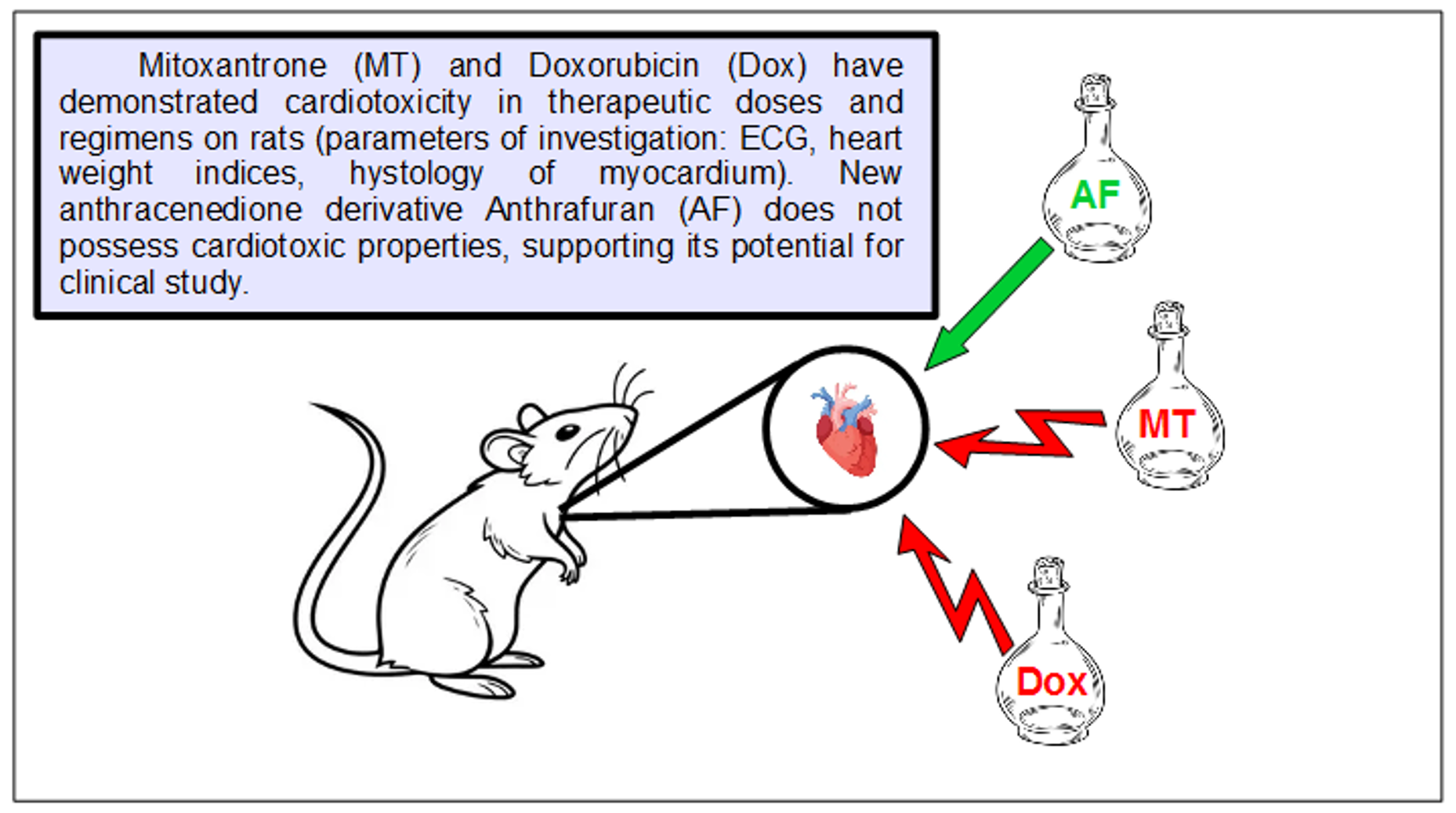
Conclusion: Unlike Dox (2.5 mg/kg x 3/72 i.v.) and MT (1 mg/kg x 3/96 i.v.), the new anthracenedione derivative AF (20 mg/kg x 3/48 per os) in therapeutic doses does not possess cardiotoxic properties, supporting its potential for clinical study.
Graphical Abstract
Keywords:
anthracenedionеs, anthrafuran, antitumor compound, cardiotoxicity, doxorubicin, mitoxantrone, ratsReferences
Aloss K, Hamar P (2023) Recent preclinical and clinical progress in liposomal doxorubicin. Pharmaceutics 15(3): 893. https://doi.org/10.3390/pharmaceutics15030893 [PubMed] [PMC]
Bayles CE, Hale DE, Konieczny A, Anderson VD, Richardson CR, Brown KV, Nguyen JT, Hecht J, Schwartz N, Kharel MK, Amissah F, Dowling TC, Nybo SE (2023) Upcycling the anthracyclines: new mechanisms of action, toxicology, and pharmacology. Toxicology and Applied Pharmacology 459: 116362. https://doi.org/10.1016/j.taap.2022.116362 [PubMed] [PMC]
Ben-Aharon I, Granot T, Meizner I, Hasky N, Tobar A, Rizel S, Yerushalmi R, Ben-Haroush A, Fisch B, Stemmer SM (2015) Long-term follow-up of chemotherapy-induced ovarian failure in young breast cancer patients: The Role of Vascular Toxicity. The Oncologist 20(9): 985– https://doi.org/10.1634/theoncologist.2015-0044 [PubMed] [PMC]
Bhagat A, Kleinerman ES (2020) Anthracycline-induced cardiotoxicity: causes, mechanisms, and prevention. Advances in Experimental Medicine and Biology 1257: 181– https://doi.org/10.1007/978-3-030-43032-0_15 [PubMed]
Bu YZ, Xu JR, Luo Q, Chen M, Mu LM, Lu WL (2020) A precise nanostructure of folate-overhung mitoxantrone DNA tetrahedron for targeted capture leukemia. Nanomaterials 10(5): 951. https://doi.org/10.3390/nano10050951 [PubMed] [PMC]
Chang HM, Moudgil R, Scarabelli T, Okwuosa TM, Yeh ETH (2017) Cardiovascular complications of cancer therapy: best practices in diagnosis, prevention, and management: Part 1. Journal of the American College of Cardiology 70(20): 2536– https://doi.org/10.1016/j.jacc.2017.09.1096 [PubMed] [PMC]
Cui J, Chen Y, Yang Q, Zhao P, Yang M, Wang X, Mang G, Yan X, Wang D, Tong Z, Wang P, Kong Y, Wang N, Wang D, Dong N, Liu M, E M, Zhang M, Yu B (2024) Protosappanin a protects dox-induced myocardial injury and cardiac dysfunction by targeting ACSL4/FTH1 axis-dependent ferroptosis. Advanced Science 11(34): e2310227. https://doi.org/10.1002/advs.202310227[PubMed] [PMC]
Dempke WCM, Zielinski R, Winkler C, Silberman S, Reuther S, Priebe W (2023) Anthracycline-induced cardiotoxicity – Are we about to clear this hurdle? European Journal of Cancer 185: 94– https://doi.org/10.1016/j.ejca.2023.02.019 [PubMed]
Elberry AA, Abdel-Naim AB, Abdel-Sattar EA, Nagy AA, Mosli HA, Mohamadin AM, Ashour OM (2010) Cranberry (Vaccinium macrocarpon) protects against doxorubicin-induced cardiotoxicity in rats. Food and Chemical Toxicology 48(5): 1178– https://doi.org/10.1016/j.fct.2010.02.008 [PubMed]
Eneh C, Lekkala MR (2023) Dexrazoxane. In: StatPearls [Internet]. Treasure Island (FL): StatPearls Publishing. [PubMed]
Evison BJ, Sleebs BE, Watson KG, Phillips DR, Cutts SM (2016) Mitoxantrone, more than just another topoisomerase II poison. Medicinal Research Reviews 36(2): 248– https://doi.org/10.1002/med.21364 [PubMed]
Fujimoto S, Ogawa M (1982) Antitumor activity of mitoxantrone against murine experimental tumors: comparative analysis against various antitumor antibiotics. Cancer Chemotherapy and Pharmacology 8(2): 157– https://doi.org/10.1007/BF00255476 [PubMed]
Huang NL, Lin JH (2014) Drug-induced conformational population shifts in topoisomerase-DNA ternary complexes. Molecules 19(6): 7415– https://doi.org/10.3390/molecules19067415 [PubMed] [PMC]
Johnson M, Keyes D (2024) Anthracycline toxicity. In: StatPearls [Internet]. Treasure Island (FL): StatPearls Publishing. [PubMed]
Kciuk M, Gielecińska A, Mujwar S, Kołat D, Kałuzińska-Kołat Ż, Celik I, Kontek R (2023)Doxorubicin – an agent with multiple mechanisms of anticancer activity. Cells 12(4): 659. https://doi.org/10.3390/cells12040659 [PubMed] [PMC]
Lehmann BD, Jovanović B, Chen X, Estrada MV, Johnson KN, Shyr Y, Moses HL, Sanders ME, Pietenpol JA (2016) Refinement of triple-negative breast cancer molecular subtypes: Implications for neoadjuvant chemotherapy selection. PLoS One 11(6): e0157368. https://doi.org/10.1371/journal.pone.0157368 [PubMed] [PMC]
Mattioli R, Ilari A, Colotti B, Mosca L, Fazi F, Colotti G (2023) Doxorubicin and other anthracyclines in cancers: Activity, chemoresistance and its overcoming. Molecular Aspects of Medicine 93: 101205. https://doi.org/10.1016/j.mam.2023.101205 [PubMed]
Maurer GS, Clayton ZS (2023) Anthracycline chemotherapy, vascular dysfunction and cognitive impairment: burgeoning topics and future directions. Future Cardiology 19(11): 547– https://doi.org/10.2217/fca-2022-0086 [PubMed] [PMC]
Murabito A, Hirsch E, Ghigo A (2020) Mechanisms of anthracycline-induced cardiotoxicity: Is mitochondrial dysfunction the answer? Frontiers in Cardiovascular Medicine 7: 35. https://doi.org/10.3389/fcvm.2020.00035 [PubMed] [PMC]
Nysom K, Holm K, Lipsitz SR, Mone SM, Colan SD, Orav EJ, Sallan SE, Olsen JH, Hertz H, Jacobsen JR, Lipshultz SE (1998) Relationship between cumulative anthracycline dose and late cardiotoxicity in childhood acute lymphoblastic leukemia. Journal of Clinical Oncology 16(2): 545– https://doi.org/10.1200/JCO.1998.16.2.545 [PubMed]
Pereverzeva ER, Treschalin MI, Eremkin NV, Shchekotikhin AE, Treschalin ID (2017) Toxicological characteristic of novel antitumour multitargeted agent anthrafuran. Russian Journal of Biotherapy [Rossiiskii Bioterapevticheskii ZHurnal] 16(4): 80– https://doi.org/10.17650/1726-9784-2017-16-4-80-84 [in Russian]
Schmetzer O, Flörcken A (2012) Sex differences in the drug therapy for oncologic diseases. Handbook of Experimental Pharmacology 214: 411–442. https://doi.org/10.1007/978-3-642-30726-3_19
Shchekotikhin AE, Dezhenkova LG, Tsvetkov VB, Luzikov YN, Volodina YL, Tatarskiy VV Jr, Kalinina AA, Treshalin MI, Treshalina HM, Romanenko VI, Kaluzhny DN, Kubbutat M, Schols D, Pommier Y, Shtil AA, Preobrazhenskaya MN (2016) Discovery of antitumor anthra[2,3-b]furan-3-carboxamides: optimization of synthesis and evaluation of antitumor properties. European Journal of Medicinal Chemistry 112: 114– https://doi.org/10.1016/j.ejmech.2016.01.050[PubMed] [PMC]
Shchekotikhin AE, Treshalina HM, Treshchalin MI, Pereverzeva ER, Isakova HB, Tikhomirov AS (2020) Experimental evaluation of anticancer efficiency and acute toxicity of anthrafuran for oral administration. Pharmaceuticals 13(5): 81. https://doi.org/10.3390/ph13050081[PubMed] [PMC]
Steiniger SC, Kreuter J, Khalansky AS, Skidan IN, Bobruskin AI, Smirnova ZS, Severin SE, Uhl R, Kock M, Geiger KD, Gelperina SE (2004) Chemotherapy of glioblastoma in rats using doxorubicin-loaded nanoparticles. International Journal of Cancer 109(5): 759– https://doi.org/10.1002/ijc.20048 [PubMed]
Tikhomirov AS, Lin CY, Volodina YL, Dezhenkova LG, Tatarskiy VV, Schols D, Shtil AA, Kaur P, Chueh PJ, Shchekotikhin AE (2018) New antitumor anthra[2,3-b]furan-3-carboxamides: synthesis and structure-activity relationship. European Journal of Medicinal Chemistry 148: 128– https://doi.org/10.1016/j.ejmech.2018.02.027 [PubMed]
Treschalin MI, Treschalin ID, Golibrodo VA, Shchekotikhin AE, Pereverzeva ER (2018) Experimental evaluation of toxic properties of LCTA-2034 by the oral route of administration. Russian Journal of Biotherapy [Rossiiskii Bioterapevticheskii ZHurnal] 17(3): 81– https://doi.org/10.17650/1726-9784-2018-17-3-81-88 [in Russian]
van der Pal HJ, van Dalen EC, Hauptmann M, Kok WE, Caron HN, van den Bos C, Oldenburger F, Koning CC, van Leeuwen FE, Kremer LC (2010) Cardiac function in 5-year survivors of childhood cancer: A long-term follow-up study. Archives of Internal Medicine 170(14): 1247– https://doi.org/10.1001/archinternmed.2010.233 [PubMed]
Vandecruys E, Mondelaers V, De Wolf D, Benoit Y, Suys B (2012) Late cardiotoxicity after low dose of anthracycline therapy for acute lymphoblastic leukemia in childhood. Journal of Cancer Survivorship: Research and Practice 6(1): 95– https://doi.org/10.1007/s11764-011-0186-6 [PubMed] [PMC]
Vejpongsa P, Yeh ET (2014) Topoisomerase 2β: A promising molecular target for primary prevention of anthracycline-induced cardiotoxicity. Clinical Pharmacology and Therapeutics95(1): 45– https://doi.org/10.1038/clpt.2013.201 [PubMed]
Wallace KB, Sardão VA, Oliveira PJ (2020) Mitochondrial determinants of doxorubicin-induced cardiomyopathy. Circulation Research 126(7): 926– https://doi.org/10.1161/CIRCRESAHA.119.314681 [PubMed] [PMC]
Zbinden G, Beilstein AK (1982) Comparison of cardiotoxicity of two anthracenediones and doxorubicin in rats. Toxicology Letters 11(3-4): 289– https://doi.org/10.1016/0378-4274(82)90163-1 [PubMed]
Published
How to Cite
Issue
Section
License
Copyright (c) 2026 Polozkova VA, Pereverzeva ER, Yazeryan SG, Efremov IA, Shchekotikhin AE

This work is licensed under a Creative Commons Attribution 4.0 International License.
 Русский
 English