Analysis of the neuroprotective activity of myrtle secondary metabolites in an ischemia-reperfusion model in rats: Overall electrical activity and neurological deficit
Authors
-
Marina Yu. Ravaeva
V.I. Vernadsky Crimean Federal University
 https://orcid.org/0000-0002-6081-1628
- Eva S. Yan V.I. Vernadsky Crimean Federal University
- Irina A. Roslyakova V.I. Vernadsky Crimean Federal University
-
Maria V. Nagorskaya
V.I. Vernadsky Crimean Federal University
https://orcid.org/0009-0002-0528-2791
-
Elena N. Chuyan
V.I. Vernadsky Crimean Federal University
https://orcid.org/0000-0001-6240-2732
-
Anait V. Zelenskaya
Kuban State Medical University
https://orcid.org/0000-0001-9512-2526
-
Andrey I. Sidyakin
y, V.I. Vernadsky Crimean Federal University
https://orcid.org/0000-0002-5125-7514
-
Ekaterian Yu. Bakova
Federal State Budgetary Institution “Order of the Red Banner of Labor Nikitsky Botanical Gardens – National Scientific Center of the Russian Academy of Sciences”
https://orcid.org/0000-0003-4995-8044
DOI:
https://doi.org/10.18413/rrpharmacology.12.1108Abstract
Introduction: The aim of the study was to investigate the effects of myrtle secondary metabolites (hydrolate, syrup I, and syrup II) on overall brain electrical activity and the severity of neurological deficits in rats in simulated ischemia-reperfusion.
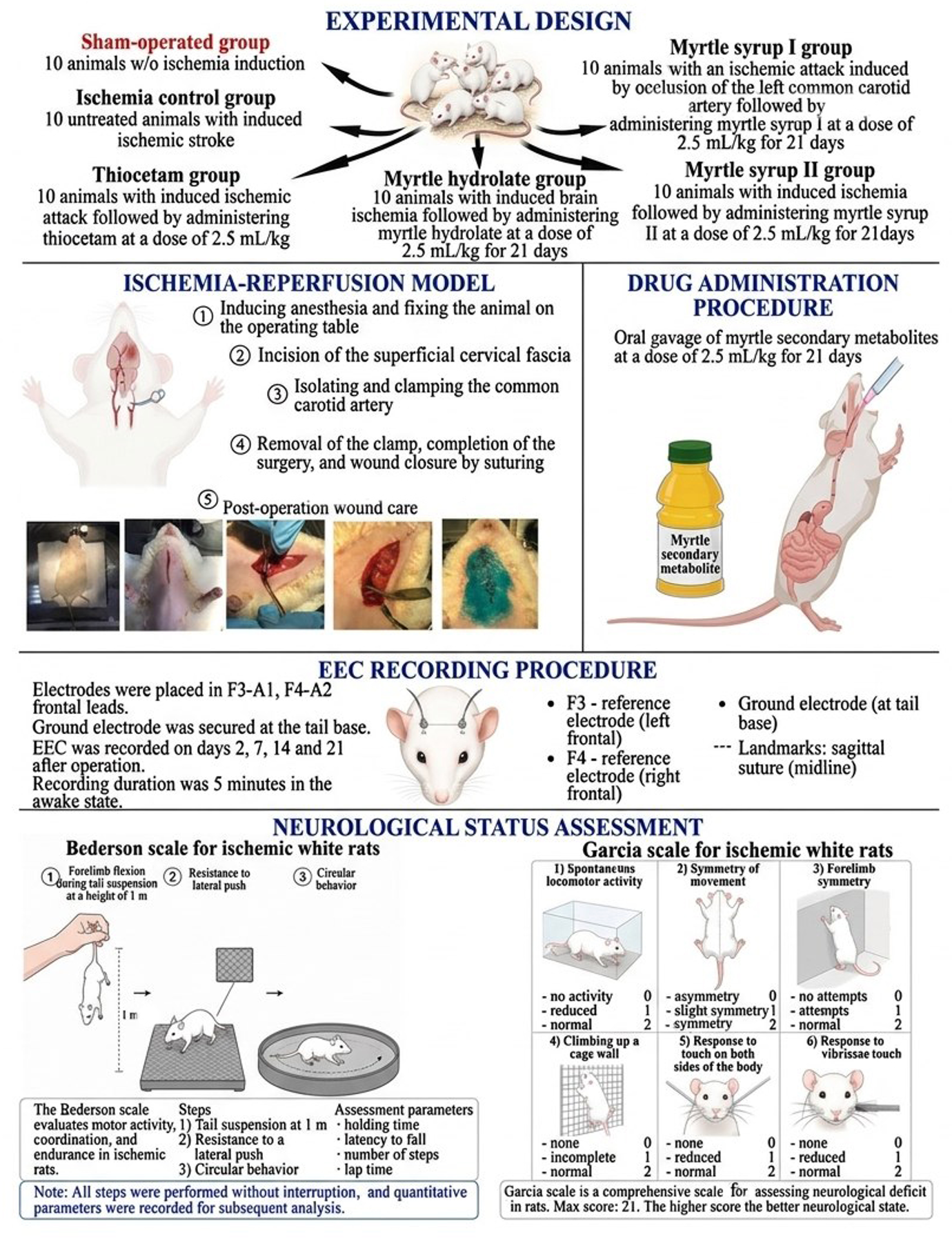
Materials and Methods: Ischemia-reperfusion was modeled in 60 male Wistar rats using 30-minute occlusion of the left common carotid artery followed by restoration of blood flow. The animals were divided into six groups (n=10): sham-operated (SO); ischemia control (I/C); a comparison group Thiocetam; and experimental groups that received intragastrically administered myrtle hydrolate (Hydrolate), syrup I (Syrup I), and syrup II (Syrup II) at a dose of 2.5 mL/kg daily for 21 days.
Results: Ischemia caused persistent suppression of EEG amplitudes (by 40–61%), spectrum restructuring with a predominance of delta (+47–63%) and theta rhythms (+41–119%) and suppression of alpha rhythm (–54–75%), as well as severe neurological deficit. Hydrolate had a moderate effect in the early period, but by day 21, amplitudes had fallen by 12–14% below the ischemia control (I/C) levels. Syrup I restored amplitudes (+29–82%), spectrum (alpha rhythm +151–345%, delta rhythm –36%), and neurological status by days 7–14. Syrup II restored neurological deficit by day 2 (0.08 points on the Bederson scale versus 1.67 in I/C); by day 7, the neurological deficit was fully restored, with EEG amplitudes increasing by 17–63% and alpha rhythm – by 104–272%.
Discussion: The differences revealed in the neuroprotective activity of the three myrtle secondary metabolite compositions correlate with their chemical profiles. In terms of the intensity of their neuroprotective effect, the myrtle secondary metabolites were ranked in the following order: Hydrolate < Syrup I ≈ Thiocetam < Syrup II.
Conclusion: Myrtle secondary metabolites, particularly Syrup II with its high flavonoid content, exert a complex neuroprotective effect, which manifests in the coordinated restoration of electrophysiological and behavioral parameters.
Graphical Abstract
Keywords:
ischemia-reperfusion, Myrtus communis, secondary metabolites, electroencephalograph, neurological deficit, myricetin, phenolic acids, neuroprotection, ratsReferences
Aggul AG, Demir GM, Yilmaz I (2022) Ethanol extract of myrtle (Myrtus communis) berries as a remedy for streptozotocin-induced oxidative stress in rats. Applied Biochemistry and Biotechnology 194(4): 1645–1658. https://doi.org/10.1007/s12010-021-03746-4 [PubMed]
Ajčević M, Furlanis G, Naccarato M, Miladinović A, Buoite Stella A, Caruso P, Cillotto T, Accardo A, Manganotti P (2021) Hyper-acute EEG alterations predict functional and morphological outcomes in thrombolysis-treated ischemic stroke: a wireless EEG study. Medical & Biological Engineering & Computing 59(1): 121–129. https://doi.org/10.1007/s11517-020-02280-z [PubMed] [PMC]
Alsbrook DL, Di Napoli M, Bhatia K, Biller J, Andalib S, Hinduja A, Rodrigues R, Rodriguez M, Sabbagh SY, Selim M, Farahabadi MH, Jafarli A, Divani AA (2023) Neuroinflammation in acute ischemic and hemorrhagic stroke. Current Neurology and Neuroscience Reports 23(8): 407–431. https://doi.org/10.1007/s11910-023-01278-2 [PubMed] [PMC]
Al-Snafi AE, Teibo JO, Shaheen HM, Akinfe OA, Teibo TKA, Emieseimokumo N, Elfiky MM, Al-Kuraishy HM, Al-Garbeeb AI, Alexiou A, Papadakis M, Mahana HAM, Younes AM, Elbanna OA, Qasem AAR, Shahin IYI, Batiha GE (2024) The therapeutic value of Myrtus communis: an updated review. Naunyn-Schmiedeberg’s Archives of Pharmacology 397(7): 4579–4600. https://doi.org/10.1007/s00210-024-02978-x [PubMed] [PMC]
Bakova EYu, Pozdnyakov DI, Konovalov DA, Bakova NN, Orobinskaya VN (2023) Antioksidantnye svoystva i toksichnost’ vodnogo izvlecheniya i siropa mirta obyknovennogo [Antioxidant properties and toxicity of aqueous extract and syrup of common myrtle]. Sovremennaya nauka i innovatsii [Modern Science and Innovation] 4: 108–115. [in Russian]
Chuyan EN, Mironyuk IS, Cheretaev IV, Ravaeva MYu, Liventsov SYu, Murtazaeva AM, Shevchuk OM, Bakova NN (2024) Vazotropnaya aktivnost' vtorichnykh metabolitov mirta obyknovennogo (Myrtus communis) [Vasotropic activity of secondary metabolites of common myrtle (Myrtus communis L.)]. Uchenye zapiski Krymskogo federal’nogo universiteta imeni V. I. Vernadskogo. Biologiya. Khimiya [Proceedings of V.I.Vernadsky Federal University. Biology. Chemistry] 10: 254–273. [in Russian]
Dabbaghi MM, Fadaei MS, Soleimani Roudi H, Baradaran Rahimi V, Askari VR (2023) A review of the biological effects of Myrtus communis. Physiological Reports 11(14): e15670. https://doi.org/10.14814/phy2.15670 [PubMed] [PMC]
Dai Z, Zhang L, Liu X, Kou M, An L, Wang W, Xu J, Su Y (2024) Predictive value of quantitative electroencephalogram combined with transcranial Doppler ultrasound in delayed cerebral ischemia after subarachnoid hemorrhage. World Neurosurgery 186: 48–53.https://doi.org/10.1016/j.wneu.2024.03.045 [PubMed]
Damulin IV, Ekusheva EV (2014) Protsessy neyroplastichnosti posle insul’ta [Neuroplasticity processes after stroke]. Nevrologiya, neyropsikhiatriya, psikhosomatika [Neurology, Neuropsychiatry, Psychosomatics] 3: 69–74. [in Russian]
Dayneko AS, Shmonin AA, Shumeeva AV, Kovalenko AE, Melnikova EV, Vlasova TD (2014) Metody otsenki nevrologicheskogo defitsita u krys posle 30-minutnoy fokal'noy ishemii mozga na rannikh i pozdnikh srokakh postishemicheskogo perioda [Methods for assessing neurological deficit in rats after 30-minute focal cerebral ischemia in early and late post-ischemic periods]. Regionarnoe Krovoobrashchenie i Mikrotsirkulyatsiya [Regional Blood Circulation and Microcirculation] 13: 68–78. [in Russian]
Demchenko AV, Belenichev IF (2015) Comparative assessment of the effectiveness of modern neuroprotectors in conditions of experimental chronic cerebral ischemia. Zaporozhye Medical Journal 2(89): 45–49.
Dong JH, Gao ZH, Han F, Liu MR, Qian BL, Cao WX, Liu YJ (2025) Advances in liposome-delivered neuroprotective agents in treatment of ischemic stroke. Zhongguo Zhong Yao Za Zhi 50(22): 6205–6214. https://doi.org/10.19540/j.cnki.cjcmm.20250606.601 [PubMed] [in Chinese]
Hayani M, Benabbouha T, Naceiri Mrabti N, Eljebri S, Sabiri M, Zair T (2024) Bioactive profiling, antibacterial efficacy and computational modelling of Myrtus communis essential oil (Morocco). Chemistry & Biodiversity 21(6): e202302114. https://doi.org/10.1002/cbdv.202302114 [PubMed]
Hui X, Wang E, Zhang H (2021) Neuroprotective phytochemicals in experimental ischemic stroke: mechanisms and potential clinical applications. Oxidative Medicine and Cellular Longevity 2021: 6685204. https://doi.org/10.1155/2021/6685204 [PubMed] [PMC]
Imran M, Saeed F, Hussain G, Imran A, Mehmood Z, Gondal TA, El-Ghorab A, Ahmad I, Pezzani R, Arshad MU, Bacha U, Shariarti MA, Rauf A, Muhammad N, Shah ZA, Zengin G, Islam S (2021) Myricetin: a comprehensive review on its biological potentials. Food Science & Nutrition 9(10): 5854–5868. https://doi.org/10.1002/fsn3.2513 [PubMed] [PMC]
Kal’chuk RO (2014) Stressprotektory v lekarstvennoy pomoshchi pri eksperimental’nom parodontite [Stress protectors in the drug therapy of experimental parodontitis]. Meditsinskiy vestnik Yuga Rossii [Medical Bulletin of the Russian South] (1): 50–53. [in Russian]
Logvinenko LA (2017) Kul’tura mirta (Myrtus communis) obyknovennogo v usloviyakh Yuzhnogo berega Kryma [Cultivation of common myrtle (Myrtus communis L.) in the conditions of the Southern coast of Crimea]. Agrarnyy Vestnik Urala [Agrarian Bulletin of the Urals] 9: 16–24. [in Russian]
Ma R, Xie Q, Li Y, Chen Z, Ren M, Chen H, Li H, Li J, Wang J (2020) Animal models of cerebral ischemia: A review. Biomedicine & Pharmacotherapy 131: 110686. https://doi.org/10.1016/j.biopha.2020.110686 [PubMed]
Mangiardi M, Bonura A, Iaccarino G, Alessiani M, Bravi MC, Crupi D, Pezzella FR, Fabiano S, Pampana E, Stilo F, Alfano G, Anticoli S (2023) The pathophysiology of collateral circulation in acute ischemic stroke. Diagnostics 13(14): 24–25. https://doi.org/10.3390/diagnostics13010024 [PubMed] [PMC]
Medda S, Fadda A, Mulas M (2021) Quantification of total phenols, tannins, anthocyanins content in Myrtus communis and antioxidant activity evaluation in function of plant development stages and altitude of origin site. Agronomy 11(6): 1059. https://doi.org/10.3390/agronomy11061059
Narayan SK, Grace Cherian S, Babu PP (2021) Preclinical animal studies in ischemic stroke: challenges and some solutions. Animal Models and Experimental Medicine 4(2): 104–115. https://doi.org/10.1002/ame2.12166 [PubMed] [PMC]
Novikova LB, Sharapova KM (2018) EEG-kharakteristika patsiyentov, perenesshikh polusharnyy ishemicheskiy insul’t [EEG characteristics of patients after hemispheric ischemic stroke]. Farmateka [Pharmateca] 5: 54–58. [in Russian]
Odeh D, Oršolić N, Berendika M, Đikić D, Domjanić Drozdek S, Balbino S, Repajić M, Dragović-Uzelac V, Jurčević IL (2022) Antioxidant and anti-atherogenic activities of essential oils from Myrtus communis and Laurus nobilis L. in rat. Nutrients 14(7): 1465. https://doi.org/10.3390/nu14071465 [PubMed] [PMC]
Paul S, Candelario-Jalil E (2021) Emerging neuroprotective strategies for the treatment of ischemic stroke: Аn overview of clinical and preclinical studies. Experimental Neurology 335: 113518. https://doi.org/10.1016/j.expneurol.2020.113518 [PubMed] [PMC]
Pu L, Wang L, Zhang R (2020) Projected global trends in ischemic stroke incidence, deaths and disability-adjusted life years from 2020 to 2030. Stroke 54(5): 1330–1339. https://doi.org/10.1161/STROKEAHA.120.033495 [PubMed]
Ren ZL, Lan X, Cheng JL, Zheng YX, Chen CA, Liu Y, He YH, Han JH, Wang QG, Cheng FF, Li CX, Wang XQ (2025) Astrocyte-neuron metabolic crosstalk in ischaemic stroke. Neurochemistry International 185: 105876. https://doi.org/10.1016/j.neuint.2024.105876[PubMed]
Salatin S, Bazh E, Khodaii Z (2023) Nanoparticle formulations of antioxidants for the management of oxidative stress in stroke: A review. Biomedicines 11(11): 1016. https://doi.org/10.3390/biomedicines11041016 [PubMed] [PMC]
Shan B, Cai YZ, Brooks JD, Corke H (2007) The in vitro antibacterial activity of dietary spice and medicinal herb extracts. International Journal of Food Microbiology 117(1): 112–119. https://doi.org/10.1016/j.ijfoodmicro.2007.03.003 [PubMed]
Sikirynska DO, Hudyma A A, Pokhodun K A, Antonyshyn IV (2021) Influence of cranioskeltal trauma, complicated with blood loss, on the bile-forming function of liver during the early period of traumatic disease among rats with different resistance to hypoxia and its correction. Journal of Education, Health and Sport 11: 326–337. https://doi.org/10.12775/JEHS.2021.11.01.032
Skvortsova VI, Stakhovskaya LV, Airiyan NYu (2018) Epidemiologiya insul’ta v Rossiyskoy Federatsii [Epidemiology of Stroke in the Russian Federation]. Consilium Medicum 20: 10–14. [in Russian]
Sysoev YI, Prikhodko VA, Kan AV, Titovich IA, Karev VE, Okovityi SV (2022) Changes in brain electrical activity after transient middle cerebral artery occlusion in rats. Neurology International 14(3): 547–560. https://doi.org/10.3390/neurolint14030044 [PubMed] [PMC]
Takasugi Y, Hishikawa T, Shimizu T, Murai S, Haruma J, Hiramatsu M, Tokunaga K, Takeda Y, Sugiu K, Morimatsu H, Date I (2024) Power suppression in EEG after the onset of SAH is a significant marker of early brain injury in rat models. Scientific Reports 14(1): 2277. https://doi.org/10.1038/s41598-024-52888-0 [PubMed] [PMC]
Tao T, Liu M, Chen M, Luo Y, Wang C, Xu T, Jiang Y, Guo Y, Zhang JH (2020) Natural medicine in neuroprotection for ischemic stroke: challenges and prospective. Pharmacology & Therapeutics 216: 107695. https://doi.org/10.1016/j.pharmthera.2020.107695 [PubMed]
Thapa K, Shivam K, Khan H, Kaur A, Dua K, Singh S, Singh TG (2023) Emerging targets for modulation of immune response and inflammation in stroke. Neurochemical Research 48(6): 1663–1690. https://doi.org/10.1007/s11064-022-03859-4 [PubMed]
Uysal S, Sinan KI, Jekő J (2023) Assessment of antioxidant and enzyme inhibition properties of Myrtus communis leaves. International Journal of Secondary Metabolite 10: 166–174. https://doi.org/10.21448/ijsm.1173780
Yildirim F, San B, Yildirim AN (2015) Mineral composition of leaves and fruit in some myrtle (Myrtus communis) genotypes. Erwerbs-Obstbau 57: 149–152. https://doi.org/10.1007/s10341-015-0245-8
Zakharov VV (2015) Kognitivnye narusheniya posle insul'ta: mediko-sotsial’naya znachimost’ i podkhody k terapii [Cognitive impairment after stroke: medical and social significance and approaches to therapy]. Nervnye bolezni [Neuroligical Diseases] 2: 2–7. [in Russian]
Zappasodi F, Olejarczyk E, Marzetti L, Assenza G, Pizzella V, Tecchio F (2014) Fractal dimension of EEG activity senses neuronal impairment in acute stroke. PLoS ONE 9(6): e100199. https://doi.org/10.1371/journal.pone.0100199 [PubMed] [PMC]
Published
How to Cite
Issue
Section
License
Copyright (c) 2026 Ravaeva MYu, Yan ES, Roslyakova IA, Nagorskaya MV, Chuyan EN, Zelenskaya AV, Sidyakin AI, Bakova EYu

This work is licensed under a Creative Commons Attribution 4.0 International License.
 Русский
 English