
Reasons for using carnitine in managing dioxins-induced metabolic dysfunction-associated steatotic liver disease: A scoping review
Authors
-
Marwan Al-Nimer
College of Medicine, University of Diyala, Baqubah, Iraq
 https://orcid.org/0000-0002-5336-3353
-
Vian Wasta Esmail
University of Sulaimani, Kurdistan region, Iraq
https://orcid.org/0000-0002-5914-8136
-
Tavga Aziz
College of Pharmacy, University of Sulaimani, Kurdistan region, Iraq
https://orcid.org/0000-0003-2742-6127
DOI:
https://doi.org/10.18413/rrpharmacology.12.729Abstract
Introduction: Preclinical studies and epidemiological observational surveys showed that dioxin is a toxic substance that causes hepatic steatosis, metabolic dysregulation, insulin resistance, and type 2 diabetes mellitus. Workers in industries who live near the contaminated areas or consume contaminated food are at risk of metabolic dysfunction-associated steatotic liver disease (MASLD).
Materials and Methods: This scoping review was conducted according to the Joanna Briggs Institute (JBI) methodology and summarised the published literature on the mechanisms of action of carnitine (s) that counteract the mechanisms of dioxin(s)-inducing MASLD/MDAFLD/NAFLD/NASH/ in the preclinical studies. We addressed this exploratory review as a broad question and did not intend to conduct a systematic review; for that reason, we did not follow PRISMA guidelines.
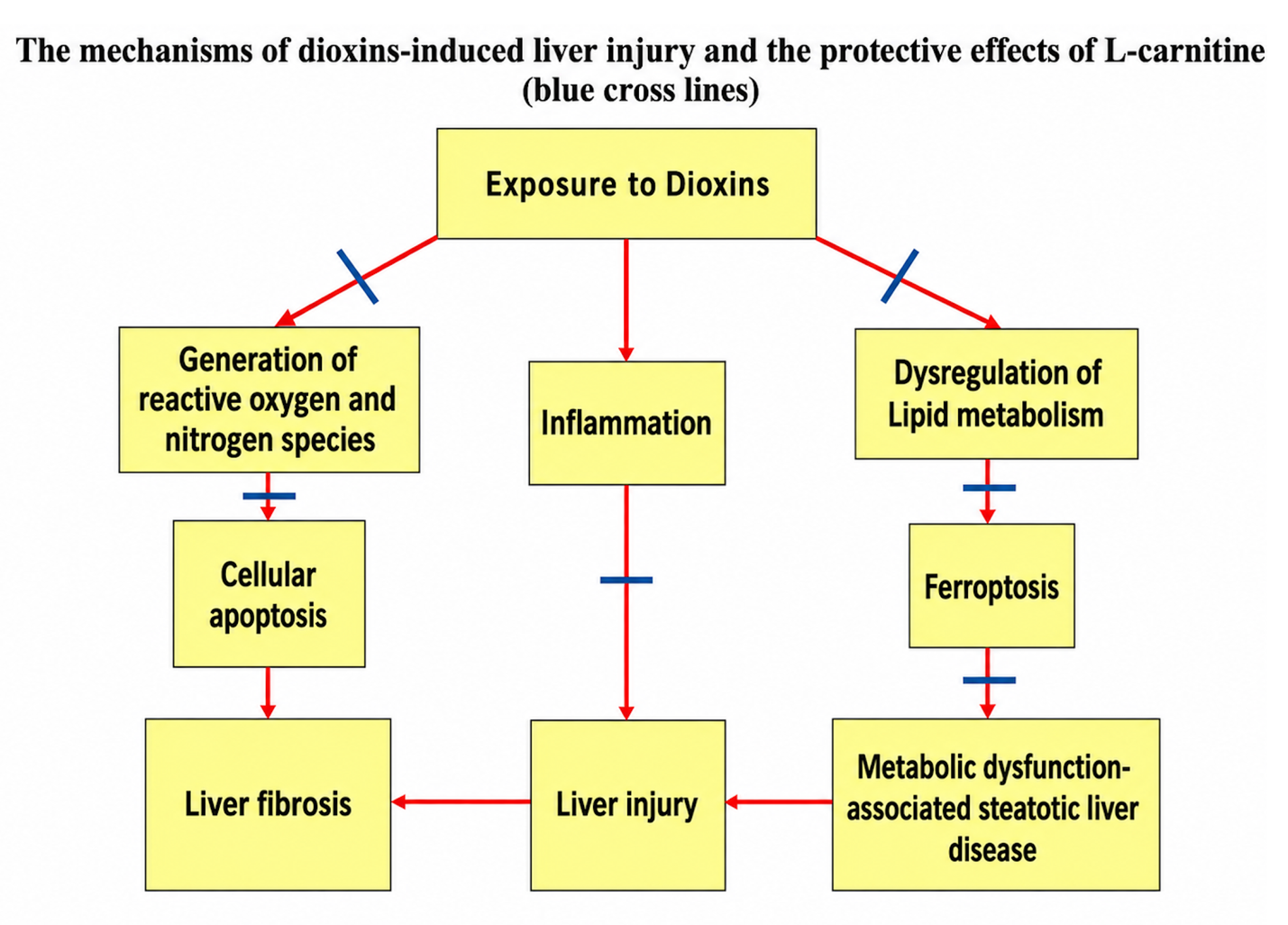
Results and Discussion: The mechanisms by which dioxin-induced MASLAD can be counteracted by L-carnitine or acetyl-L-carnitine at the same site of dioxin effects are discussed in this scoping review. Carnitine acts as a metabolic antagonist against dioxin, according to the findings of preclinical, clinical observational, controlled clinical trials, and meta-analysis studies. Therefore, using competitive or non-competitive aryl receptor-blocking drugs to stop dioxin's harmful effects is not necessary.
Conclusion: L-carnitine or acetyl-L-carnitine as a supplementary nutrient could prevent or improve the clinical picture of MASLD in people at risk of dioxin toxicity.
Graphical Abstract
Keywords:
Acetyl-L-Carnitine, Aryl hydrocarbon receptors, Carnitine, Dioxin, Metabolic dysfunction associated steatotic liver disease, Reactive oxygen speciesReferences
Abolfathi M, Mohd-Yusof BN, Hanipah ZN, Mohd Redzwan S, Yusof LM (2020) The effects of carnitine supplementation on clinical characteristics of patients with non-alcoholic fatty liver disease: A systematic review and meta-analysis of randomized controlled trials. Complementary Therapies in Medicine 48: 102273. https://doi.org/10.1016/j.ctim.2019.102273 [PubMed]
Adams LA, Roberts SK, Strasser SI, Mahady SE, Powell E, Estes C, Razavi H, George J (2020) Nonalcoholic fatty liver disease burden: Australia, 2019-2030. Journal of Gastroenterology and Hepatolology 35(9): 1628–1635. https://doi.org/10.1111/jgh.15009 [PubMed] [PMC]
Alhusaini AM, Alsoghayer R, Alhushan L, Alanazi AM, Hasan IH (2023) Acetyl-L-carnitine and liposomal co-enzyme q10 attenuate hepatic inflammation, apoptosis, and fibrosis induced by propionic acid. Internationl Journal of Molecular Sciences 24(14): 11519. https://doi.org/10.3390/ijms241411519 [PubMed] [PMC]
Angulo P, Kleiner DE, Dam-Larsen S, Adams LA, Bjornsson ES, Charatcharoenwitthaya P, Mills PR, Keach JC, Lafferty HD, Stahler A, Haflidadottir S, Bendtsen F (2015) Liver fibrosis, but no other histologic features, is associated with long-term outcomes of patients with nonalcoholic fatty liver disease. Gastroenterology 149(2): 389–397. https://doi.org/10.1053/j.gastro.2015.04.043 [PubMed] [PMC]
Badmus OO, Hillhouse SA, Anderson CD, Hinds TD, Stec DE (2022) Molecular mechanisms of metabolic associated fatty liver disease (MAFLD): Functional analysis of lipid metabolism pathways. Clinical Science (London) 136(18): 1347–1366. https://doi.org/10.1042/CS20220572 [PubMed] [PMC]
Bae JC, Lee WY, Yoon KH, Park JY, Son HS, Han KA, Lee KW, Woo JT, Ju YC, Lee WJ, Cho YY, Lee MK (2015) Improvement of nonalcoholic fatty liver disease with carnitine-orotate complex in type 2 diabetes (CORONA): A randomized controlled trial. Diabetes Care 38(7): 1245–1252. https://doi.org/10.2337/dc14-2852[PubMed]
Baghban F, Hosseinzadeh M, Mozaffari-Khosravi H, Dehghan A, Fallahzadeh H (2021) The effect of L-Carnitine supplementation on clinical symptoms, C-reactive protein and malondialdehyde in obese women with knee osteoarthritis: A double blind randomized controlled trial. BMC Musculoskeletal Disorders 22(1): 195. https://doi.org/10.1186/s12891-021-04059 [PubMed] [PMC]
Całkosiński I, Rosińczuk-Tonderys J, Bazan J, Dobrzyński M, Bronowicka-Szydełko A, Dzierzba K (2014) Influence of dioxin intoxication on the human system and possibilities of limiting its negative effects on the environment and living organisms. Annals of Agricultural and Environmental Medicine: AAEM 21(3): 518–524. https://doi/org/10.5604/12321966.1120594 [PubMed]
Chalasani N, Younossi Z, Lavine JE, Charlton M, Cusi K, Rinella M, Harrison SA, Brunt EM, Sanyal AJ (2018) The diagnosis and management of nonalcoholic fatty liver disease: Practice guidance from the American Association for the Study of Liver Diseases. Hepatology 67(1): 328–357. https://doi.org/10.1002/hep.29367[PubMed]
Chen SC, Liao TL, Wei YH, Tzeng CR, Kao SH (2010) Endocrine disruptor, dioxin (TCDD)-induced mitochondrial dysfunction and apoptosis in human trophoblast-like JAR cells. Molecular Human Reproduction 16(5): 361–372. https://doi.org/10.1093/molehr/gaq004 [PubMed]
Choi M, Park S, Lee M (2020) L-Carnitine’s effect on the biomarkers of metabolic syndrome: A systematic review and meta-analysis of randomized controlled trials. Nutrients 12 (9): 2795. https://doi.org/10.3390/nu12092795[PubMed] [PMC]
Cholico GN, Fling RR, Zacharewski NA, Fader KA, Nault R, Zacharewski TR (2021) Thioesterase induction by 2,3,7,8-tetrachlorodibenzo-p-dioxin results in a futile cycle that inhibits hepatic β-oxidation. Scientific Reports 11(1): 15689. https://doi.org/10.1038/s41598-021-95214-0 [PubMed] [PMC]
Das DN, Panda PK, Sinha N, Mukhopadhyay S, Naik PP, Bhutia SK (2017) DNA damage by 2,3,7,8-tetrachlorodibenzo-p-dioxin-induced p53-mediated apoptosis through activation of cytochrome P450/aryl hydrocarbon receptor. Environmental Toxicology and Pharmacology 55: 175–185. https://doi.org/10.1016/j.etap.2017.08.012 [PubMed]
Doskey CM, Fader KA, Nault R, Lydic T, Matthews J, Potter D, Sharratt B, Williams K, Zacharewski T (2020) 2,3,7,8-Tetrachlorodibenzo-p-dioxin (TCDD) alters hepatic polyunsaturated fatty acid metabolism and eicosanoid biosynthesis in female Sprague-Dawley rats. Toxicology and Applied Pharmacology 398: 115034. https://doi.org/10.1016/j.taap.2020.115034 [PubMed] [PMC]
Duval C, Teixeira-Clerc F, Leblanc AF, Touch S, Emond C, Guerre-Millo M, Lotersztajn S, Barouki R, Aggerbeck M, Coumoul X (2017) Chronic exposure to low doses of dioxin promotes liver fibrosis development in the C57BL/6J diet-induced obesity mouse model. Environmental Health Perspectives 125(3): 428–436. https://doi.org/10.1289/EHP316 [PubMed] [PMC]
EFSA Panel on Contaminants in the Food Chain (CONTAM); Knutsen HK, Alexander J, Barregård L, Bignami M, Brüschweiler B, Ceccatelli S, Cottrill B, Dinovi M, Edler L, Grasl-Kraupp B, Hogstrand C, Nebbia CS, Oswald IP, Petersen A, Rose M, Roudot AC, Schwerdtle T, Vleminckx C, Vollmer G, Wallace H, Fürst P, Håkansson H, Halldorsson T, Lundebye AK, Pohjanvirta R, Rylander L, Smith A, van Loveren H, Waalkens-Berendsen I, Zeilmaker M, Binaglia M, Gómez Ruiz JÁ, Horváth Z, Christoph E, Ciccolallo L, Ramos Bordajandi L, Steinkellner H, Hoogenboom LR (2018) Risk for animal and human health related to the presence of dioxins and dioxin-like PCBs in feed and food. EFSA Journal 16(11): e05333 https://doi.org/10.2903/j.efsa.2018.5333[PubMed] [PMC]
Eskridge W, Cryer DR, Schattenberg JM, Gastaldelli A, Malhi H, Allen AM, Noureddin M, Sanyal AJ (2023) Metabolic dysfunction-associated steatotic liver disease and metabolic dysfunction-associated steatohepatitis: The patient and physician perspective. Journal of Clinical Medicine 12(19): 6216. https://doi.org/10.3390/jcm12196216 [PubMed] [PMC]
Eskridge W, Vierling JM, Gosbee W, Wan GA, Hyunh ML, Chang HE (2021) Screening for undiagnosed non-alcoholic fatty liver disease (NAFLD) and non-alcoholic steatohepatitis (NASH): A population-based risk factor assessment using vibration controlled transient elastography (VCTE). PLoS One 16(11): e0260320. https://doi.org/10.1371/journal.pone.0260320 [PubMed] [PMC]
Fallah F, Mahdavi R (2023) Ameliorating effects of L-carnitine and synbiotic co-supplementation on anthropometric measures and cardiometabolic traits in women with obesity: A randomized controlled clinical trial. Frontiers in Endocrinology 14: 1237882. https://doi.org/10.3389/fendo.2023.1237882 [PubMed] [PMC]
Feng G, Byrne CD, Targher G, Wang F, Zheng MH (2022) Ferroptosis and metabolic dysfunction-associated fatty liver disease: Is there a link? Liver International 42(7): 1496–1502. https://doi.org/10.1111/liv.15163 [PubMed]
Fling RR, Doskey CM, Fader KA, Nault R, Zacharewski TR (2020) 2,3,7,8-Tetrachlorodibenzo-p-dioxin (TCDD) dysregulates hepatic one carbon metabolism during the progression of steatosis to steatohepatitis with fibrosis in mice. Scientific Reports 10(1): 14831 https://doi.org/10.1038/s41598-020-71795-0 [PubMed] [PMC]
Francque S, Verrijken A, Caron S, Prawitt J, Paumelle R, Derudas B (2015) PPARα gene expression correlates with severity and histological treatment response in patients with non-alcoholic steatohepatitis. Journal of Hepatology 63(1): 164–173. https://doi.org/10.1016/j.jhep.2015.02.019 [PubMed]
Furue M, Ishii Y, Tsukimori K, Tsuji G (2021) Aryl hydrocarbon receptor and dioxin-related health hazards-lessons from Yusho. International Journal of Molecular Sciences 22(2): 708. https://doi.org/10.3390/ijms22020708[PubMed] [PMC]
Gang N, Van Allen K, Villeneuve PJ, MacDonald H, Bruin JE (2022) Sex-specific associations between type 2 diabetes incidence and exposure to dioxin and dioxin-like pollutants: A meta-analysis. Frontiers in Toxicology 3: 685840. https://doi.org/10.3389/ftox.2021.685840 [PubMed] [PMC]
García-Monzón C, Martín-Pérez E, Iacono OL, Fernández-Bermejo M, Majano PL, Apolinario A, Larrañaga E, Moreno-Otero R (2000) Characterization of pathogenic and prognostic factors of nonalcoholic steatohepatitis associated with obesity. Journal of Hepatology 33(5): 716–724. https://doi.org/10.1016/s0168-8278(00)80301-3[PubMed]
Geisler CE, Renquist BJ (2017) Hepatic lipid accumulation: cause and consequence of dysregulated glucoregulatory hormones. Journal of Endocrinology 234(1): R1–R21. https://doi.org/10.1530/JOE-16-0513[PubMed]
Goldstein BJ, Mahadev K, Wu X (2005) Redox paradox: insulin action is facilitated by insulin-stimulated reactive oxygen species with multiple potential signaling targets. Diabetes 54(2): 311–321. https://doi.org/10.2337/diabetes.54.2.311 [PubMed] [PMC]
Goodman M, Narayan KM, Flanders D, Chang ET, Adami HO, Boffetta P, Mandel JS (2015) Dose-response relationship between serum 2,3,7,8-tetrachlorodibenzo-p-dioxin and diabetes mellitus: a meta-analysis. American Journal of Epidemiology 181(6): 374–384. https://doi.org/10.1093/aje/kwu307 [PubMed] [PMC]
Grgurevic I, Podrug K, Mikolasevic I, Kukla M, Madir A, Tsochatzis EA (2020) Natural history of nonalcoholic fatty liver disease: implications for clinical practice and an individualized approach. Canadian Journal of Gastroenterology and Hepatology 2020: 9181368. https://doi.org/10.1155/2020/9181368 [PubMed] [PMC]
Hagström H, Adams LA, Allen AM, Byrne CD, Chang Y, Duseja A, Grønbæk H, Ismail MH, Jepsen P, Kanwal F, Kramer J, Loomba R, Mark HE, Newsome PN, Rinella ME, Rowe IA, Ryu S, Sanyal A, Schattenberg JM, Serper M, Sheron N, Simon TG, Spearman CW, Tapper EB, Villota-Rivas M, Wild SH, Wong VW, Yilmaz Y, Zelber-Sagi S, Åberg F, Lazarus JV (2024) The future of International Classification of Diseases coding in steatotic liver disease: An expert panel Delphi consensus statement. Hepatology Communications 8(2): e0386. https://doi.org/10.1097/HC9.0000000000000386 [PubMed]
Hanai T, Shiraki M, Imai K, Suetugu A, Takai K, Shimizu M (2020) Usefulness of carnitine supplementation for the complications of liver cirrhosis. Nutrients 12(7): 1915. https://doi.org/10.3390/nu12071915 [PubMed]
Hattori Y, Takeda T, Fujii M, Taura J, Ishii Y, Yamada H (2014) Dioxin-induced fetal growth retardation: the role of a preceding attenuation in the circulating level of glucocorticoid. Endocrine 47(2): 572–580. https://doi.org/10.1007/S12020-014-0257-3 [PubMed]
He J, Hu B, Shi X, Weidert ER, Lu P, Xu M, Huang M, Kelley EE, Xie W (2013) Activation of the aryl hydrocarbon receptor sensitizes mice to nonalcoholic steatohepatitis by deactivating mitochondrial sirtuin deacetylase Sirt3. Molecular and Cellular Biology 33(10): 2047–2055. https://doi.org/10.1128/MCB.01658-12[PubMed]
Hong JH, Lee MK (2021) Carnitine orotate complex ameliorates insulin resistance and hepatic steatosis through carnitine acetyltransferase pathway. Diabetes and Metabolism Journal 45(6): 933–947. https://doi.org/10.4093/dmj.2020.0223 [PubMed] [PMC]
Hong S, Gordon D, Stec DE, Hinds TD (2020) Bilirubin: A Ligand of the PPARα Nuclear Receptor. In: Badr MZ (Ed.) Nuclear Receptors: The Art and Science of Modulator Design and Discovery. Springer International Publishing, 463–482. (Cham: 10.1007/978-3-030-78315-0_17)
Hoyeck MP, Matteo G, MacFarlane EM, Perera I, Bruin JE (2022) Persistent organic pollutants and β-cell toxicity: a comprehensive review. American Journal of Physiology. Endocrinology and Metabolism. 322(5): E383–E413.https://doi.org/10.1152/ajpendo.00358.2021 [PubMed] [PMC]
Hoyeck MP, Angela Ching ME, Basu L, van Allen K, Palaniyandi J, Perera I, Poleo-Giordani E, Hanson AA, Ghorbani P, Fullerton MD, Bruin JE (2024) The aryl hydrocarbon receptor in β-cells mediates the effects of TCDD on glucose homeostasis in mice. Molecular Metabolism 81: 101893. https://doi.org/10.1016/j.molmet.2024.101893 [PubMed] [PMC]
Huang CY, Wu CL, Yang YC, Chang JW, Kuo YC, Cheng YY, Wu JS, Lee CC, Guo HR (2015) Association between dioxin and diabetes mellitus in an endemic area of exposure in Taiwan: A population-based study. Medicine 94(42): e1730. https://doi.org/10.1097/MD.0000000000001730 [PubMed] [PMC]
Hwang HJ, Dornbos P, Steidemann M, Dunivin TK, Rizzo M, LaPres JJ (2016) Mitochondrial-targeted aryl hydrocarbon receptor and the impact of 2,3,7,8-tetrachlorodibenzo-p-dioxin on cellular respiration and the mitochondrial proteome. Toxicology and Applied Pharmacology 304: 121–132. https://doi.org/10.1016/j.taap.2016.04.005 [PubMed] [PMC]
Kawano Y, Cohen DE (2013) Mechanisms of hepatic triglyceride accumulation in non-alcoholic fatty liver disease. Journal of Gastroenterology 48(4): 434–441. https://doi.org/10.1007/s00535-013-0758-5 [PubMed] [PMC]
Kulkarni PS, Crespo JG, Afonso CA (2008) Dioxins sources and current remediation technologies: A review. Environment International 34(1): 139–153. https://doi.org/10.1016/j.envint.2007.07.009 [PubMed]
Kumar J, Lind L, Salihovic S, van Bavel B, Ingelsson E, Lind PM (2014) Persistent organic pollutants and liver dysfunction biomarkers in a population-based human sample of men and women. Environmental Research 134: 25125–25126. https://doi.org/10.1016/j.envres.2014.07.023 [PubMed]
Ipsen DH, Lykkesfeldt J, Tveden-Nyborg P (2018) Molecular mechanisms of hepatic lipid accumulation in non-alcoholic fatty liver disease. Cellular and Molecular Life Sciences 75(18): 3313–3327. https://doi.org/10.1007/s00018-018-2860-6 [PubMed] [PMC]
Lee MS, Lee HJ, Lee HS, Kim Y (2006) L-carnitine stimulates lipolysis via induction of the lipolytic gene expression and suppression of the adipogenic gene expression in 3T3-L1 adipocytes. Journal of Medicinal Food 9(4): 468–473. https://doi.org/10.1089/jmf.2006.9.468 [PubMed]
Lee S, Lim Y, Kang Y, Jung K, Jee S (2022) The association between blood concentrations of PCDD/DFs, DL-PCBs and the risk of type 2 diabetes mellitus and thyroid cancer in South Korea. International Journal of Environmental Research and Public Health 19(14): 8745. https://doi.org/10.3390/ijerph19148745 [PubMed][PMC]
Li JM, Li LY, Zhang YX, Jiang ZY, Limbu SM, Qiao F (2019) Functional differences between l- and d-carnitine in metabolic regulation evaluated using a low-carnitine Nile tilapia model. British Journal of Nutrition 122(6): 625–638. https://doi.org/10.1017/S000711451900148X [PubMed]
Li G, Peng Y, Chen Z, Li H, Liu D, Ye X (2022) Bidirectional association between hypertension and NAFLD: A systematic review and meta-analysis of observational studies. International Journal of Endocrinology 2022: 8463640. https://doi.org/10.1155/2022/8463640 [PubMed] [PMC]
Li M, Yang K, De Vivo I, Eliassen AH, Qureshi AA, Nan H, Han J (2023) Association between plasma L-carnitine levels and mitochondrial DNA copy number. BMC Molecular and Cell Biology 24(1): 35. https://doi.org/10.1186/s12860-023-00496-z [PubMed] [PMC]
Liang Y, Tang Z, Jiang Y, Ai C, Peng J, Liu Y, Chen J, Zhang J, Cai Z (2020) Serum metabolic changes associated with dioxin exposure in a Chinese male cohort. Environment International 143: 105984.https://doi.org/10.1016/j.envint.2020.105984 [PubMed]
Liang Y, Tang Z, Jiang Y, Ai C, Peng J, Liu Y, Chen J, Xin X, Lei B, Zhang J, Cai Z (2021) Lipid metabolism disorders associated with dioxin exposure in a cohort of Chinese male workers revealed by a comprehensive lipidomics study. Environmental International 155: 106665. https://doi.org/10.1016/j.envint.2021.106665[PubMed]
Lu YC, Chang CC, Wang CP, Hung WC, Tsai IT, Tang WH, Wu CC, Wei CT, Chung FM, Lee YJ, Hsu CC (2020) Circulating fatty acid-binding protein 1 (FABP1) and nonalcoholic fatty liver disease in patients with type 2 diabetes mellitus. International Journal of Medical Sciences 17(2): 182–190. https://doi.org/10.7150/ijms.40417[PubMed] [PMC]
Liu A, Cai Y, Yuan Y, Liu M, Zhang Z, Xu Y, Jiao P (2023) Efficacy and safety of carnitine supplementation on NAFLD: a systematic review and meta-analysis. Systematic Reviews 12(1): 74. https://doi.org/10.1186/s13643-023-02238-w [PubMed] [PMC]
Lyu J, Okada H, Sunagozaka H, Kawaguchi K, Shimakami T, Nio K, Murai K, Shirasaki T, Yoshida M, Arai K, Yamashita T, Tanaka T, Harada K, Takamura T, Kaneko S, Yamashita T, Honda M (2024) Potential utility of l-carnitine for preventing liver tumors derived from metabolic dysfunction-associated steatohepatitis. Hepatology Communications 8(5): e0425. Https://doi.org/10.1097/HC9.0000000000000425 [PubMed] [PMC]
Mahdi C, Ajeng M, Sari M (2019) The effects goat milk yoghurt casein on malondialdehyde (MDA) level of rats (Rattus norvegicus) exposured by 2,3,7,8 tetrachlorodibenzo-p-dioxin (TCCD). IOP Conference Series: Materials Science and Engineering 509: 012026. https://doi.org/10.1088/1757-899X/509/1/012026
Martí-Carvajal AJ, Gluud C, Arevalo-Rodriguez I, Martí-Amarista CE (2019) Acetyl-L-carnitine for patients with hepatic encephalopathy. The Cochrane Database of Systematic Reviews 1(1): CD011451. https://doi.org/10.1002/14651858.CD011451.pub2 [PubMed] [PMC]
Miquilena-Colina ME, Lima-Cabello E, Sánchez-Campos S, García-Mediavilla MV, Fernández-Bermejo M, Lozano-Rodríguez T, Vargas-Castrillón J, Buqué X, Ochoa B, Aspichueta P, González-Gallego J, García-Monzón C (2011) Hepatic fatty acid translocase CD36 upregulation is associated with insulin resistance, hyperinsulinaemia and increased steatosis in non-alcoholic steatohepatitis and chronic hepatitis C. Gut 60(10): 1394–1402. https://doi.org/10.1136/gut.2010.222844 [PubMed]
Mirrafiei A, Jayedi A, Shab-Bidar S (2024) The effects of L-carnitine supplementation on weight loss, glycemic control, and cardiovascular risk factors in patients with Type 2 Diabetes: A systematic review and dose-response meta-analysis of randomized controlled trials. Clinical Therapeutics 46(5): 404–410. https://doi.org/10.1016/j.clinthera.2024.03.002 [PubMed]
Miyaaki H, Kobayashi H, Miuma S, Fukusima M, Sasaki R, Haraguchi M, Nakao K (2020) Blood carnitine profiling on tandem mass spectrometry in liver cirrhotic patients. BMC Gastroenterol 20(1): 41. https://doi.org/10.1186/s12876-020-01190-6 [PubMed] [PMC]
Modanloo M, Shokrzadeh M (2019) Analyzing mitochondrial dysfunction, oxidative stress, and apoptosis: Potential role of L-carnitine. Iranian Journal of Kidney Diseases 13(2): 74–86. [PubMed]
Mollica G, Senesi P, Codella R, Vacante F, Montesano A, Luzi L, Terruzzi I. (2020) L-carnitine supplementation attenuates NAFLD progression and cardiac dysfunction in a mouse model fed with methionine and choline-deficient diet. Digestive and Liver Disease 52(3): 314–323. https://doi.org/10.1016/j.dld.2019.09.002 [PubMed]
Montesano A, Senesi P, Vacante F, Mollica G, Benedini S, Mariotti M, Luzi L, Terruzzi I (2020) L-Carnitine counteracts in vitro fructose-induced hepatic steatosis through targeting oxidative stress markers. Journal of Endocrinological Investigation 43(4): 493–503. https://doi.org/10.1007/s40618-019-01134-2 [PubMed] [PMC]
Muriel P (2009) Role of free radicals in liver diseases. Hepatology International 3(4): 526–536.https://doi.org/10.1007/s12072-009-9158-6 [PubMed] [PMC]
Nault R, Fader KA, Lydic TA, Zacharewski TR (2017) Lipidomic evaluation of aryl hydrocarbon receptor-mediated hepatic steatosis in male and female mice elicited by 2,3,7,8-tetrachlorodibenzo-p-dioxin. Chemical Research in Toxicology 30(4): 1060–1075. https://doi.org/10.1021/acs.chemrestox.6b00430 [PubMed] [PMC]
Nehra V, Angulo P, Buchman AL, Lindor KD (2001) Nutritional and metabolic considerations in the etiology of nonalcoholic steatohepatitis. Digestive Diseases and Sciences 46(11): 2347–2352. https://doi.org/10.1023/a:1012338828418 [PubMed]
Norouzi M, Mesbah-Namin SA, Sharifi Z, Deyhim MR (2024) L-carnitine contributes to enhancement of viability and quality of platelet concentrates through changing the apoptotic and anti-apoptotic associated microRNAs. Transfusion Clinique et Biologique 31(2): 87–94. https://doi.org/10.1016/j.tracli.2024.01.007 [PubMed]
Ohashi H, Nishioka K, Nakajima S, Kim S, Suzuki R, Aizaki H, Fukasawa M, Kamisuki S, Sugawara F, Ohtani N, Muramatsu M, Wakita T, Watashi K (2018) The aryl hydrocarbon receptor-cytochrome P450 1A1 pathway controls lipid accumulation and enhances the permissiveness for hepatitis C virus assembly. The Journal of Biological Chemistry 293(51): 19559–19571. Https://doi.org/10.1074/jbc.RA118.005033 [PubMed] [PMC]
Olivero-Verbel J, Harkema JR, Roth RA, Ganey PE (2021) Fenofibrate, a peroxisome proliferator-activated receptor-alpha agonist, blocks steatosis and alters the inflammatory response in a mouse model of inflammation-dioxin interaction. Chemico-Biological Interactions 345: 109521. https://doi.org/10.1016/j.cbi.2021.109521[PubMed]
Pang Q, Zhang JY, Song SD, Qu K, Xu XS, Liu SS, Liu C (2015) Central obesity and nonalcoholic fatty liver disease risk after adjusting for body mass index. World Journal of Gastroenterology 21(5): 1650–16622. https://doi.org/10.3748/wjg.v21.i5.1650 [PubMed] [PMC]
Papalou O, Kandaraki EA, Papadakis G, Diamanti-Kandarakis E (2019) Endocrine disrupting chemicals: An occult mediator of metabolic disease. Frontiers in Endocrinology 10: 112. https://doi.org/10.3389/fendo.2019.00112[PubMed]
Peng XE, Wu YL, Lu QQ, Hu ZJ, Lin X (2014) MTTP polymorphisms and susceptibility to non-alcoholic fatty liver disease in a Han Chinese population. Liver International 34(1): 118– https://doi.org/10.1111/liv.12220[PubMed]
Petriello MC, Brandon JA, Hoffman J, Wang C, Tripathi H, Abdel-Latif A, Ye X, Li X, Yang L, Lee E, Soman S, Barney J, Wahlang B, Hennig B, Morris AJ (2018) Dioxin-like PCB 126 increases systemic inflammation and accelerates atherosclerosis in lean LDL receptor-deficient mice. Toxicological Sciences 162(2): 548– https://doi.org/10.1093/toxsci/kfx275 [PubMed]
Pham PQ, Nguyen VB, Pham TT, Duong NX, Nguyen HT, Ha QV, Nguyen TD, Hoang TM, Dinh DT, Tran QTN, Bui LK, Vu TT, Phan MV, Luong TM, Nguyen K, Vu DA, Pham TN (2022) Histopathological alterations in the livers of chronic hepatitis patients exposed to agent orange/dioxin in Vietnam. Toxics 10(6): 315. https://doi.org/10.3390/toxics10060315 [PubMed]
Pierre S, Chevallier A, Teixeira-Clerc F, Ambolet-Camoit A, Bui LC, Bats AS, Fournet JC, Fernandez-Salguero P, Aggerbeck M, Lotersztajn S, Barouki R, Coumoul X (2014) Aryl hydrocarbon receptor-dependent induction of liver fibrosis by dioxin. Toxicological Sciences 137(1): 114– https://doi.org/10.1093/toxsci/kft236 [PubMed]
Rebouche CJ (1992) Carnitine function and requirements during the life cycle. FASEB Journal 6(15): 3379– [PubMed]
Rinella ME, Lazarus JV, Ratziu V, Francque SM, Sanyal AJ, Kanwal F, Romero D, Abdelmalek MF, Anstee QM, Arab JP, Arrese M, Bataller R, Beuers U, Boursier J, Bugianesi E, Byrne CD, Castro Narro GE, Chowdhury A, Cortez-Pinto H, Cryer DR, Cusi K, El-Kassas M, Klein S, Eskridge W, Fan J, Gawrieh S, Guy CD, Harrison SA, Kim SU, Koot BG, Korenjak M, Kowdley KV, Lacaille F, Loomba R, Mitchell-Thain R, Morgan TR, Powell EE, Roden M, Romero-Gómez M, Silva M, Singh SP, Sookoian SC, Spearman CW, Tiniakos D, Valenti L, Vos MB, Wong VW, Xanthakos S, Yilmaz Y, Younossi Z, Hobbs A, Villota-Rivas M, Newsome PN; NAFLD Nomenclature consensus group (2023) A multisociety Delphi consensus statement on new fatty liver disease nomenclature. Hepatology (Baltimore) 78(6): 1966– https://doi./org/10.1097/HEP.0000000000000520 [PubMed]
Romano M, Vacante M, Cristaldi E, Colonna V, Gargante MP, Cammalleri L, Malaguarnera M (2008) L-carnitine treatment reduces steatosis in patients with chronic hepatitis C treated with alpha-interferon and ribavirin. Digestive Diseases and Sciences 53(4): 1114– https://doi.org/10.1007/s10620-007-9983-1 [PubMed]
Rong L, Zou J, Ran W, Qi X, Chen Y, Cui H, Guo J (2023) Advancements in the treatment of non-alcoholic fatty liver disease (NAFLD). Frontiers in Endocrinology 13: 1087260. https://doi.org/10.3389/fendo.2022.1087260[PubMed] [PMC]
Rotondo E, Chiarelli F (2020) Endocrine-disrupting chemicals and insulin resistance in children. Biomedicines 8(6): 137. https://doi.org/10.3390/biomedicines8060137 [PubMed] [PMC]
Sanyal AJ, Campbell-Sargent C, Mirshahi F, Rizzo WB, Contos MJ, Sterling RK, Luketic VA, Shiffman ML, Clore JN (2001) Nonalcoholic steatohepatitis: association of insulin resistance and mitochondrial abnormalities. Gastroenterology 120(5): 1183– https://doi.org/10.1053/gast.2001.23256 [PubMed]
Schecter A, Birnbaum L, Ryan JJ, Constable JD (2006) Dioxins: an overview. Environmental Research 101(3): 419– https://doi.org/10.1016/j.envres.2005.12.003 [PubMed]
Song SJ, Lai JC, Wong GL, Wong VW, Yip TC (2024) Can we use old NAFLD data under the new MASLD definition? Journal of Hepatology 80(2): e54–e56. https://doi.org/10.1016/j.jhep.2023.07.021 [PubMed]
Spengler EK, Loomba R (2015) Recommendations for diagnosis, referral for liver biopsy, and treatment of nonalcoholic fatty liver disease and nonalcoholic steatohepatitis. Mayo Clinic Proceedings 90(9): 1233–1246https://doi.org/10.1016/j.mayocp.2015.06.013 [PubMed] [PMC]
Street ME, Angelini S, Bernasconi S, Burgio E, Cassio A, Catellani C, Cirillo F, Deodati A, Fabbrizi E, Fanos V, Gargano G, Grossi E, Iughetti L, Lazzeroni P, Mantovani A, Migliore L, Palanza P, Panzica G, Papini AM, Parmigiani S, Predieri B, Sartori C, Tridenti G, Amarri S (2018) Current knowledge on endocrine disrupting chemicals (EDCs) from animal biology to humans, from pregnancy to adulthood: highlights from a National Italian Meeting. International Journal of Molecular Sciences 19(6): 1647. https://doi.org/10.3390/ijms19061647[PubMed] [PMC]
Targher G, Byrne CD, Tilg H (2024) MASLD: A systemic metabolic disorder with cardiovascular and malignant complications. Gut 73(4): 691– https://doi.org/10.1136/gutjnl-2023-330595 [PubMed]
Thomas JA, Kendall BJ, El-Serag HB, Thrift AP, Macdonald GA (2024) Hepatocellular and extrahepatic cancer risk in people with non-alcoholic fatty liver disease. The Lancet Gastroenterology & Hepatology 9(2): 159– https://doi.org/10.1016/S2468-1253(23)00275-3 [PubMed]
Tong J, Lan XT, Zhang Z, Liu Y, Sun DY, Wang XJ, Ou-Yang SX, Zhuang CL, Shen FM, Wang P, Li DJ (2023) Ferroptosis inhibitor liproxstatin-1 alleviates metabolic dysfunction-associated fatty liver disease in mice: potential involvement of PANoptosis. Acta Pharmacologica Sinica 44(5): 1014– https://doi.org/10.1038/s41401-022-01010-5 [PubMed] [PMC]
Torres DM, Williams CD, Harrison SA (2012) Features, diagnosis, and treatment of nonalcoholic fatty liver disease. Clinical Gastroenterology and Hepatology 10(8): 837–858. https://doi.org/10.1016/j.cgh.2012.03.011[PubMed]
Tuomisto J (2019) Dioxins and dioxin-like compounds: toxicity in humans and animals, sources, and behaviour in the environment. Wiki Journal of Medicine 6(1): 8. https://doi.org/10.15347/WJM/2019.008
Valkner KJ, Bieber LL (1982) Short-chain acylcarnitines of human blood and urine. Biochemical Medicine 28(2): 197– https://doi.org/10.1016/0006-2944(82)90070-9 [PubMed]
Vashistha VK, Bhushan R (2015) Bioanalysis and enantioseparation of dl-carnitine in human plasma by the derivatization approach. Bioanalysis 7(19): 2477– https://doi.org/10.4155/bio.15.155 [PubMed]
Videla LA, Rodrigo R, Orellana M, Fernandez V, Tapia G, Quiñones L, Varela N, Contreras J, Lazarte R, Csendes A, Rojas J, Maluenda F, Burdiles P, Diaz JC, Smok G, Thielemann L, Poniachik J (2004) Oxidative stress-related parameters in the liver of non-alcoholic fatty liver disease patients. Clinical Science (London) 106(3): 261– https://doi.org/10.1042/CS20030285 [PubMed]
Vuong TP (2022) Research on the relationship between exposure to dioxins and cancer incidence in Vietnam. Toxics 10(7): 384. https://doi.org/10.3390/toxics10070384 [PMC]
Wahlang B, Hardesty JE, Jin J, Falkner KC, Cave MC (2019). Polychlorinated biphenyls and nonalcoholic fatty liver disease. Current Opinion in Toxicology 14: 21–28. https://doi.org/10.1016/j.cotox.2019.06.001 [PubMed][PMC]
Wang C, Liu X, Zhai J, Zhong C, Zeng H, Feng L, Yang Y, Li X, Ma M, Luan T, Deng J (2024) Effect of oxidative stress induced by 2,3,7,8- tetrachlorodibenzo-p-dioxin on DNA damage. Journal of Hazardous Materials 472: 134485. https://doi.org/10.1016/j.jhazmat.2024.134485 [PubMed]
Wanless IR, Bargman JM, Oreopoulos DG, Vas SI (1989) Subcapsular steatonecrosis in response to peritoneal insulin delivery: A clue to the pathogenesis of steatonecrosis in obesity. Modern Pathology 2(2): 69– [PubMed]
Weir E (2005) Dioxin contamination and poisoning. Canadian Medical Association Journal 172(7): 873. https://doi.org/10.1503/cmaj.045283 [PubMed] [PMC]
Xu Y, Jiang W, Chen G, Zhu W, Ding W, Ge Z, Tan Y, Ma T, Cui G (2017) L-carnitine treatment of insulin resistance: A systematic review and meta-analysis. Advances in Clinical and Experimental Medicine 26(2): 333–338. https://doi.org/10.17219/acem/61609 [PubMed]
Yang JH, Lee HG (2010) 2,3,7,8-Tetrachlorodibenzo-p-dioxin induces apoptosis of articular chondrocytes in culture. Chemosphere 79(3): 278– Https://doi.org/10.1016/j.chemosphere.2010.01.040 [PubMed]
Yoneda M, Yamamoto T, Honda Y, Imajo K, Ogawa Y, Kessoku T, Kobayashi T, Nogami A, Higurashi T, Kato S, Hosono K, Saito S, Nakajima A (2021) Risk of cardiovascular disease in patients with fatty liver disease as defined from the metabolic dysfunction associated fatty liver disease or nonalcoholic fatty liver disease point of view: A retrospective nationwide claims database study in Japan. Journal of Gastroenterology 56(11): 1022– https://doi.org/10.1007/s00535-021-01828-6 [PubMed] [PMC]
Yoshida R, Ogawa Y (2000) Oxidative stress induced by 2, 3, 7, 8-tetrachlorodibenzo-P-dioxin: An application of oxidative stress markers to cancer risk assessment of dioxins. Industrial Health 38(1): 5-14. https://doi.org/10.2486/indhealth.38.5 [PubMed]
Younossi Z, Anstee QM, Marietti M, Hardy T, Henry L, Eslam M, George J, Bugianesi E (2018) Global burden of NAFLD and NASH: Trends, predictions, risk factors and prevention. Nature Reviews. Gastroenterology & Hepatology 15(1): 11– https://doi.org/10.1038/nrgastro.2017.109 [PubMed]
Younossi ZM, Wong VW, Anstee QM, Romero-Gomez M, Trauner MH, Harrison SA, Lawitz EJ, Okanoue T, Camargo M, Kersey K, Myers RP, Goodman Z, Stepanova M (2020) Fatigue and pruritus in patients with advanced fibrosis due to nonalcoholic steatohepatitis: The impact on patient-reported outcomes. Hepatology Communications 4(11): 1637– https://doi.org/10.1002/hep4.1581 [PubMed] [PMC]
Zakharova N, Luo C, Aringazina R, Samusenkov V (2023) The efficacy of L-carnitine in patients with nonalcoholic steatohepatitis and concomitant obesity. Lipids in Health and Disease 22(1): 101. https://doi.org/10.1186/s12944-023-01867-3 [PubMed] [PMC]
Zidan A, Hedya SE, Elfeky DM, Abdin AA (2018) The possible anti-apoptotic and antioxidant effects of acetyl l-carnitine as an add-on therapy on a relapsing-remitting model of experimental autoimmune encephalomyelitis in rats. Biomedicine & Pharmacotherapy 103: 1302– https://doi.org/:10.1016/j.biopha.20 [PubMed]
Published
How to Cite
Issue
Section
License
Copyright (c) 2026 Al-Nimer M, Wasta Esmail V, Aziz T

This work is licensed under a Creative Commons Attribution 4.0 International License.
 Русский
 English