
Does succinate enhance the antihypoxic effects of 2-ethylthiobenzimidazole?
Authors
-
Andrey V. Lyubimov
Institute of Experimental Medicine
 https://orcid.org/0000-0001-9829-4681
-
Irina B. Krylova
Institute of Experimental Medicine
https://orcid.org/0000-0002-7079-3152
-
Elena N. Selina
Institute of Experimental Medicine
https://orcid.org/0000-0003-4591-209X
-
Peter D. Shabanov
Institute of Experimental Medicine
https://orcid.org/0000-0003-1464-1127
DOI:
https://doi.org/10.18413/rrpharmacology.11.759Abstract
Introduction: 2-Ethylthiobenzimidazole hydrobromide (2-ETBI∙HBr) has shown itself as a drug of the restoring therapy after injuries, infections, intoxications, surgeries, and also as actoprotective drug used to increase physical activity in the extreme conditions. 2-Ethylthiobenzimidazole succinate (2-ETBI•SUCN) was synthesized, which is expected to have similar properties. The aim of this study was to compare the antihypoxic effects of two 2-ethylthiobenzimidol compounds (2-ETBI•HBr and 2-ETBI•SUCN) in two models of normobaric hypoxia in mice – acute hypoxic hypoxia with hypercapnia and acute hypoxic hypoxia without hypercapnia in gas exchange camera.
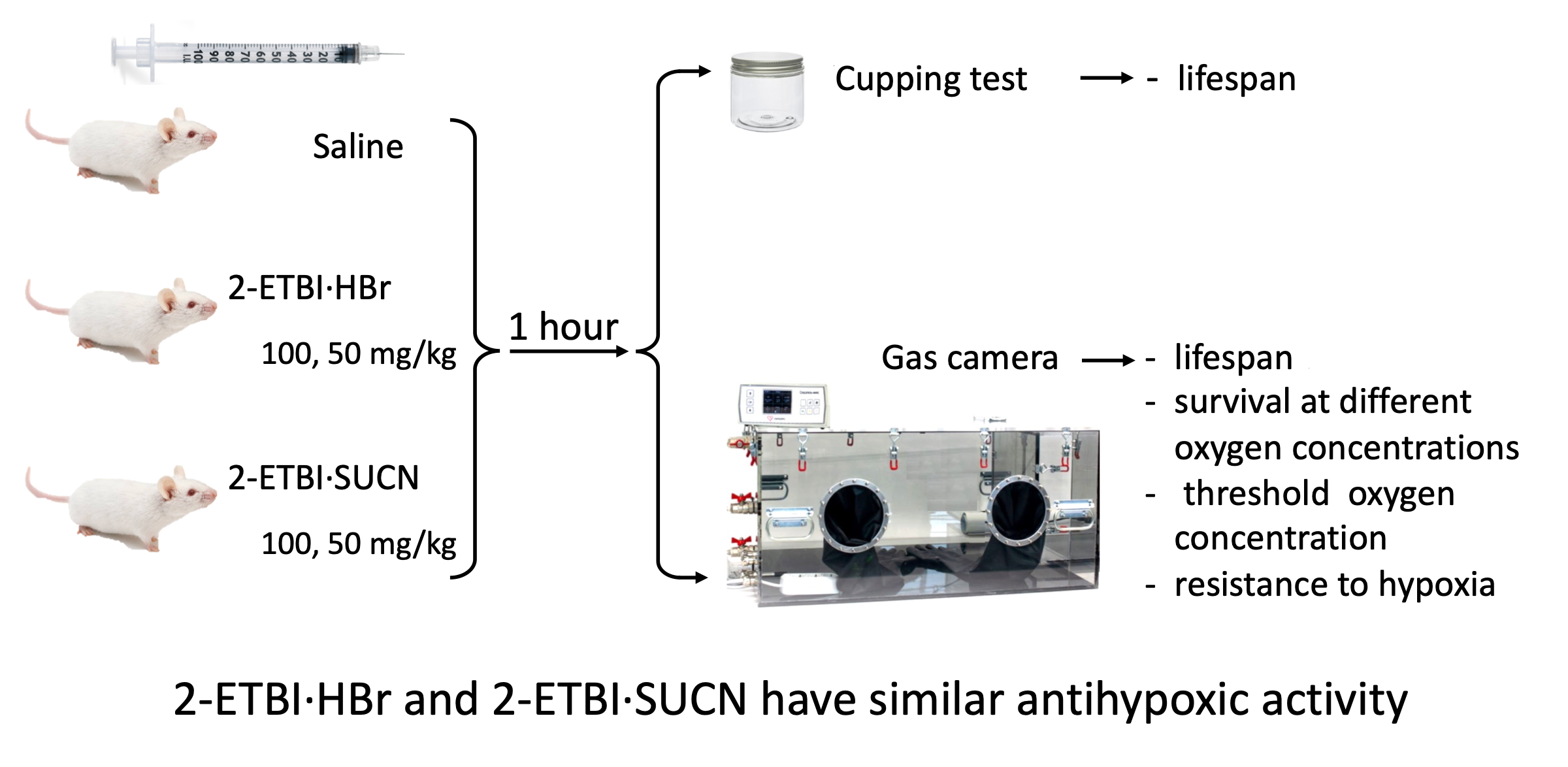
Materials and Methods: The experiments were performed on 86 white outbred male mice weighing 20-22 g. Several groups of 8-12 mice were formed. Two of them were served as controls, and the rest received one of the compounds (2-ETBI•HBr or 2-ETBI•SUCN) 50 or 100 mg/kg once intraperitoneally 1 hour before hypoxic exposure. The doses were chosen on the base of the described maximum of antihypoxic effect of 2-ethylthiobenzimidazole. We also took into account acute toxicity (LD50), which was 450±35 mg/kg for 2-ETBI•HBr and 520±30 mg/kg for 2-ETBI•SUCN. Acute normobaric hypoxic hypoxia with hypercapnia was reproduced by placing mice in individual glass chambers with a volume of 0.25 L. The lifespan of the animals was recorded in minutes. Acute normobaric hypoxic hypoxia without hypercapnia was created using a hermetic gas chamber for laboratory studies with automatic monitoring, control and maintenance of the hypoxic gas composition. Normobaric hypoxia in the chamber was modeled by reducing the oxygen concentration in the gas mixture from 21% to 2% by displacing it with nitrogen. Lifespan, survival at different oxygen concentrations, threshold oxygen concentration, and resistance to hypoxia were estimated.
Results: In the model of acute hypoxia with hypercapnia (“cupping test”) both 2-ETBI•HBr and 2-ETBI•SUCN showed a moderate antihypoxic effect. It turned out that the dose of 50 mg/kg of both compounds was more effective. Under normobaric hypoxic hypoxia in the gas exchange chamber 2-ETBI∙HBr increased the lifespan by 58%, 2-ETBI•SUCN – by 46%, but statistical differences between these values were not noted. Both compounds increased the lifespan of mice at critical oxygen concentrations (6→2%) more than 2 times. At the same time, the tolerance to low oxygen concentrations increased from its concentration of 4.56% in the control to 2.97% after administration of 2-ETBI•HBr and to 3.23% after 2-ETBI•SUCN administration. Finally, both antihypoxants also increased the overall score of resistance to hypoxia in points more than 2 times.
Conclusion: 2-Ethylthiobenzimidazole, regardless of the anionic part of the molecule, exhibits a pronounced antihypoxic effect in tow models of normobaric hypoxic hypoxia in mice. Its value for 2-ETBI•HBr and 2-ETBI•SUCN was similar in the model of normobaric hypoxia in a gas chamber. The minimum oxygen concentration at which mice survived was about 3%. In ”cupping hypoxia” with hypercapnia, both antihypoxants showed greater effectiveness at a dose of 50 mg/kg than 100 mg/kg. Thus, succinate does not make a significant contribution to the antihypoxic activity of the 2-ethylthiobenzimidazole.
Graphical Abstract
Keywords:
gas chamber, hydrobromide, hypoxia with hypercapnia, mice, normobaric hypoxiaReferences
Buznik GV (2022) Does succinate as a component of a drug increase the effectiveness of treating asthenic spectrumdisorders in patients with somatic injuries? Reviews of Clinical Pharmacology and Drug Therapy [Obzory po Klinicheskoi Farmakologii i Lekartsvennoj Terapii] 20(1): 89–98. https://doi.org/10.17816/RCF20189-98 [in Russian]
Buznik GV, Shabanov PD (2022) Succinate-containing antihypoxants in the treatment of asthenic disorders. Bulletin of the National Academy of Sciences of the Kyrgyz Republic [Izvestiya Natsional’noi Akademii Nauk Kyrgyzskoi Respubliki] S6: 27–32. [in Russian]
Dekkanova VD, Danilov VR, Polyakova MS (2015) The influence of metaprote, succinic acid and their combination on the body’s resistance to acute hypoxic hypoxia. Bulletin of Medical Internet Conferences [Byulleten’ Meditsinskikh Internet-Konferentsii] 5(12): 2015-12-4017-T-5517. [in Russian]
Detraux D, Renard P (2022) Succinate as a new actor in pluripotency and early development? Metabolites 12(7): 651. https://doi.org/10.3390/metabo12070651 [PubMed] [PMC]
Karkishchenko NN, Karkishchenko VN, Shustov EB, Kapanadze GD, Reviakin AO, Semenov KhKh, Bolotova VC, Dulya MS (2017) Biomedical (Preclinical) Study of Antihypoxic Activity of Drugs: Methodological Recommendations MR 21-44-2017. FMBA of Russia, Moscow, 97 pp. [in Russian]
Kashirin AO, Krylova IB, Selina EN, Polukeev VA, Zarubina IV, Bychkov ER, Shabanov PD (2021) Antihypoxic effect of new synthetic derivatives of 7-alkoxycoumarin and 4-aminocoumarin in acute hypobaric hypoxia in rats. Reviews on Clinical Pharmacology and Drug Therapy [Obzory po Klinicheskoi Farmakologii i Lekartsvennoi Terapii] 19(4): 413–420. https://doi.org/10.17816/RCF194413-420 [in Russian]
Kim AE, Shustov EB, Ganapolsky VP (2024) Pathogenetic and pharmacodynamic features of the application of succinic acid derivatives for various diseases of the cardiovascular and nervous systems. Psychopharmacology and Biological Narcology [Psikhofarmakologiya i Biologicheskaya Narkologiya] 15(1): 7–22. https://doi.org/10.17816/phbn626718 [in Russian]
Kozhurin MV, Zarubina IV, Shabanov PD (2024) Antioxidant effects of 2-ethylthiobenzimidazole and a complex of succinic acid salts in rats pre-trained to hypoxia during acute oxygen starvation. Psychopharmacology and Biological Narcology [Psikhofarmakologiya i Biologicheskaya Narkologiya] 15(3): 179–188.https://doi.org/10.17816/phbn635858 [in Russian]
Rashkevich OS, Volchek AV (2024) Antihypoxic effect of a combination of bemithil and thymoquinone under conditions of hypercapnic hypoxia. Bulletin of the National Academy of Sciences of Belarus. Series of Medical Sciences [Izvestiya Natsional’noi Akademii Nauk Belarusi. Seriya Meditsinskikh Nauk] 21(4): 345–352.https://doi.org/10.29235/1814-6023-2024-21-4-345-352 [in Russian]
Sadykov RF (2009) Antihypoxic activity of 1-(thietanyl-3)2-benzimidazole derivatives. Kazan Medical Journal[Kazanskii Meditsinskii ZHurnal] 90(1): 53–57. [in Rusian]
Shabanov PD (2023) Department of pharmacology of the military medical academy in the 21st century: New achievements based on historical traditions (2000–2023). Psychopharmacology and Biological Narcology [Psikhofarmakologiya i Biologicheskaya Narkologiya] 14(4): 263–284. https://doi.org/10.17816/phbn623094 [in Russian]
Shabanov PD, Kozhurin MV, Zarubina IV (2024) Antihypoxic effects of 2-ethylthiobenzimidazole and a complex of succinic acid salts in rats pre-trained to hypoxia during acute oxygen starvation. Bulletin of the Smolensk State Medical Academy [Vestnik Smolenskoi Gosudarstvennoi Meditsinskoi Akademii] 23(3): 23–32.https://doi.org/10.37903/vsgma.2024.3.3 [in Russian]
Sosin DE, Parfenov VA, Evseev AV, Pravdivtsev VA, Evseeva MA (2013) Antihypoxic agent. Patent RU2472503C1. https://patents.google.com/patent/RU2472503C1/ru [in Russian]
Shakhmardanova SA, Galenko-Yaroshevsky PA (2017) N-alkenylimidazole metal complex derivatives as effective agents for the hypoxic conditions. Research Result: Pharmacology and Clinical Pharmacology 3(1): 49-72. https://doi.org/10.18413/2500-235X-2017-3-1-49-72
Tsublova EG, Yasnetsov VikV, Skachilova SYa, Yasnetsov VlV (2012) A drug with actoprotective, antihypoxic, neuroprotective, antiamnestic and thermoprotective activity. Patent RU2460529C1. https://patenton.ru/patent/RU2460529C1 [in Rusiian]
Vorobyova VV, Levchenkova OS, Lenskaya KV (2024) Role of bioenergetic hypoxia in the morphological transformation of the myocardium during vibration disease. Psychopharmacology and Biological Narcology [Psikhofarmakologiya i Biologicheskaya Narkologiya] 15(1): 69–78. https://doi.org/10.17816/phbn625963 [in Russian]
Zarubina IV, Lukk MV, Shabanov PD (2012) Antihypoxic and antioxidant effects of exogenous succinic acid and aminothiol succinate-containing antihypoxants. Bulletin of Experimental Biology and Medicine 153(3): 336–339. https://doi.org/10.1007/s10517-012-1709-5 [PubMed]
Published
How to Cite
Issue
Section
License
Copyright (c) 2025 Lyubimov AV, Krylova IB, Selina EN, Shabanov PD

This work is licensed under a Creative Commons Attribution 4.0 International License.
 Русский
 English