
Neuroprotective activity of Styphnolobium japonicum fruit extract in cerebral ischemia-reperfusion injury
Authors
-
Sergey M. Gulyaev
Institute of General and Experimental Biology of the Siberian Branch of the Russian Academy of Sciences
 https://orcid.org/0000-0001-8412-5799
-
Olga L. Saybel
All-Russian Scientific Research Institute of Medicinal and Aromatic Plants
https://orcid.org/0000-0001-8059-5064
-
Andrey I. Radimich
All-Russian Scientific Research Institute of Medicinal and Aromatic Plants
https://orcid.org/0000-0002-1139-8902
-
Tamara D. Dargaeva
All-Russian Scientific Research Institute of Medicinal and Aromatic Plants
https://orcid.org/0000-0002-0722-9479
-
Tamara D. Rendyuk
Sechenov First Moscow State Medical University (Sechenov University)
https://orcid.org/0000-0002-0359-3847
DOI:
https://doi.org/10.18413/rrpharmacology.11.797Abstract
Introduction: Recently, there has been a growing interest in the study of flavonoids with neuroprotective activity. Fruits of the Styphnolobium japonicum can be used as the source of such flavonoids. The research aim was to determine the neuroprotective effect of Styphnolobium japonicum fruit extract (SFE) in rats with cerebral ischemia-reperfusion.
Materials and Methods: In the experiment, Wistar rats were used, divided into groups: 1 – sham operated rats, water; 2 – control, water + cerebral ischemia-reperfusion (I-R); 3 – rats treated with SFE at a dose of 200 mg/kg + I-R; 4 – rats treated with ginkgo biloba extract (GBE) at a dose of 50 mg/kg + I-R. The I-R model was reproduced in rats by the occlusion of the common carotid arteries with hypotension. The SFE effect on the neurological status of animals and their behavior was determined using neurological and ethological tests such as an open field (OF) and an elevated plus maze (EPM) ones. The SFE effect on the brain morphofunctional state in the rats with ischemia-reperfusion was determined by the pathomorphological examination.
Results: The neurological deficit in the test groups was 3 times lower than the control values, the indicators of motor activity in the OF test were 2 times higher; the level of anxiety in rats in the EPM test was lower: the number of visits to the open arms of the maze and the duration of stay there were 3.8 times and 10 times greater, respectively, compared with those in the control. In the test group rats, the proportions of regressive forms of neurons in the cortex and hippocampus were lower than in the control rats. The dominant component here is sophoraflavonoloside.
Conclusion: SFE has a neuroprotective effect on rats with cerebral ischemia-reperfusion. The SFE neuroprotective effect may presumably be due to the activity of kaempferol glycosides, the dominant of which is sophoraflavonoloside.
Graphical Abstract
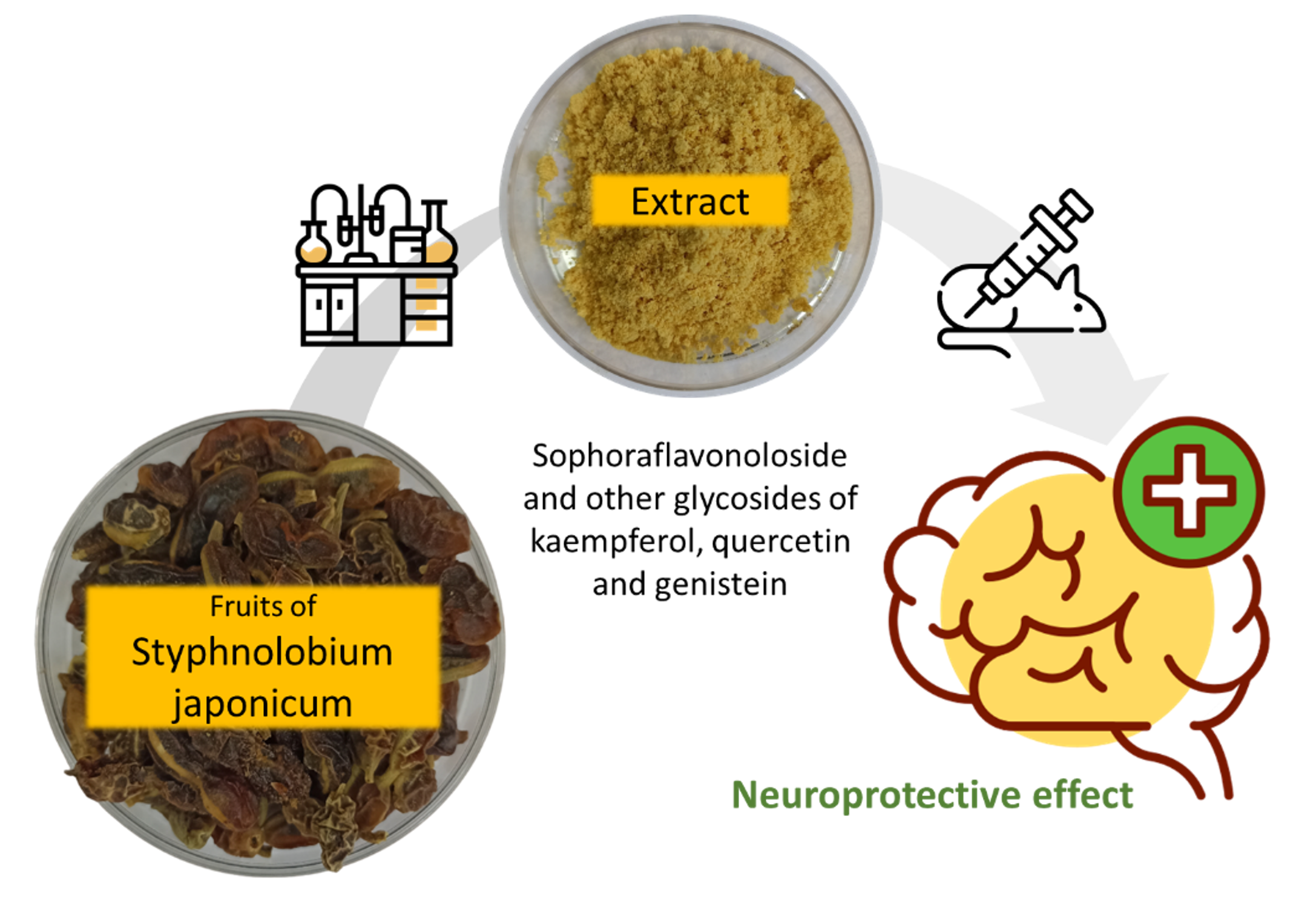
Keywords:
Styphnolobium japonicum, sophoraflavonoloside, kaempferol glycosides, cerebral ischemia-reperfusion, neuroprotection, morphologyReferences
Adamu A, Li S, Gao F, Xue G (2024) The role of neuroinflammation in neurodegenerative diseases: current understanding and future therapeutic targets. Frontiers in Aging Neuroscience 16: 1347987. https://doi.org/10.3389/fnagi.2024.1347987
Bederson JB, Pitts LH, Tsuji M, Nishimura MC, Davis RL, Bartkowski H (1986) Rat middle cerebral artery occlusion: evaluation of the model and development of a neurologic examination. Stroke 17(3): 472-476. https://doi.org/10.1161/01.str.17.3.472
Buresh Ya, Bureshova O, Houston DP (1991) Methods And Basic Experiments in Studying the Brain and Behavior. Moscow, 399 pp. [in Russian]
Cai H, Zhao MY, Wang CZ, Wang JN, Tang WP, Mao WB, Feng S, Ding FF, Ke J, Shi TT, Wang Y, Yu TH, Xu WY, Wang LN, Chen J, Gong YJ, Zhang S, Xu JF, Chen GJ, Qian Y, Ding YY (2025) Nrf2/STAT3-mediated activation of SLC6A3 underlies the neuroprotective effect of quercetin in ischemic stroke. Phytomedicine 145: 157061. https://doi.org/10.1016/j.phymed.2025.157061
Chaubey S, Singh L (2025) Deciphering the mechanisms underlying the neuroprotective potential of kaempferol: a comprehensive investigation. Naunyn-Schmiedeberg’s Archives of Pharmacology 398(3): 2275-2292. https://doi.org/10.1007/s00210-024-03515-8
Cheng N, Bell L, Lamport DJ, Williams CM (2022) Dietary flavonoids and human cognition: A meta-analysis. Molecular Nutrition & Food Research 66(21): e2100976. https://doi.org/10.1002/mnfr.202100976
Cherdak MA, Mkhitaryan EA, Sharashkina NV, Ostapenko VS, Isaev RI, Seifedinova AB, Runikhina NK, KotovskayaYuV, Tkacheva ON, Yakhno NN (2024) The prevalence of cognitive disorders in older patients in the Russian Federation. S.S. Korsakov Journal of Neurology and Psychiatry. Special editions 124(4-2): 5-11. [in Russian] https://doi.org/10.17116/jnevro20241240425
Dabeek WM, Marra MV (2019) Dietary quercetin and kaempferol: bioavailability and potential cardiovascular-related bioactivity in humans. Nutrients 11(10): 2288. https://doi.org/10.3390/nu11102288
Danis EG, Mogulkoc R, Baltaci AK (2025) Flavonoids in brain ischemia-reperfusion and their effect on kinases as signaling pathway activity. CNS & Neurological Disorders – Drug Targets 10(24): 750-765. https://doi.org/10.2174/0118715273374176250414051135
Guo N, Chen Z, Cao S-Q, Shang F-D (2024) Sophora japonica L. bioactives: Chemistry, sources, and processing techniques. Food Frontiers 5: 1166–1187. https://doi.org/10.1002/fft2.367
Flanagan E, Müller M, Hornberger M, Vauzour D (2018) Impact of flavonoids on cellular and molecular mechanisms underlying age-related cognitive decline and neurodegeneration. Current Nutrition Reports 7(2): 49-57. https://doi.org/10.1007/s13668-018-0226-1
Kim GH, Kim JE, Rhie SJ, Yoon S (2015) The role of oxidative stress in neurodegenerative diseases. Experimental Neurobiology 24(4): 325-340. https://doi.org/10.5607/en.2015.24.4.325
Li Y, Zhang JJ, Chen RJ, Chen L, Chen S, Yang XF, Min JW (2022) Genistein mitigates oxidative stress and inflammation by regulating Nrf2/HO-1 and NF-κB signaling pathways in hypoxic-ischemic brain damage in neonatal mice. Annals of Translational Medicine 10(2): 32. https://doi.org/10.21037/atm-21-4958
Merkulov GA (1969) Course of pathohistological technique, Leningrad, 423 pp. [in Russian] Paxinos G, Watson C (2007) The Rats Brain in Stereotaxic Coordinates. New York, 451 pp.
Saybel OL, Gulyaev SM, Radimich AI, Ferubko EV, Dargaeva TD (2024) Determination of the flavonoid composition of Sophora japonica fruit extract and assessment of its cerebroprotective activity. Chemical and Pharmaceutical Journal 12(58): 29-34. https://doi.org/10.30906/0023-1134-2024-58-12-29-34 [in Russian]
Shadman J, Haghi-Aminjan H, Alipour MR, Panahpour H (2025) The neuroprotective mechanisms of kaempferol in experimental ischemic stroke: a preclinical systematic review. Molecular Neurobiology 62(8): 9527-9544. https://doi.org/10.1007/s12035-025-04848-y
Yang J, Ma Y.M, Yang L, Li P, Jing L, Li PA, Zhang JZ (2025) Quercetin alleviates cerebral ischemia and reperfusion injury in hyperglycemic animals by reducing endoplasmic reticulum stress through activating SIRT1. PLoS One 20(4): e0321006. https://doi.org/10.1371/journal.pone.0321006
Yang SE, Lien J, Tsai CW, Wu CR (2022) Therapeutic potential and mechanisms of novel simple o-substituted isoflavones against cerebral ischemia reperfusion. International Journal of Molecular Sciences 23(18): 10394. https://doi.org/10.3390/ijms231810394
Zeng ZJ, Lin X, Wang PQ, Chen X, Shen CX, Li Y, Gao W (2025) Discovery of a novel MARK4 antagonist from safflower to improve ischemic stroke by inhibiting microglial NLRP3 inflammasome activation. Phytomedicine 144: 156909. https://doi.org/10.1016/j.phymed.2025.156909
Published
How to Cite
Issue
Section
License
Copyright (c) 2025 Gulyaev SM, Saybel OL, Radimich AI, Dargaeva TD, Rendyuk TD

This work is licensed under a Creative Commons Attribution 4.0 International License.
 Русский
 English