
Evaluation of the anxiolytic properties of benzimidazole-2-thioethanones, 2-alkylthio- and 2-alkylsulfonylbenzimidazoles
Authors
-
Dmitriy V. Maltsev
Volgograd State Medical University
 https://orcid.org/0000-0002-2005-6621
-
Kristina I. Adzhienko
Volgograd State Medical University
https://orcid.org/0009-0003-2860-8456
-
Maxim A. Perfiliev
Volgograd State Medical University
https://orcid.org/0000-0002-5326-3299
-
Dmitriy A. Nekrasov
Volgograd State Medical University
https://orcid.org/0000-0002-1722-011X
-
Maria O. Maltseva
Volgograd State Medical University
https://orcid.org/0000-0002-4173-7143
- Karina R. Magomedova Volgograd State Medical University
-
Raul I. Musaev
Volgograd State Medical University
https://orcid.org/0009-0006-3973-0184
-
Pavel M. Vassiliev
Volgograd State Medical University
https://orcid.org/0000-0002-8188-5052
-
Olga N. Zhukovskaya
Southern Federal University
https://orcid.org/0000-0003-2485-2139
-
Alexander A. Spasov
Volgograd State Medical University
https://orcid.org/0000-0002-7185-4826
DOI:
https://doi.org/10.18413/rrpharmacology.12.1156Abstract
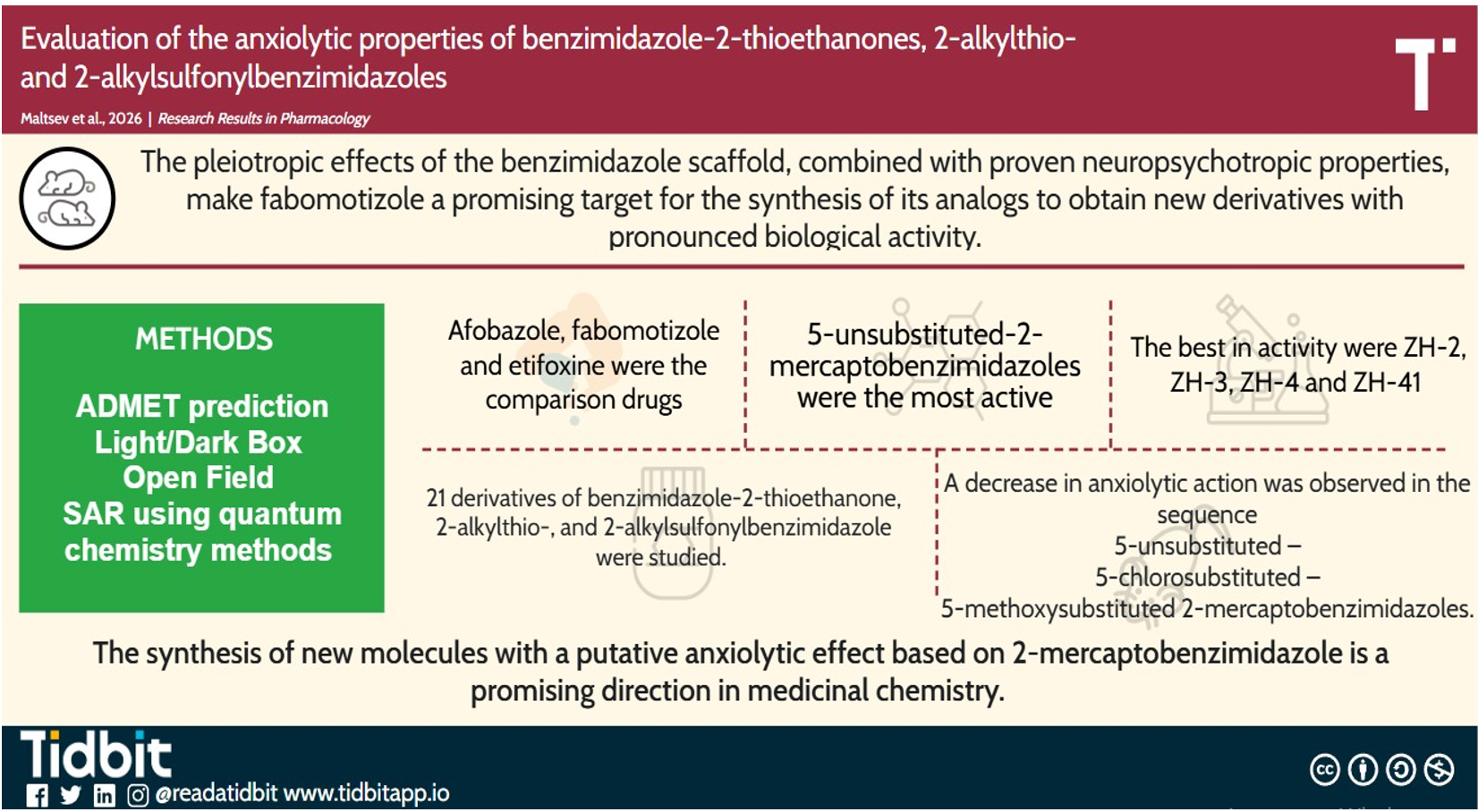
Introduction: Fabomotizole is an anxyolytic drug produced in Russia, a 2-mercaptobenzimidazole derivative. The pleiotropic effects of the benzimidazole scaffold, combined with proven neuropsychotropic properties, make fabomotizole a promising target for the synthesis of its analogs to obtain new derivatives with pronounced biological activity.
Materials and Methods: The study involved 125 white outbred male mice, randomly divided into 25 experimental groups (n=5). Twenty-one derivatives of benzimidazole-2-thioethanone, 2-alkylthio-, and 2-alkylsulfonylbenzimidazole were studied. The screening dose was calculated at the level of 1/100 of LD50, determined in silico by the consensus ADMET prediction. The behavioral patterns of the animals were assessed in vivo in Light/Dark Box and Open Field in comparison with etifoxine (50 mg/kg), fabomotizole (20 mg/kg), and phenazepam (0.01 mg/kg). In the final stage, the studied structures were optimized using quantum chemistry methods for subsequent analysis of the structure-activity relationship.
Results and Discussion: The most active derivatives of 2-mercaptobenzimidazole were derivatives of 5-unsubstituted-2-mercaptobenzimidazole: ZH-2, ZH-3, ZH-4, and ZH-41. Among all the studied compounds, a decrease in anxiolytic effect was observed in sequence: 5-unsubstituted – 5-chloro-substituted – 5-methoxy-substituted 2-mercaptobenzimidazoles. A study of the mercaptobenzimidazole fragment using molecular mechanics and quantum chemistry methods revealed that the addition of a substituent to the benzene ring leads to a redistribution of the electron density of cyclic structures.
Conclusion: The synthesis of new molecules with a putative anxiolytic effect based on 2-mercaptobenzimidazole is a promising direction in medicinal chemistry. The most active compounds are those without a substituent at position 5 of the benzimidazole ring.
Graphical Abstract
Keywords:
Open Field, Light/Dark Box, ADMET, 2-mercaptobenzimidazole, quantum chemistry, afobazole, phenazepam, etifoxineReferences
Alwaili MA, Abu-Almakarem AS, Aljohani S, Alkhodair SA, Al-Bazi MM, Eid TM, Alamri J, Mobasher MA, Algarzae NK, A Khayyat AI, Alshaygy LS, El-Said KS (2024) Avenanthramide-C ameliorate doxorubicin-induced hepatotoxicity via modulating Akt/GSK-3β and Wnt-4/β-Catenin pathways in male rats. Frontiers in Molecular Biosciences 11: 1507786. https://doi.org/10.3389/fmolb.2024.1507786 [PubMed] [PMC]
Alzhrani ZMM, Alam MM, Nazreen S (2022) Recent advancements on benzimidazole: A versatile scaffold in medicinal chemistry. Mini Reviews in Medicinal Chemistry 22(2): 365–386. https://doi.org/10.2174/1389557521666210331163810 [PubMed]
da Silva DM, Sanz G, Vaz BG, de Carvalho FS, Lião LM, de Oliveira DR, da Silva Moreira LK, Cardoso CS, de Brito AF, da Silva DPB, da Rocha FF, Santana IGC, Galdino PM, Costa EA, Menegatti R (2018) Tert-butyl 4-((1-phenyl-1H-pyrazol-4-yl) methyl) piperazine-1-carboxylate (LQFM104) – New piperazine derivative with antianxiety and antidepressant-like effects: Putative role of serotonergic system. Biomedicine & Pharmacotherapy 103: 546–552. https://doi.org/10.1016/j.biopha.2018.04.077 [PubMed]
Dabburu GR, Garg A, Singhal N, Kumar M (2025) Afobazole: a potential drug candidate which can inhibit SARS CoV-2 and mimicry of the human respiratory pacemaker protein. In Silico Pharmacology 13(1): 30. https://doi.org/10.1007/s40203-025-00316-6 [PubMed][PMC]
Daina A, Michielin O, Zoete V (2017) SwissADME: A free web tool to evaluate pharmacokinetics, drug-likeness and medicinal chemistry friendliness of small molecules. Scientific Reports 7(1): 1–13 [PubMed] [PMC]
Dong J, Wang NN, Yao ZJ, Zhang L, Cheng Y, Ouyang D, Lu AP, Cao DS (2018) ADMETlab: A platform for systematic ADMET evaluation based on a comprehensively collected ADMET database. Journal of Cheminformatics 10(1): 29. [PubMed] [PMC]
Campos-Cardoso R, Godoy LD, Lazarini-Lopes W, Novaes LS, Dos Santos NB, Perfetti JG, Garcia-Cairasco N, Munhoz CD, Padovan CM (2023) Exploring the light/dark box test: Protocols and implications for neuroscience research. Journal of Neuroscience Methods 384: 109748. https://doi.org/10.1016/j.jneumeth.2022.109748 [PubMed]
Kapitsa IG, Alymov AA, Savinkova EV, Voronina TA, Seredenin SB (2023) Experimental study of antidepressant properties of afobazole. Bulletin of Experimental Biology and Medicine 175(1): 59–62. https://doi.org/10.1007/s10517-023-05811-4 [PubMed]
Kryzhanovskii SA, Antipova TA, Vititnova MB, Nikolaev SV, Durnev AD (2021) Angiogenic effects of anxiolytic fabomotizole. Doklady. Biochemistry and Biophysics 497(1): 63–65. https://doi.org/10.1134/S1607672921020101 [PubMed]
Pires DEV, Blundell TL, Ascher DB (2015) pkCSM: Predicting small-molecule pharmacokinetic and toxicity properties using graph-based signatures. Journal of Medicinal Chemistry 58(9): 4066–4072 [PubMed] [PMC]
Spasov AA, Zhukovskaya ON, Maltsev DV, Miroshnikov MV, Skripka MO, Sultanova KT, Morkovnik AS (2020) Anxiolytic activity of 11h-2,3,4,5-tetrahydro[1,3]diazepino[1,2-a]benzimidazole and 2-mercaptobenzimizadole derivatives. Russian Journal of Bioorganic Chemistry 46(1): 107–114. https://doi.org/10.1134/S1068162020010124
Stewart JJP (2013) Optimization of parameters for semiempirical methods VI: More modifications to the NDDO approximations and re-optimization of parameters. Journal of Molecular Modeling 19: 1–32. [PubMed] [PMC]
Vasava MS, Bhoi MN, Rathwa SK, Jethava DJ, Acharya PT, Patel DB, Patel HD (2020) Benzimidazole: A milestone in the field of medicinal chemistry. Mini Reviews in Medicinal Chemistry 20(7): 532–565. https://doi.org/10.2174/1389557519666191122125453[PubMed]
Voronin MV, Kadnikov IA, Voronkov DN, Seredenin SB (2019) Chaperone Sigma1R mediates the neuroprotective action of afobazole in the 6-OHDA model of Parkinson's disease. Scientific Reports 9(1): 17020. https://doi.org/10.1038/s41598-019-53413-w [PubMed] [PMC]
Wahba AS, Asal DM, Mesbah NM, Abo-Elmatty DM, Hazem RM, Abdel-Hamed AR (2025) Afobazole alleviates streptozotocin-induced diabetic nephropathy in rats via hypoglycemic, antioxidant, anti-inflammatory, and anti-apoptotic properties: Role of the S1R/Nrf2 antioxidant axis. Life Sciences 363: 123410. https://doi.org/10.1016/j.lfs.2025.123410[PubMed]
Yang H, Lou C, Sun L, Li J, Cai Y, Wang Z, Li W, Liu G, Tang Y (2019) admetSAR 2.0: Web-service for prediction and optimization of chemical ADMET properties. Bioinformatics (Oxford, England) 35(6): 1067–1069. https://doi.org/10.1093/bioinformatics/bty707[PubMed]
Published
How to Cite
Issue
Section
License
Copyright (c) 2026 Maltsev DV, Adzhienko KI, Perfiliev MA, Nekrasov DA, Maltseva MO, Magomedova KR, Musaev RI, Vasiliev PM, Zhukovskaya ON, Spasov AA

This work is licensed under a Creative Commons Attribution 4.0 International License.
 Русский
 English