
Assessment of possible biomarkers of individual representatives of 1,4-dihydropyridines by methods of molecular docking and predictor analysis
Authors
-
Elena Yu. Bibik
Luhansk State Medical University named after St. Luke
 https://orcid.org/0000-0002-2622-186X
-
Ivan A. Nekrasa
LLC “IMC Clinic №.1”; Dmitrov
https://orcid.org/0000-0001-9980-126X
- Vladislav V. Bibik Regional Center for the Development of Giftedness “Intellectual Reserve of the Republic
-
Konstantin A. Frolov
Luhansk State Medical University named after St. Luke
https://orcid.org/0000-0002-8045-7582
-
Sergey G. Krivokolysko
Luhansk State University named after V.I. Dal
https://orcid.org/0000-0001-9879-9217
DOI:
https://doi.org/10.18413/rrpharmacology.11.571Abstract
Introduction: Some of the promising classes of chemical compounds for research are 1,4-dihydropyridines, which have potential biological activity and low toxicity. The use of modern technologies for the analysis of substances in silico makes it possible to predict their potential biological effects with a high degree of probability, thereby facilitating further preclinical studies.
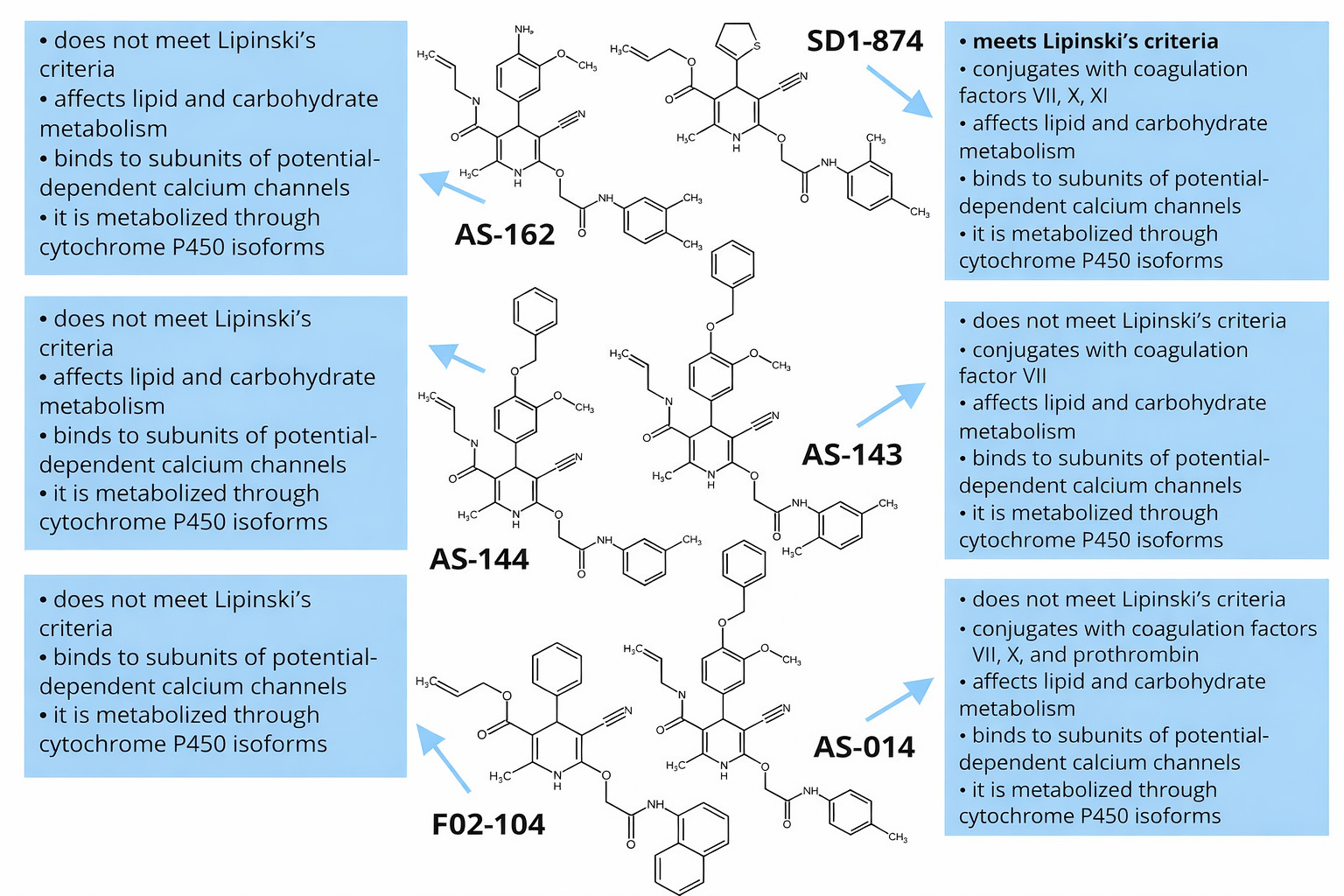
Materials and Methods: For the purpose of predictive analysis and molecular docking, 6 newcompounds of the 1,4-dihydropyridine group were selected with lab codes SD1-874, F02-104, AS-143, AS-014, AS-144, AS-162. The studied compounds were subjected to predictive analysisin silico. Based on its results, the ADMET (Absorption, Distribution, Metabolism, Excretion, Toxicity) parameters were predicted. PASS Online, Molinspiration Property Calculation Serviceand OSIRIS Property Explorer services were used for predictor analysis. Molecular docking was carried out using the GalaxyWEB Sagittarius service, followed by evaluation of the results usingthe RCSB Protein Data Bank and UniProt Consortium databases. Based on the results of the calculation of physical and chemical parameters, the presence of Lipinski’s criteria was evaluatedin all the samples studied.
Results and Discussion: Of the 6 compounds under consideration, the SD1-874 sample haspotential oral activity, according to Lipinski's criteria. Based on the results of predictive analysis in silico, all the studied substances, except SD1-874, are potentially capable of blocking calcium channels. SD1-874 probably has an effect on lipid and carbohydrate metabolism. Evaluating the results of molecular docking, three groups of proteins can be distinguished with which the studied samples can potentially conjugate: a group of proteins that regulate the processes of apoptosis, mitosis, and DNA transcription, a group of proteins that affect blood clotting, and a group that affects the metabolism of lipoproteins, lipids, and glucose. The ability to conjugate with calcium channel subunits is also noted; however, the probability of such an interaction by the molecular docking program is estimated as unlikely. All the studied compounds interact withvarious isoforms of cytochrome P450.
Conclusion. According to the results of predictor analysis and the results of molecular docking, among the 6 compounds of 1,4-dihydropyridines selected for analysis, the compound with lab codes SD1-874 is considered the most promising for further study due to the presence of oral bioactivity.
Graphical Abstract
Keywords:
preclinical studies, in silico analysis, 1,4-dihydropyridinesReferences
Bibik IV, Bibik EYu, Dotsenko VV, Frolov KA, Krivokolisko SG, Aksenov NA, Aksenova IV, Shcherbakov SV, Ovcharov SN (2021) Synthesis and analgesic activity of new heterocyclic cyanothioacetamide derivatives. Russian Journal of General Chemistry [Zhurnal Obshchei Khimii] 91 (2): 190–204. https://doi.org/10.31857/S0044460X21020025 [in Russian]
Bibik IV, Frolov KA, Dotsenko VV, Krivokolisko SG, Bibik EYu (2023) Pain-relieving and anti-edema properties of new derivatives of condensed 3-aminothieno[2,3-b]pyridines and 1,4-dihydropyridines. Acta Biomedica Scientifica 8 (4): 220–234. https://doi.org/10.29413/ABS.2023-8.4.24 [in Russian]
Bochev AV, Bibik EYu, Krivokolisko SG (2025) Comparison of in silico and in vivo results of a study of the embryotoxic and teratogenic effects of original 3-cyano-1,4-dihydropyridines, cyanothioacetamide derivatives. Experimental and Clinical Pharmacology 88 (1): 27–32. https://doi.org/10.30906/0869-2092-2025-88-1-27-32 [in Russian]
Bocheva AA, Bibik EYu, Krivokolisko SG (2023) Determination of biological targets and types of pharmacological activity of new partially hydrogenated pyridines, derivatives of α-cyanothioacetamide. Scientific and Medical Bulletin of the Central Black Earth Region [Nauchno-Meditsinskii Vestnik Tsentral’nogo Chernozem’ya] 24 (3): 37–43.https://doi.org/10.18499/1990-472X-2023-24-3-37-43 [in Russian]
Dotsenko VV, Krivokolysko BS, Bibik EY, Frolov KA, Aksenov NA, Aksenova IV, Krivokolysko SG (2023) Synthesis and in vivo evaluation of hepatoprotective effects of novel sulfur-containing 1,4-dihydropyridines and 1,2,3,4-tetrahydropyridines. Current Bioactive Compounds 19 (5): 73-88. https://doi.org/10.2174/1573407219666221017095803
Galaxy Seoklab (galaxy.seoklab.org)
Ketova ES, Myazina AV, Bibik EYu and Krivokolysko SG (2024) New compounds with a dihydropyridine framework as promising hypolipidemic and hepatoprotective agents. Research Results in Pharmacology 10(3): 61–71. https://doi.org/10.18413/rrpharmacology.10.483
Khedkar SA, Auti PB (2014) 1,4-Dihydropyridines: A class of pharmacologically important molecules. Mini-Reviews in Medicinal Chemistry 14 (3): 282–290. https://doi.org/10.2174/1389557513666131119204126 [PubMed]
Krivokolisko DS, Dotsenko VV, Bibik EYu, Myazina AV, Krivokolisko SG, Vasilin VK, Pankov AA, Aksenov NA, Aksenova IV (2022) Synthesis, structure and analgesic activity of ethyl esters of 4-({4-(2-furyl)-5-cyano-1,4-dihydropyridin-3-yl}carboxamido)benzoic acid. Russian Journal of General Chemistry [Zhurnal Obshcheo Khimii] 92 (1): 72–91. https://doi.org/10.31857/S0044460X22010097 [in Russian]
Krivokolysko DS, Dotsenko VV, Bibik EY, Samokish AA, Venidiktova YS, Frolov KA, Krivokolysko SG, Pankov AA, Aksenov NA, Aksenova IV (2022) New hybrid molecules based on sulfur-containing nicotinonitriles: synthesis, analgesic activity in acetic acid-induced writhing test, and molecular docking studies. Russian Journal of Bioorganic Chemistry 48 (3): 628–635. https://doi.org/10.1134/S1068162022030104
Krivokolysko DS, Dotsenko VV, Bibik EYu, Myazina AV, Krivokolysko SG, Vasilin VK, Pankov AA, Aksenov NA, Aksenova IV (2021) Synthesis, structure, and analgesic activity of 4-(5-cyano-{4-(fur-2-yl)-1,4-dihydropyridin-3-yl}carboxamido)benzoic acids ethyl esters. Russian Journal of General Chemistry 91 (12): 2588–2605. https://doi.org/10.1134/S1070363221120306
Lipinski CA, Lombardo F, Dominy BW, Feeney PJ (1997) Experimental and computational approaches to estimate solubility and permeability in drug discovery and development settings. Advanced Drug Delivery Reviews 23 (1-3): 3-25. https://doi.org/1016/s0169-409x(00)00129-0 [PubMed]
Molinspiration Property Calculator (molinspiration.com/cgi/properties)
Oleynik IS, Bibik EYu, Dotsenko VV, Strelkov VD, Lukina DYu, Frolov KA, Krivokolisko SG, Vasilin VK (2023) Synthesis, antiexudative and anti-inflammatory properties of substituted 2-methyl-4-(2-furyl)-N-(2,4-dichlorophenyl)-5-cyano-1,4-dihydropyridine-3-carboxamides. Bulletin of the South Ural State University [Vestnik Yuzhno-Ural’skogo Gosudarstvennogo Universiteta] 15(3): 118–138. https://doi.org/10.14529/chem230306. [in Russian]
Organic Chemistry Portal (organic-chemistry.org/prog/peo)
PASS Online (way2drug.com/PassOnline/predict.php)
Protein Data Bank (rcsb.org)
Schlander M, Hernandez-Villafuerte K, Cheng CY, Mestre-Ferrandiz J, Baumann M (2021) How much does it cost to research and develop a new drug? A systematic review and assessment. Pharmacoeconomics 39 (11): 1243–1269. https://doi.org/1007/s40273-021-01065-y [PubMed] [PMC]
Simoens S, Huys I (2021) R&D costs of new medicines: a landscape analysis. Frontiers in Medicine 26 (8): 760–762. https://doi.org/3389/fmed.2021.760762 [PubMed] [PMC]
UniProt (uniprot.org)
Published
How to Cite
Issue
Section
License
Copyright (c) 2025 Bibik EYu, Nekrasa IA, Bibik VV, Frolov KA, Krivokolysko SG

This work is licensed under a Creative Commons Attribution 4.0 International License.
 Русский
 English