Modeling of cisplatin-induced acute kidney injury and its correction using polydatin
Авторы
-
Aleksandr S. Netrebenko
Belgorod Regional Oncology Clinic
 https://orcid.org/0000-0003-2212-0508
-
Tatiana G. Pokrovskaya
Belgorod State National Research University
https://orcid.org/0000-0001-6802-5368
-
Elena G. Netrebenko
Belgorod Regional Oncology Clinic
https://orcid.org/0009-0003-3612-4398
-
Margarita V. Edamenko
Belgorod Regional Oncology Clinic
https://orcid.org/0009-0005-1517-2133
-
Dmitriy B. Kuzmin
Belgorod Regional State City Hospital №2
https://orcid.org/0000-0002-0257-6340
- Aleksandr V. Paulauskas
-
Dmitry S. Skuryatin
Belgorod State National Research University
https://orcid.org/0009-0001-1599-4795
-
Ekaterina I. Skuryatina
Belgorod State National Research University
https://orcid.org/0009-0001-5193-4618
-
Igor A. Efremenko
Belgorod State National Research University
https://orcid.org/0009-0005-5056-2866
-
Tatyana V. Avtina
https://orcid.org/0000-0003-0509-5996
DOI:
https://doi.org/10.18413/rrpharmacology.12.1072Аннотация
Introduction: Cisplatin is a key drug used for anticancer therapy. However, its use is often accompanied by the development of acute kidney injury. The aim of this study was to develop an optimal model of cisplatin-induced kidney injury in rats and use it to study the nephroprotective properties of polydatin.
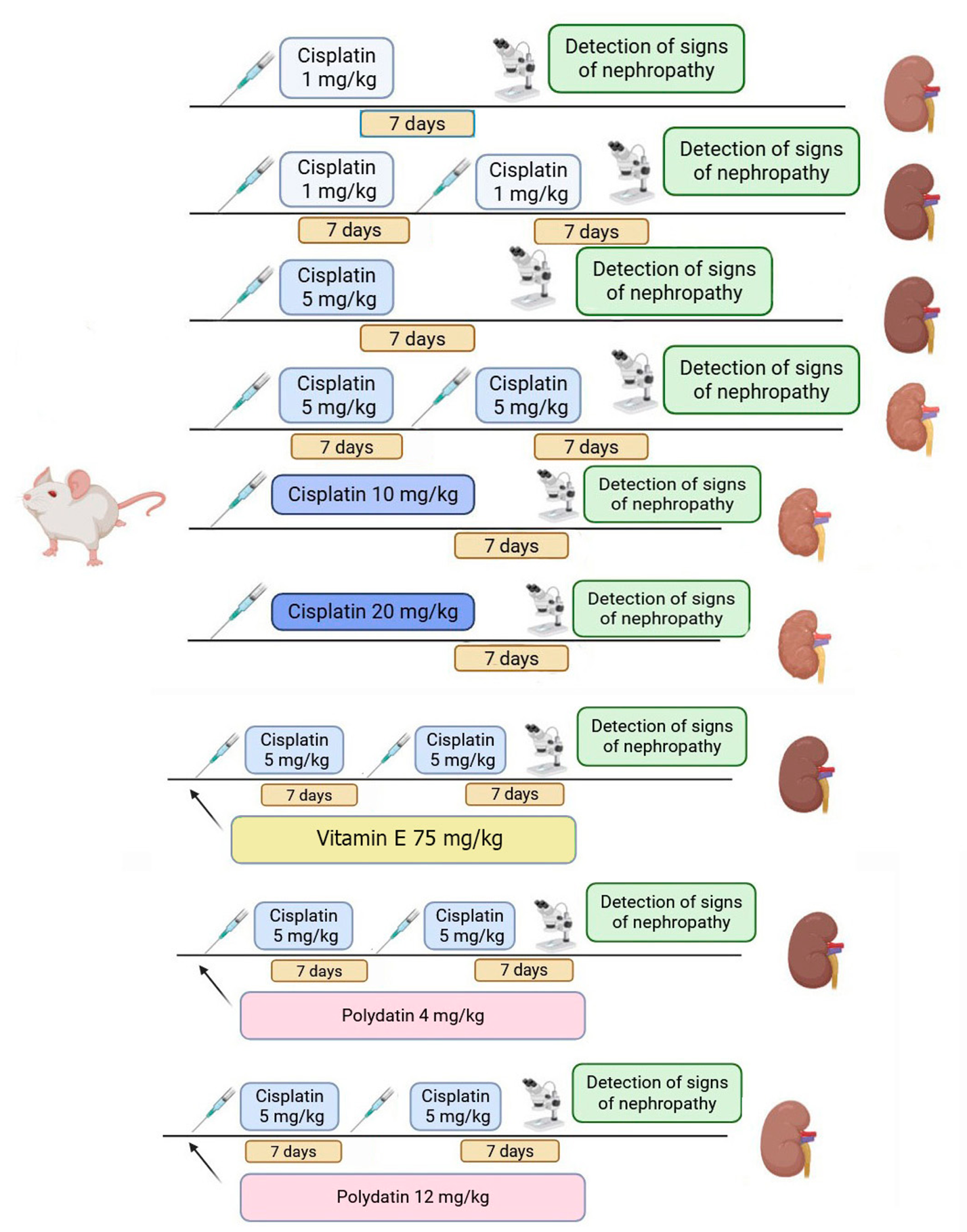
Materials and Methods. The experiment was performed in 100 male Wistar rats. To test the cisplatin-induced acute kidney injury model, seven groups (n=10) were formed. Animals were administered cisplatin intraperitoneally at doses of 1 mg/kg, 5 mg/kg, 10 mg/kg, and 20 mg/kg once or twice on days 1 and 8. Nephrotoxicity was corrected using polydatinat doses of 4 mg/kg and 12 mg/kg. Alpha-tocopherol acetate at a dose of 75 mg/kg was used as a reference drug. The test drug and the reference drug were administered intragastrically daily for 14 days. Nephroprotection was assessed based on the following parameters: creatinine, urea, potassium and sodium ions in the blood serum, glomerular filtration rate, fractional sodium extraction, and renal parenchyma microcirculation.
Results and Discussion. The optimal model of cisplatin-induced acute kidney injury was the one in which cisplatin was administered at a dose of 5 mg/kg on days 1 and 8 of the experiment. This was evidenced by an increase in creatinine level to 124.0 ± 8.6 μmol/L and urea to 20.3 ± 1.2 mmol/L, a decrease in glomerular filtration rate to 0.08 ± 0.01 mL/minand a 2-fold deterioration in microcirculation. Other models were significantly inferior in representativeness. Polydatindemonstrated dose-dependent nephroprotective properties, which was confirmed by improvement in laboratory and instrumental parameters.
Conclusions. The use of cisplatin at a dose of 5 mg/kg intraperitoneally on days 1 and 8 results in optimal modeling of cisplatin-induced acute kidney injury in rats in the experiment. The potential of intragastric use of polydatin for nephroprotection in cisplatin-induced acute kidney injury has been proven in dosages of 4 mg/kg and 12 mg/kg per day for 14 days.
Графическая аннотация
Ключевые слова:
cisplatin, acute kidney injury, nephrotoxicity, microcirculation, polydatinБиблиографические ссылки
Abdel-Rahman Mohamed A, Khater SI, Metwally MMM, El-Kholy AA, Sheikh BY, Kassab RB, Abdel Moneim AE (2022) TGF-β1, NAG-1, and antioxidant enzyme expression alterations in cisplatin-induced nephrotoxicity in a rat model: Comparative modulating role of melatonin, vitamin E, and ozone. Gene 820: 146293. https://doi.org/10.1016/j.gene.2022.146293 [PubMed]
Abo-Elmaaty AMA, Behairy A, El-Naseery NI, Abdel-Daim MM (2020) The protective efficacy of vitamin E and cod liver oil against cisplatin-induced acute kidney injury in rats. Environmental Science and Pollution Research International 27(35): 44412–44426. https://doi.org/10.1007/s11356-020-10351-9 [PubMed]
Altındağ F, Ergen H (2023) Sinapic acid alleviates cisplatin-induced acute kidney injury by mitigating oxidative stress and apoptosis. Environmental Science and Pollution Research International 30(5): 12402–12411. https://doi.org/10.1007/s11356-022-22940-x [PubMed]
Bratchikov OI, Tyuzikov IA, Dubonos PA (2021) Nutritional supplementation of the pharmacotherapy of prostate diseases. Research Results in Pharmacology 7(3): 1–14. https://doi.org/10.3897/rrpharmacology.7.67465
Burnasheva EV, Shatokhin YV, Snezhko IV, Solodkiy VA, Vardanyan AV, Mikhailova IN (2018) Kidney damage during antitumor therapy. Nephrology 22(5): 17–24. https://doi.org/10.24884/1561-6274-2018-22-5-17-24 [in Russian]
Darwish MA, Abo-Youssef AM, Khalaf MM, Abo-Saif AA, Saleh IG, Abdelghany TM (2017) Vitamin E mitigates cisplatin-induced nephrotoxicity due to reversal of oxidative/nitrosative stress, suppression of inflammation and reduction of total renal platinum accumulation. Journal of Biochemical and Molecular Toxicology 31(1): e21833. https://doi.org/10.1002/jbt.21833 [PubMed]
dos Santos NA, Carvalho Rodrigues MA, Martins NM, dos Santos AC (2012) Cisplatin-induced nephrotoxicity and targets of nephroprotection: An update. Archives of Toxicology 86(8): 1233–1250. https://doi.org/10.1007/s00204-012-0821-7 [PubMed]
Fahmy MI, Khalaf SS, Yassen NN, Sayed RH (2023) Nicorandil attenuates cisplatin-induced acute kidney injury in rats via activation of PI3K/AKT/mTOR signaling cascade and inhibition of autophagy. International Immunopharmacology 123: 111457. https://doi.org/10.1016/j.intimp.2023.111457 [PubMed]
Fang CY, Lou DY, Zhou LQ, Wang JC, Yang B, He QJ, Wang JJ, Weng QJ (2021) Natural products: potential treatments for cisplatin-induced nephrotoxicity. Acta Pharmacologica Sinica 42(12): 1951–1969. https://doi.org/10.1038/s41401-021-00620-9 [PubMed] [PMC]
George B, Szilagyi JT, Joy MS, Aleksunes LM, Aleksunes JT (2022) Regulation of renal calbindin expression during cisplatin-induced kidney injury. Journal of Biochemical and Molecular Toxicology 36(7): e23068. https://doi.org/10.1002/jbt.23068 [PubMed] [PMC]
Gołąbek-Grenda A, Kaczmarek M, Juzwa W, Olejnik A (2023) Natural resveratrol analogs differentially target endometriotic cells into apoptosis pathways. Science Report 13(1): 11468. https://doi.org/10.1038/s41598-023-38692-8[PubMed] [PMC]
Holditch SJ, Brown CN, Lombardi AM, Nguyen KN, Edelstein CL (2019) Recent advances in models, mechanisms, biomarkers, and interventions in cisplatin-induced acute kidney injury. International Journal of Molecular Sciences 20(12): 3011. https://doi.org/10.3390/ijms20123011 [PubMed] [PMC]
Jiang M, Dong Z (2008) Regulation and pathological role of p53 in cisplatin nephrotoxicity. Journal of Pharmacology and Experimental Therapeutics 327(2): 300–307. https://doi.org/10.1124/jpet.108.139162 [PubMed]
Kaprin AD, Starinsky VV, Shakhzadova AO (2024) Malignant neoplasms in Russia in 2023 (incidence and mortality). P.A. Herzen Moscow Oncology Research Institute – branch of the National Medical Research Center of Radiology of the Ministry of Health of the Russian Federation, Moscow. 276 pp. ISBN 978-5-85502-298-8 [in Russian]
Karami A, Fakhri S, Kooshki L, Khan H (2022) Polydatin: pharmacological mechanisms, therapeutic targets, biological activities, and health benefits. Molecules 27(19): 6474. https://doi.org/10.3390/molecules27196474 [PubMed] [PMC]
Kuwata K, Nakamura I, Ide M, Sato Y, Murase T, Ohta Y, Yamada H (2015) Comparison of changes in urinary and blood levels of biomarkers associated with proximal tubular injury in rat models. Journal of Toxicologic Pathology 28(3): 151–164. https://doi.org/10.1293/tox.2014-0039 [PubMed] [PMC]
Latcha S, Jaimes EA, Patil S, Glezerman IG, Mehta S, Flombaum CD (2016) Long-term renal outcomes after cisplatin treatment. Clinical Journal of the American Society of Nephrology 11(7): 1173–1179. https://doi.org/10.2215/CJN.08070715 [PubMed] [PMC]
Li R, Li J, Huang Y, Li H, Yan S, Lin J, Xie Q, Wen S, Wang Q, Chen Y, Zhang X, Li S, Liu L, Huang X, Huang Q, Zeng J, Liu Z (2018) Polydatin attenuates diet-induced nonalcoholic steatohepatitis and fibrosis in mice. International Journal of Biological Sciences 14(11): 1411–1425. https://doi.org/10.7150/ijbs.26086 [PubMed] [PMC]
Luft FC (2021) Biomarkers and predicting acute kidney injury. Acta Physiologica 231(1): e13479. https://doi.org/10.1111/apha.13479 [PubMed]
Majee C, Mazumder R, Choudhary AN, Salahuddin (2023) An insight into the hepatoprotective activity and structure-activity relationships of flavonoids. Mini-Reviews in Medicinal Chemistry 23(2): 131–149. https://doi.org/10.2174/1389557522666220602141142 [PubMed]
Mamache W, Benchiekh A, Benslama A, Benchiekh F, Benabdallah H, Amira S (2025) Salvia extracts: Unraveling phenolic compounds and assessing their antiglycation, anti-inflammatory, and cytotoxic properties. Research Results in Pharmacology 11(2): 1–16. https://doi.org/10.18413/rrpharmacology.11.534
McSweeney KR, Gadanec LK, Qaradakhi T, Ali B, Zulli A, Apostolopoulos V (2021) Mechanisms of cisplatin-induced acute kidney injury: Pathological mechanisms, pharmacological interventions, and genetic mitigations. Cancers 13(7): 1572. https://doi.org/10.3390/cancers13071572 [PubMed] [PMC]
Miller RP, Tadagavadi RK, Ramesh G, Reeves WB (2010) Mechanisms of cisplatin nephrotoxicity. Toxins 2(11): 2490–2518. https://doi.org/10.3390/toxins2112490 [PubMed] [PMC]
Netrebenko AS (2023) Correction of renal ischemia/reperfusion injury with the combination of infliximab and the erythropoietin-derived peptide mimetic pHBSP. Research Results in Pharmacology 9(2): 85–97. https://doi.org/10.18413/rrpharmacology.9.10032
Netrebenko AS, Gureev VV, Pokrovskii MV, Yakushev VI, Avdeeva EV, Gureeva AV, Zatolokina MA (2022) Research of the renoprotective effect of a combination of the peptide mimicking the spatial structure of the β erythropoietin chain and infliximab in a renal ischemia-reperfusion injury model. Journal of Volgograd State Medical University [Vestnik Volgogradskogo Gosudarstvennogo Meditsinskogo Universiteta] 19(1): 167–172. https://doi.org/10.19163/1994-9480-2022-19-1-167-172 [in Russian]
Okladnikov SM, Nikitina SY (2023) Healthcare in Russia 2023: Statistical collection. Rosstat, Moscow. 179 pp. [in Russian]
Ozkok A, Edelstein CL (2014) Pathophysiology of cisplatin-induced acute kidney injury. BioMed Research International 2014: 967826. https://doi.org/10.1155/2014/967826 [PubMed] [PMC]
Perše M, Večerić-Haler Ž (2018) Cisplatin-induced rodent model of kidney injury: Characteristics and challenges. BioMed Research International 2018: 1462802. https://doi.org/10.1155/2018/1462802 [PubMed] [PMC]
Sergeeva NS, Karmakova TA, Savchina VV, Alentov II, Karpenko EY, Marshutina NV, Kaprin AD (2024) KIM-1 and other markers of acute kidney injury in cisplatin-induced nephrotoxicity. Annals of the Russian Academy of Medical Sciences [Vestnik Rossiiskoi Akademii Meditsinskikh Nauk] 79(4): 327–337. https://doi.org/10.15690/vramn17959 [in Russian]
Shcheblykina OV, Kostina DA, Stoyanova NG, Efremenko IA, Avtina TV (2024) Pharmacological correction of post-contrast acute kidney injury with a functional product based on fermented grape juice. Research Results in Pharmacology 10(4): 61–65. https://doi.org/10.18413/rrpharmacology.10.546
Sohn SJ, Kim SY, Kim HS, Chung YH, Kim JH, Maeng EH, Lee MY, Hong YA, Lim JH, Kim YS, Kim HW, Choi BS, Kim YS, Moon KH, Park CW (2013) In vitro evaluation of biomarkers for cisplatin-induced nephrotoxicity using HK-2 human kidney epithelial cells. Toxicology Letters 217(3): 235–242. https://doi.org/10.1016/j.toxlet.2012.12.001[PubMed]
Tang J, Li Y, Wang J, Wu Q, Yan H (2019) Polydatin suppresses the development of lung inflammation and fibrosis by inhibiting activation of the NACHT domain-, leucine-rich repeat-, and pyrin domain-containing protein 3 inflammasome and the nuclear factor-κB pathway after Mycoplasma pneumoniae infection. Journal of Cellular Biochemistry 120(6): 10137–10144. https://doi.org/10.1002/jcb.28297 [PubMed]
Veiga-Matos J, Remião F, Morales AI (2020) Pharmacokinetics and toxicokinetics roles of membrane transporters at kidney level. Journal of Pharmaceutical Sciences 109(12): 333–356. https://doi.org/10.1016/j.xphs.2020.08.025 [PubMed]
Vinken P, Starckx S, Barale-Thomas E, Looszova A, Sonee M, Goeminne N, Verschueren K, Baes M, Coussement W (2012) Tissue Kim-1 and urinary clusterin as early indicators of cisplatin-induced acute kidney injury in rats. Toxicologic Pathology 40(7): 1049–1062. https://doi.org/10.1177/0192623312444765 [PubMed]
Wadey RM, Pinches MG, Jones HB, Riccardi D, Price SA (2014) Tissue expression and correlation of a panel of urinary biomarkers following cisplatin-induced kidney injury. Toxicologic Pathology 42(3): 591–602. https://doi.org/10.1177/0192623313492044 [PubMed]
Yasmin F, Tang KS (2025) Potential role of polydatin in treating diabetes mellitus and diabetes-related chronic complications. Bioscience Reports 45(5): BSR20241307. https://doi.org/10.1042/BSR20241307 [PubMed] [PMC]
Загрузки
Опубликован
Как цитировать
Выпуск
Раздел
Лицензия
Copyright (c) 2026 Netrebenko AS, Pokrovskaya TG, Netrebenko EG, Edamenko MV, Kuzmin DB, Paulauskas AV, Skuryatin DS, Skuryatina EI, Efremenko IA, Avtina TV

Это произведение доступно по лицензии Creative Commons «Attribution» («Атрибуция») 4.0 Всемирная.
 Русский
 English