Investigation of behavioral characteristic changes in animals with varying injury severity following brain tissue damage in a mouse model of neonatal hypoxia-ischemia during the juvenile period
Авторы
-
Владимир М. Покровский
Белгородский государственный национальный исследовательский университет
 https://orcid.org/0000-0003-3138-2075
-
Иван И. Чацкий
Белгородский государственный национальный исследовательский университет
https://orcid.org/0009-0001-0072-4426
-
Мария Р. Маслиникова
Белгородский государственный национальный исследовательский университет
https://orcid.org/0009-0003-4042-7631
-
Наталия В. Заболотских
Кубанский государственный медицинский университет
https://orcid.org/0000-0002-2409-4684
-
Аркадий В. Нестеров
Белгородский государственный национальный исследовательский университет
https://orcid.org/0000-0003-3822-4213
- Никита В. Попов Белгородский государственный национальный исследовательский университет
-
Михаил В. Корокин
Белгородский государственный национальный исследовательский университет
https://orcid.org/0000-0001-5402-0697
DOI:
https://doi.org/10.18413/rrpharmacology.11.863Аннотация
Introduction: Neonatal hypoxia-ischemia (HI) remains one of the most significant causes of perinatal central nervous system injuries and subsequent neurodevelopmental disorders. The development of new therapeutic interventions requires improvements in existing methods for assessing clinical status according to the severity of the pathological process, enabling more precise evaluation of disease correction.
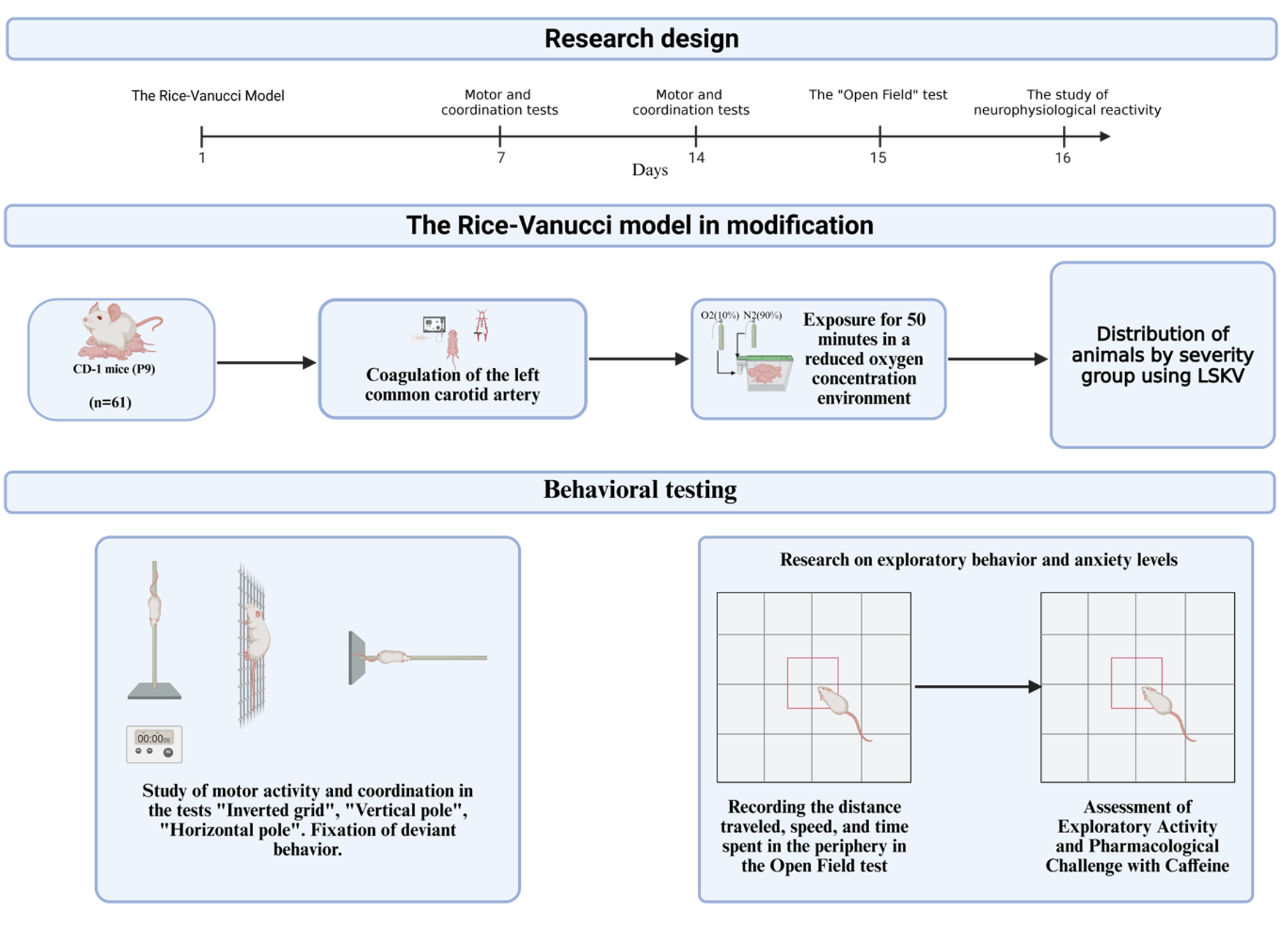
Materials and Methods: Neonatal hypoxia-ischemia was modeled in CD-1 mice at 9 days of age (n=51). Motor and coordination impairments were assessed using the inverted grid, vertical pole, and horizontal pole tests on days 7 and 14. Anxiety-like behavior and exploratory activity were evaluated in the open field test on day 15. Neurophysiological reactivity was examined by administering caffeine (20 mg/kg) one hour prior to the Open field test on day 16.
Results: A statistically significant difference in motor activity was observed between the mild and moderate injury groups compared to the intact group, with reductions of 37% and 57% in the inverted grid test and 27% and 53% in the vertical pole test, respectively. Pharmacological challenge with caffeine stimulated a 1.5-fold increase in speed and distance travelled in the moderate injury group compared to those in the intact group, despite baseline statistically significant differences in the Open field test.
Conclusion: The experimental approach to assessing the clinical status of animals after neonatal hypoxia-ischemia modeling, followed by stratification based on injury severity, revealed statistically significant differences across multiple parameters between the studied groups.
Графическая аннотация
Ключевые слова:
neonatal hypoxia-ischemia, motor behavior, caffeine, dopaminergic system, severity stratification, miceБиблиографические ссылки
Babbo CC, Mellet J, van Rensburg J, Pillay S, Horn AR, Nakwa FL, Velaphi SC, Kali GTJ, Coetzee M, Masemola MYK, Ballot DE, Pepper MS (2024) Neonatal encephalopathy due to suspected hypoxic ischemic encephalopathy: pathophysiology, current, and emerging treatments. World Journal of Pediatrics 20(11): 1105–1114. https://doi.org/10.1007/s12519-024-00836-9 [PubMed] [PMC]
Brégère C, Schwendele B, Radanovic B, Guzman R (2022) Microglia and stem-cell mediated neuroprotection after neonatal hypoxia-ischemia. Stem Cell Reviews and Reports 18(2): 474–522. https://doi.org/10.1007/s12015-021-10213-y [PubMed] [PMC]
Chen A, Teng C, Wei J, Wu X, Zhang H, Chen P, Cai D, Qian H, Zhu H, Zheng X, Chen X (2025) Gut microbial dysbiosis exacerbates long-term cognitive impairments by promoting intestinal dysfunction and neuroinflammation following neonatal hypoxia-ischemia. Gut Microbes 17(1): 2471015. https://doi.org/10.1080/19490976.2025.2471015 [PubMed] [PMC]
Essawy SS, Tawfik MK, Korayem HE (2017) Effects of adenosine receptor antagonists in MPTP mouse model of Parkinson’s disease: mitochondrial DNA integrity. Archives of Medical Science 13(3): 659-669. https://doi.org/10.5114/aoms.2017.67284 [PubMed] [PMC]
Hamdy N, Eide S, Sun HS, Feng ZP (2020) Animal models for neonatal brain injury induced by hypoxic ischemic conditions in rodents. Experimental Neurology 334: 113457. https://doi.org/10.1016/j.expneurol.2020.113457 [PubMed]
Ibrahim MK, Kamal M, Tikamdas R, Nouh RA, Tian J, Sayed M (2020) Effects of chronic caffeine administration on behavioral and molecular adaptations to sensory contact model induced stress in adolescent male mice. Behavior Genetics 50(5): 374–383. https://doi.org/10.1007/s10519-020-10003-1 [PubMed]
Kim M, Yu JH, Seo JH, Shin YK, Wi S, Baek A, Song SY, Cho SR (2017) Neurobehavioral assessments in a mouse model of neonatal hypoxic-ischemic brain injury. Journal of Visualized Experiments (129): 55838. https://doi.org/10.1080/19490976.2025.2471015[PubMed] [PMC]
Kozina EA, Kim AR, Kurina AY, Ugrumov MV (2017) Cooperative synthesis of dopamine by non-dopaminergic neurons as a compensatory mechanism in the striatum of mice with MPTP-induced Parkinsonism. Neurobiology of Disease 98: 108–121. https://doi.org/10.1016/j.nbd.2016.12.005 [PubMed]
Kweon S.H, Ryu HG, Park H, Lee S, Kim N, Kwon SH, Ma SX, Kim S, Ko HS (2024) Linking Gba1 E326K mutation to microglia activation and mild age-dependent dopaminergic neurodegeneration. BioRxiv 21:2023.09.14.557673. https://doi.org/10.1101/2023.09.14.557673 [PubMed] [PMC]
Lopes JP, Pliássova A, Cunha RA (2019) The physiological effects of caffeine on synaptic transmission and plasticity in the mouse hippocampus selectively depend on adenosine A1 and A2A receptors. Biochemical Pharmacology 166: 313–321. https://doi.org/10.1016/j.bcp.2019.06.008 [PubMed]
Odorcyk FK, Ribeiro RT, Roginski AC, Duran-Carabali LE, Couto-Pereira NS, Dalmaz C, Wajner M, Netto CA (2021) Differential age-dependent mitochondrial dysfunction, oxidative stress, and apoptosis induced by neonatal hypoxia-ischemia in the immature rat brain. Molecular Neurobiology 58(5): 2297–2308. https://doi.org/10.1007/s12035-020-02261-1 [PubMed]
Qian Y, Chen M, Forssberg H, Diaz Heijtz R (2013) Genetic variation in dopamine-related gene expression influences motor skill learning in mice. Genes, Brain and Behavior 12(6): 604–614. https://doi.org/10.1111/gbb.12062 [PubMed]
Ratliff WA, Saykally JN, Mervis RF, Lin X, Cao C, Citron BA (2019) Behavior, protein, and dendritic changes after model traumatic brain injury and treatment with nanocoffee particles. BMC Neuroscience 20(1): 44. https://doi.org/10.1186/s12868-019-0525-5 [PubMed] [PMC]
Sheldon RA, Windsor C, Ferriero DM (2018) Strain-related differences in mouse neonatal hypoxia-ischemia. Developmental Neuroscience 40(5–6): 490–496. https://doi.org/10.1159/000495880 [PubMed] [PMC]
Wang Q, Wang M, Choi I, Sarrafha L, Liang M. Ho L, Farrell K, Beaumont KG, Sebra R, De Sanctis C, Crary JF, Ahfeldt T, Blanchard J, Neavin D, Powell J, Davis DA, Sun X, Zhang B, Yue Z (2024) Molecular profiling of human substantia nigra identifies diverse neuron types associated with vulnerability in Parkinson’s disease. Science Advances 10(2): eadi8287. https://doi.org/10.1126/sciadv.adi8287 [PubMed] [PMC]
Weston NM, Rolfe AT, Freelin AH, Reeves TM, Sun D (2021) Traumatic brain injury modifies synaptic plasticity in newly-generated granule cells of the adult hippocampus. Experimental Neurology 336: 113527. https://doi.org/10.1016/j.expneurol.2020.113527 [PubMed] [PMC]
Zhou KQ, McDouall A, Drury PP, Lear CA, Cho KHT, Bennet L, Gunn AJ, Davidson JO (2021) Treating seizures after hypoxic-ischemic encephalopathy-current controversies and future directions. International Journal of Molecular Sciences 22(13): 7121. https://doi.org/10.3390/ijms22137121
Zhu H, Bai S, Ma W, Qian H, Du P (2024) A combined effect of fish-originated collagen peptides and caffeine on the cognitive function of sleep-deprived mice. Food & Function 15(2): 917–929. https://doi.org/10.1039/d3fo03841f [PubMed]
Загрузки
Опубликован
Как цитировать
Выпуск
Раздел
Лицензия
Copyright (c) 2025 Pokrovsky VM, Chatsky IV, Maslinikova MR, Zabolotskikh NV, Nesterov AV, Popov. NV, Korokin MV

Это произведение доступно по лицензии Creative Commons «Attribution» («Атрибуция») 4.0 Всемирная.
 Русский
 English