
HAEE tetrapeptide as a promising neuroprotector: comparison with Piracetam in an experimental model of Alzheimer's disease
Authors
-
Evgenii A. Patrakhanov
Belgorod State National Research University
 https://orcid.org/0000-0002-8415-4562
-
Elеna V. Kuzubova
Belgorod State National Research University
https://orcid.org/0000-0003-2425-5027
-
Nikita S. Zhunusov
Belgorod State National Research University
https://orcid.org/0000-0002-1969-3615
-
Alexandra I. Radchenko
https://orcid.org/0000-0002-4554-2116
-
Vladislav Y. Kurdyukov
Belgorod State National Research University
https://orcid.org/0009-0004-4388-2389
-
Anastasia R. Denisova
Belgorod State National Research University
https://orcid.org/0009-0000-2878-6883
-
Alina A. Avramenko
Belgorod State National Research University
https://orcid.org/0009-0004-8983-1843
-
Mikhail V. Pokrovskii
Belgorod State National Research University
https://orcid.org/0000-0002-1493-3376
DOI:
https://doi.org/10.18413/rrpharmacology.12.1179Abstract
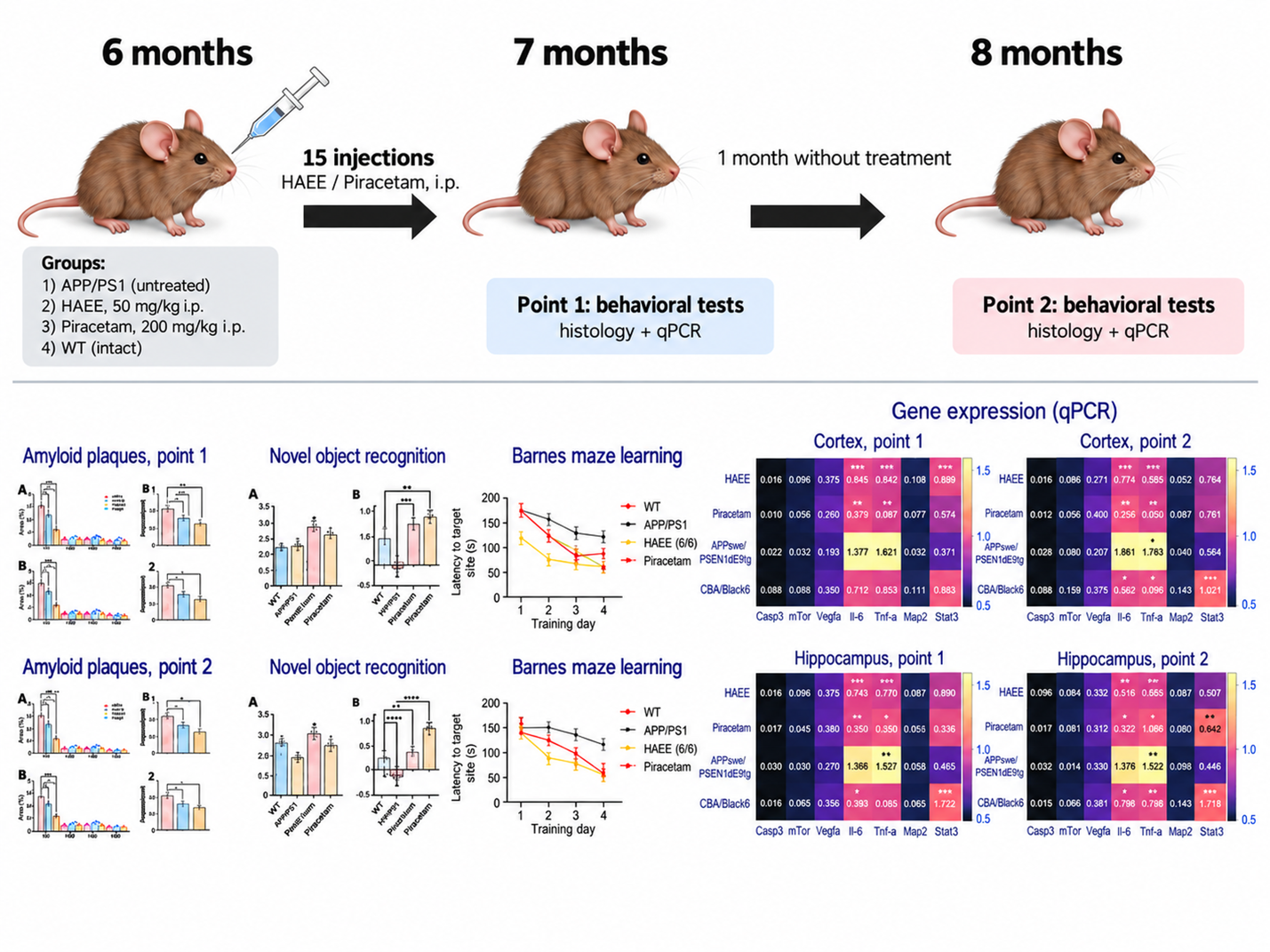
Introduction: During the experiment, the effectiveness of tetrapeptide HAEE and the comparison drug Piracetam in correcting neurodegenerative disorders in Alzheimer's disease was investigated in a model of transgenic mice.
Materials and Methods: transgenic mice of the APPswe/PS1dE9 (APP/PS1) line were used in the study. The animals were injected with HAEE and Piracetam, after which behavioral tests were performed (“Open Field”, “Light‑Dark Chamber”, “Novel Object Recognition”, “Barnes Maze”). Additionally, gene expression was analyzed using real‑time PCR. The histological study included staining of brain sections with Congo red, followed by counting amyloid plaques in the cortex and hippocampus.
Results and Discussion: The administration of HAEE and Piracetam led to an improvement in cognitive performance, with both groups demonstrating memory recovery to the level of intact controls. Histological analysis showed an increase in the number of amyloid plaques in the positive control animals and a reduction in the therapeutic groups by an average of 40%. Gene expression analysis showed that HAEE and Piracetam modulate key molecular pathways associated with neuroplasticity, inflammation, and cellular survival. Changes in the expression of the Stat3, mTor, Vegfa, and Casp3 genes have been observed, reflecting the activation of compensatory neuroprotective mechanisms, as well as the relative stabilization of the pro‑inflammatory markers Il‑6 and Tnf‑a.
Conclusion: HAEE tetrapeptide at a dosage of 50 mg per 1 kg and Piracetam at a dosage of 200 mg/kg have a comprehensive positive effect on cognitive functions, molecular and morphological parameters in Alzheimer’s disease. The results obtained in the animal model confirm its high potential as a promising neuroprotective agent, comparable to or superior to classical nootropic drugs.
Graphical Abstract
Keywords:
alzheimer's disease, beta-amyloid, behavioral testing, gene expressionReferences
Almohmadi NH, Al-Kuraishy HM, Albuhadily AK, Al-Gareeb AI, Abdelaziz AM., Alexiou A, Papadakis M, El-Saber Batiha G (2025) Alzheimer disease: Amyloid peptide controversies and challenges of anti-Aβ immunotherapy. The Journal of Pharmacology and Experimental Therapeutics 8 (392): 103639. https://doi.org/10.1016/j.jpet.2025.103639 [PubMed] [PMC]
Bach JP, Tschape JA, Kopitz J (2020) The role of peptides in neuroprotection and Alzheimer’s disease therapy. Neurochemistry International 138: 104749. https://doi.org/10.1016/j.neuint.2020.104749
De Strooper B, Karran E (2016) The cellular phase of Alzheimer’s disease. Cell 164(4): 603–615. https://doi.org/10.1016/j.cell.2015.12.056 [PubMed]
Han YE, Lim S, Lee SE, Nam MH, Oh SJ (2025) Novel mouse model of Alzheimer’s disease exhibits pathology through synergistic interactions among amyloid-β, tau, and reactive astrogliosis. Zoological Research 46(1): 41–53. https://doi.org/10.24272/j.issn.2095-8137.2024.257 [PubMed] [PMC]
Korokin MV, Gudyrev OS, Pokrovskaya TG, Danilenko LM, Zhernakova NI, Avtina TV, Parshina AV, Pribylov SA, Lebedev PR, Kochkarov AA, Kuzubova EV, Radchenko AI, Koklin IS, Taran EI (2023) Features of bone remodeling and osteoreparation processes in modeling femoral fracture in genetically modified mice with impaired enzymatic regulation of steroid hormone metabolism. Research Results in Pharmacology 9(4): 113–123. https://doi.org/10.18413/rrpharmacology.9.10062
Long JM, Holtzman DM (2019) Alzheimer disease: An update on pathobiology and treatment strategies. Cell 179(2): 312–339. https://doi.org/10.1016/j.cell.2019.09.001 [PubMed] [PMC]
Lysikova EA, Kuzubova EV, Radchenko AI, Patrakhanov EA, Chaprov KD, Korokin MV, Deykin AV, Gudyrev OS, Pokrovskii MV (2023) The APPswe/PS1dE9/Blg transgenic mouse line for modeling cerebral amyloid angiopathy associated with Alzheimer’s disease. Molecular Biology 57(1): 74–82. https://doi.org/10.1134/S0026893323010077 [PubMed]
Malykh AG, Sadaie MR (2010) Piracetam and piracetam-like drugs: from basic science to clinical applications. Drugs 70(3): 287–312. https://doi.org/10.2165/11319230-000000000-00000 [PubMed]
Mukhina KA (2025) The tetrapeptide HAEE promotes amyloid-beta clearance from the brain and reduces behavioral impairments. International Journal of Molecular Sciences 26(23): 11591. https://doi.org/10.3390/ijms262311591 [PubMed] [PMC]
Patrakhanov (2024) Effectiveness of the tetrapeptide HAEE: an innovative approach to Alzheimer’s disease treatment in experiment. Research Results in Pharmacology 10(4): 107–111. https://doi.org/10.18413/rrpharmacology.10.548
Polikarpova AV, Egorova TV, Bardina MV (2022) Genetically modified animal models of hereditary diseases for testing of gene-directed therapy. Research Results in Pharmacology 8(2): 11–26. https://doi.org/10.3897/rrpharmacology.8.82618
Welikovitch LA, Mate de Gerando A, Khasnavis A, Bhavsar H, Meltzer JC, Buée L (2025) Tau, synapse loss and gliosis progressin an Alzheimer’smousemodelafteramyloid-βimmunotherapy. Brain 148(4): 1316–1328. https://doi.org/10.1093/brain/awae345[PubMed] [PMC]
Zhang Y, Wang Y, Li Z, Zhang L (2021) Limitations of current therapeutic strategies for Alzheimer’s disease: A review. Frontiers in Aging Neuroscience 1(3): 1–12. https://doi.org/10.3389/fnagi.2021.754123
Published
How to Cite
Issue
Section
License
Copyright (c) 2026 Patrakhanov EA, Kuzubova EV, Zhunusov NS, Radchenko AI, Denisova AR, Kurdyukov VY, Avramenko AA, Pokrovskii MV

This work is licensed under a Creative Commons Attribution 4.0 International License.
 Русский
 English