Pharmacological correction of endothelial dysfunction using a complex of grape polyphenols
Авторы
-
Petr R. Lebedev
Belgorod State National Research University
 https://orcid.org/0000-0001-9102-3360
-
Tatyana V. Avtina
Belgorod State National Research University
https://orcid.org/0000-0003-0509-5996
-
Vladimir V. Gureev
Belgorod State National Research University
https://orcid.org/0000-0003-1433-1225
-
Mikhail V. Pokrovskii
Belgorod State National Research University
https://orcid.org/0000-0002-1493-3376
DOI:
https://doi.org/10.18413/rrpharmacology.12.1191Аннотация
Introduction: Endothelial dysfunction is an important component of cardiovascular disease pathogenesis. Natural polyphenols are of interest as potential endothelioprotective agents. The aim of this study was to evaluate the endothelioprotective activity of a grape polyphenol complex in a mouse model of endothelial dysfunction.
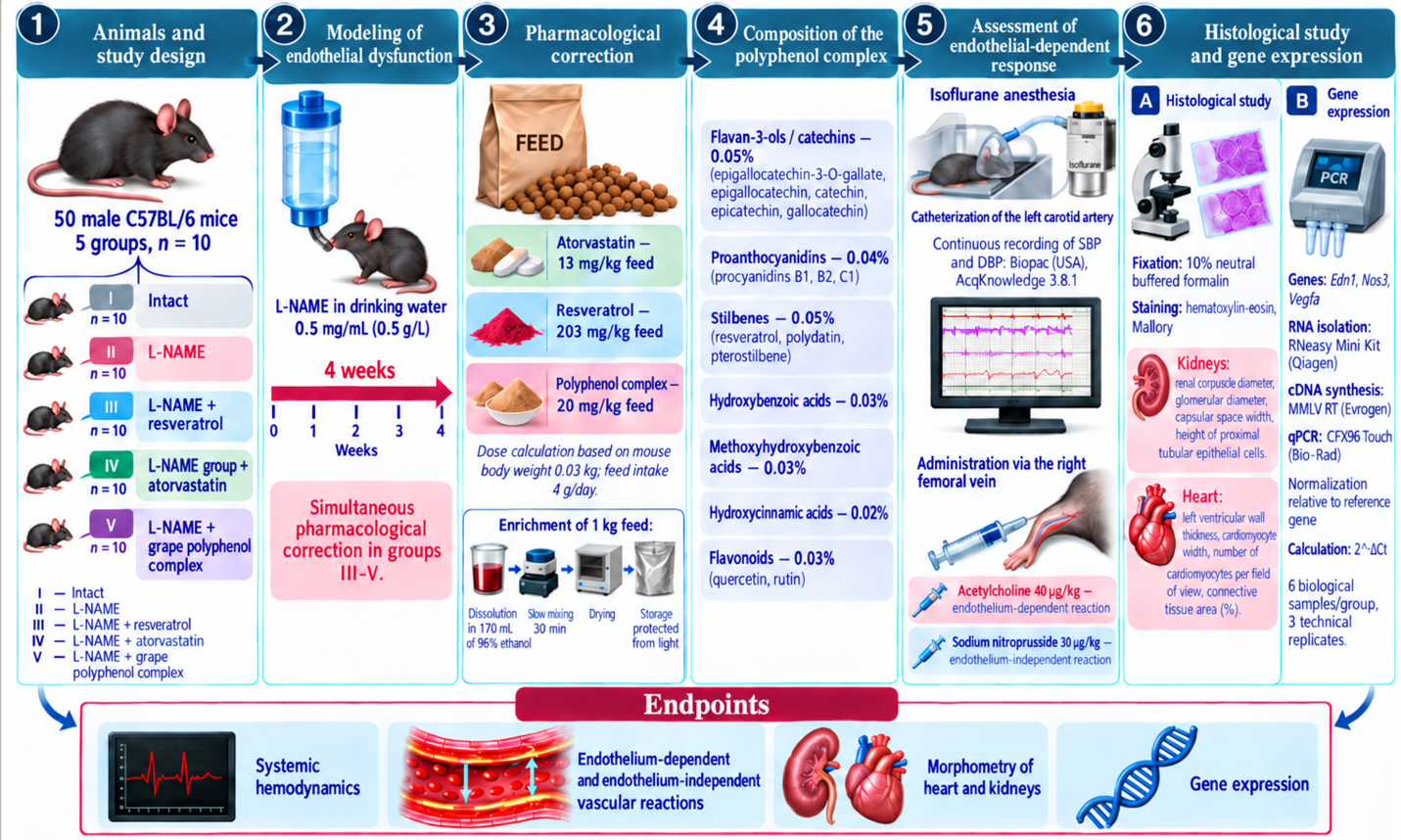
Materials and Methods: The study was performed on 50 male C57BL/6 mice. Endothelial dysfunction was induced by administration of L-NAME in drinking water (0.5 mg/mL) for 4 weeks. The animals were divided into five groups (n = 10): intact, control(L-NAME), L-NAME + resveratrol, L-NAME + atorvastatin, and L-NAME + grape polyphenol complex. The estimated daily intake per animal was 0.812 mg of resveratrol, 0.052 mg of atorvastatin, and 0.08 mL of the grape polyphenol complex. Systolic and diastolic blood pressure and endothelium-dependent vascular responses were assessed by invasive hemodynamic monitoring. Morphometric analysis of the heart and kidneys was performed. Edn1, Nos3, and Vegfa expression was evaluated by real-time quantitative PCR.
Results and Discussion: The grape polyphenol complex reduced systolic and diastolic blood pressure and the endothelial dysfunction coefficient compared with the L-NAME control. It also reduced morphological changes in the heart and kidneys, increased Nos3 expression, and decreased Edn1 and Vegfa expression. The observed changes approached the values of intact animals and indicate restoration of NO-dependent endothelial regulation.
Conclusion: Administration of the grape polyphenol complex at 0.08 mL/day for 4 weeks produced an endothelioprotective effect in C57BL/6 mice with L-NAME-induced endothelial dysfunction. Treatment improved endothelium-dependent vascular responses, systemic hemodynamics, tissue morphology, and endothelial-related gene expression.
Графическая аннотация
Ключевые слова:
endothelial dysfunction, blood pressure, L-NAME, polyphenol complex, C57BL/6 miceБиблиографические ссылки
Arabi SM, Chambari M, Bahrami LS, Hadi S, Sahebkar A (2024) Statin therapy and flow-mediated dilation: a systematic review and dose-response meta-analysis using the GRADE of data from randomized controlled trials. Current Hypertension Reviews 20(2): 90–100. https://doi.org/10.2174/0115734021280797240212091416 [PubMed]
Byun MW (2012) Effect of procyanidin C1 on nitric oxide production and hyperpolarization through Ca2+-dependent pathway in endothelial cells. Journal of Medicinal Food 15(11): 1032–1037. https://doi.org/10.1089/jmf.2012.2297 [PubMed]
Cui X, Liu X, Feng H, Zhao S, Gao H (2012) Grape seed proanthocyanidin extracts enhance endothelial nitric oxide synthase expression through 5′-AMP activated protein kinase/Sirtuin 1-Krüppel-like factor 2 pathway and modulate blood pressure in ouabain-induced hypertensive rats. Biological and Pharmaceutical Bulletin 35(12): 2192–2197. https://doi.org/10.1248/bpb.b12-00598https://doi.org/10.1248/bpb.b12-00598 [PubMed]
De Moudt S, Hendrickx JO, Neutel C, De Munck D, Leloup A, De Meyer GRY, Martinet W, Fransen P (2022) Aortic stiffness in L-NAME treated C57Bl/6 mice displays a shift from early endothelial dysfunction to late-term vascular smooth muscle cell dysfunction. Frontiers in Physiology 13: 874015. https://doi.org/10.3389/fphys.2022.874015 [PubMed] [PMC]
Ding H, Liu S, Zhao KX, Pu J, Xie YF, Zhang XW (2022) Comparative efficacy of antihypertensive agents in flow-mediated vasodilation of patients with hypertension: network meta-analysis of randomized controlled trial. International Journal of Hypertension 2022: 2432567. https://doi.org/10.1155/2022/2432567 [PubMed] [PMC]
Huang K, Chen C, Hao J, Huang J, Wang S, Liu P, Huang H (2015) Polydatin promotes Nrf2-ARE anti-oxidative pathway through activating Sirt1 to resist AGEs-induced upregulation of fibronectin and transforming growth factor-β1 in rat glomerular mesangial cells. Molecular and Cellular Endocrinology 399: 178–189. https://doi.org/10.1016/j.mce.2014.08.014 [PubMed]
Li H, Xia N, Hasselwander S, Daiber A (2019) Resveratrol and vascular function. International Journal of Molecular Sciences 20(9): 2155. https://doi.org/10.3390/ijms20092155 [PubMed] [PMC]
Li H, Zhang Q (2023) Research progress of flavonoids regulating endothelial function. Pharmaceuticals 16(9): 1201. https://doi.org/10.3390/ph16091201 [PubMed] [PMC]
Lorenz M, Wessler S, Follmann E, Michaelis W, Düsterhöft T, Baumann G, Stangl K, Stangl V (2004) A constituent of green tea, epigallocatechin-3-gallate, activates endothelial nitric oxide synthase by a phosphatidylinositol-3-OH-kinase-, cAMP-dependent protein kinase-, and Akt-dependent pathway and leads to endothelial-dependent vasorelaxation. Journal of Biological Chemistry 279(7): 6190–6195. https://doi.org/10.1074/jbc.M309114200 [PubMed]
Marcuccio G, Candia C, Maniscalco M, Ambrosino P (2025) Endothelial dysfunction in chronic obstructive pulmonary disease: an update on mechanisms, assessment tools and treatment strategies. Frontiers in Medicine 12: 1550716. https://doi.org/10.3389/fmed.2025.1550716[PubMed]
Migliori M, Cantaluppi V, Mannari C, Bertelli AAE, Medica D, Quercia AD, Navarro V, Scatena A, Giovannini L, Biancone L, Panichi V (2015) Caffeic acid, a phenol found in white wine, modulates endothelial nitric oxide production and protects from oxidative stress-associated endothelial cell injury. PLoS ONE 10(4): e0117530. https://doi.org/10.1371/journal.pone.0117530 [PubMed] [PMC]
Naderi-Meshkin H, Setyaningsih WAW (2024) Endothelial cell dysfunction: onset, progression, and consequences. Frontiers in Bioscience-Landmark 29(6): 223. https://doi.org/10.31083/j.fbl2906223 [PubMed]
Okudan N, Barışkaner H, Gökbel H, Sahin AS, Belviranlı M, Baysal H (2011) The effect of supplementation of grape seed proanthocyanidin extract on vascular dysfunction in experimental diabetes. Journal of Medicinal Food 14(11): 1298–1302. https://doi.org/10.1089/jmf.2010.0030 [PubMed]
Palaniappan LP, Allen NB, Almarzooq ZI, Anderson CAM, Arora P, Avery CL, Baker-Smith CM, Bansal N, Currie ME, Earlie RS, Fan W, Fetterman JL, Gibbs BB, Heard DG, Hiremath S, Hong H, Hyacinth HI, Ibeh C, Jiang T, Johansen MC, Kazi DS, Ko D, Kwan TW, Leppert MH, Li Y, Magnani JW, Martin KA, Martin SS, Michos ED, Mussolino ME, Ogungbe O, Parikh NI, Perez MV, Perman SM, Sarraju A, Shah NS, Springer MV, St-Onge MP, Thacker EL, Tierney S, Urbut SM, Van Spall HGC, Voeks JH, Whelton SP, Wong SS, Zhao J, Khan SS; American Heart Association Council on Epidemiology and Prevention Statistics Committee and Stroke Statistics Committee (2026) 2026 Heart Disease and Stroke Statistics: A Report of US and Global Data From the American Heart Association. Circulation 153(9): e275–e906. https://doi.org/10.1161/CIR.0000000000001412 [PubMed]
Park SH, Jeong SO, Chung HT, Pae HO (2015) Pterostilbene, an active constituent of blueberries, stimulates nitric oxide production via activation of endothelial nitric oxide synthase in human umbilical vein endothelial cells. Plant Foods for Human Nutrition 70(3): 263–268. https://doi.org/10.1007/s11130-015-0488-3 [PubMed]
Puchenkova OA, Shheblykina OV, Kostina DA, Bolgov AA, Lebedev PR, Molchanov VV, Pokrovskaya TG, Korokin MV, Nikiforov EA, Vaskina NF, Idrisov TA, Moseev TD, Melekhin VV, Varaksin MV, Charushin VN, Chupakhin ON (2025) Study of acute toxicity, endothelial- and cardioprotective properties of phenolic and thiophenolic derivatives of 2H-imidazoles. Pharmacy & Pharmacology 12(6): 394–409. https://doi.org/10.19163/2307-9266-2024-12-6-394-409
Ramirez-Sanchez I, Maya L, Ceballos G, Villarreal F (2010) (-)-Epicatechin activation of endothelial cell endothelial nitric oxide synthase, nitric oxide, and related signaling pathways. Hypertension 55(6): 1398–1405. https://doi.org/10.1161/HYPERTENSIONAHA.109.147892[PubMed] [PMC]
Ugusman A, Zakaria Z, Chua KH, Megat Mohd Nordin NA, Mahdy ZA (2014) Role of rutin on nitric oxide synthesis in human umbilical vein endothelial cells. The Scientific World Journal 2014: 169370. https://doi.org/10.1155/2014/169370 [PubMed] [PMC]
Naletova EN, Naletova OS, Serdyuk EB, Naletov SV, Alesinsky MM, Sidorenko IA, Tverdokhleb TA (2025) Pharmacoepidemiologic and clinical rationale for the inclusion of L-arginine and dihydroquercetin in the combined pharmacotherapy of hypertensive patients with COVID-19. Research Results in Pharmacology 11(1): 36–48. https://doi.org/10.18413/rrpharmacology.11.469
Wang W, Wu QH, Sui Y, Wang Y, Qiu X (2017) Rutin protects endothelial dysfunction by disturbing Nox4 and ROS-sensitive NLRP3 inflammasome. Biomedicine & Pharmacotherapy 86: 32–40. https://doi.org/10.1016/j.biopha.2016.11.134 [PubMed]
Yang DR, Wang MY, Zhang CL, Wang Y (2024) Endothelial dysfunction in vascular complications of diabetes: a comprehensive review of mechanisms and implications. Frontiers in Endocrinology 15: 1359255. https://doi.org/10.3389/fendo.2024.1359255 [PubMed] [PMC]
Загрузки
Опубликован
Как цитировать
Выпуск
Раздел
Лицензия
Copyright (c) 2026 Lebedev PR, Avtina TV, Gureev VV, Pokrovskii MV

Это произведение доступно по лицензии Creative Commons «Attribution» («Атрибуция») 4.0 Всемирная.
 Русский
 English